
WTCA Breaks the Horizon Tax Slowing Long-Range AI Planning
A new preprint introduces WTCA, an approximation scheme whose cost stays flat as the planning horizon grows, tightening bounds on Bermudan option and ethanol production problems.
 Pro
Takeaways
- New arXiv preprint introduces WTCA, an MDP approximation whose cost is independent of horizon length.
- Authored by Negar Soheili, Selvaprabu Nadarajah, and Bo Yang; theoretical contribution, no code released.
- WTCA bounds are tighter than ALP, looser than PO per-basis, but converge to optimal as basis expands.
- Parallel block coordinate descent extended to stochastic MDPs exploits the weak cross-stage coupling.
- Within equal time budget, WTCA beats PO by fitting more samples or basis functions.
- On Bermudan option and ethanol production instances, WTCA produced tighter upper bounds than PO and LSM.
A new arXiv preprint from Negar Soheili, Selvaprabu Nadarajah, and Bo Yang proposes a way to break one of the oldest scaling headaches in approximate dynamic programming: the fact that computational cost balloons as the planning horizon gets longer. Their method, called Weakly Time-Coupled Approximation (WTCA), decouples the stages of a finite-horizon Markov decision process just enough that solving it becomes essentially horizon-independent.
The horizon tax on value function approximation
Finite-horizon MDPs show up all over operations and finance, from pricing Bermudan options (early-exercisable contracts where you decide at each date whether to cash out) to running an ethanol plant that can be shut down permanently. These problems combine high-dimensional exogenous uncertainty with endogenous states, and computational complexity grows with the horizon.
The standard trick is to approximate the value function as a weighted sum of basis functions, then fit the weights. But how you fit them matters a lot:
- Least Squares Monte Carlo (LSM): fits weights via backward recursion and regression, avoiding joint optimization but accumulating error over the horizon.
- Approximate Linear Programming (ALP) and Pathwise Optimization (PO): jointly fit weights to produce upper bounds, but temporal coupling causes computational complexity to grow with the horizon.
PO gives the tightest bounds of the three but it couples every stage together in one giant optimization. Double the horizon and you roughly double the work per iteration, which is a hard ceiling for long-dated contracts or long production plans.
Coupling is a choice, not a law
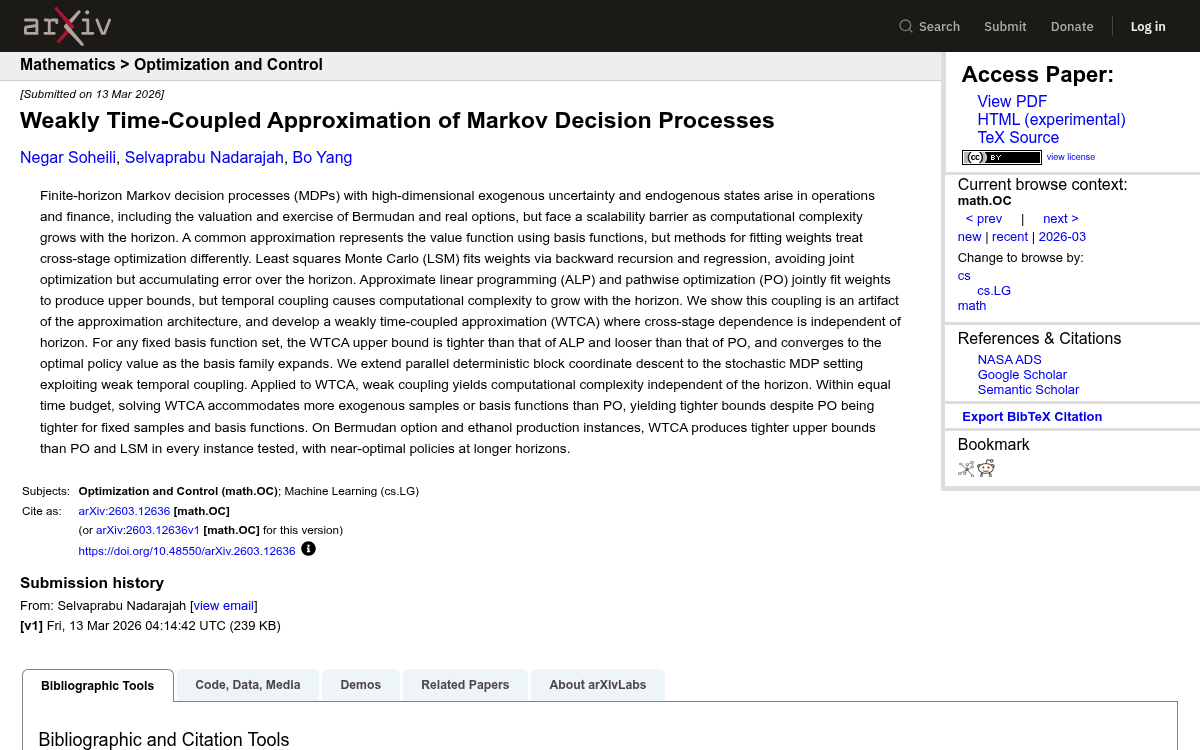
The paper's central claim is conceptual: temporal coupling causes computational complexity to grow with the horizon. We show this coupling is an artifact of the approximation architecture, and develop a weakly time-coupled approximation (WTCA) where cross-stage dependence is independent of horizon.
In other words, the tight linkage between stages in ALP and PO comes from how the approximation is written down, not from the underlying MDP. Rewrite the architecture and the cross-stage dependence can be made sparse enough that each stage is nearly its own subproblem, with only a light stitching between neighbors.
Where does WTCA land on the accuracy spectrum? For any fixed basis function set, the WTCA upper bound is tighter than that of ALP and looser than that of PO, and converges to the optimal policy value as the basis family expands. So it is not free lunch on bound quality per-basis, but it opens the door to a different optimization strategy.
Parallel block coordinate descent on the stages
To exploit the weak coupling, the authors extend parallel deterministic block coordinate descent to the stochastic MDP setting exploiting weak temporal coupling. Applied to WTCA, weak coupling yields computational complexity independent of the horizon. Each stage's weights become a block that can be updated in parallel, with the stochastic dynamics handled through Monte Carlo samples.

The practical consequence shows up when you fix a wall-clock budget instead of counting basis functions. Within equal time budget, solving WTCA accommodates more exogenous samples or basis functions than PO, yielding tighter bounds despite PO being tighter for fixed samples and basis functions. The advantage widens as the horizon grows: although PO provides a tighter bound than WTCA for any fixed set of basis functions and exact expectations, under a fixed computational time budget WTCA can produce tighter bounds than PO, and this reversal widens as the horizon grows.
What the experiments show
The authors evaluate WTCA on two classic benchmarks in this literature: Bermudan option pricing and merchant ethanol production. Both settings admit MDP formulations with a high-dimensional exogenous state and involve irreversible endogenous transitions, such as option exercise and facility abandonment.
The headline empirical result: on Bermudan option and ethanol production instances, WTCA produces tighter upper bounds than PO and LSM in every instance tested, with near-optimal policies at longer horizons. That last clause is the interesting one, because near-optimality at long horizons is exactly where the incumbent methods degrade fastest.
Where this fits and where it does not
WTCA lives in a specific corner of the reinforcement learning and stochastic optimization world: finite-horizon problems with rich exogenous randomness (prices, demand, weather) and a small but consequential set of endogenous choices (exercise, shutdown, inventory moves). It is not a policy gradient method, it is not a neural-network value approximator, and it targets rigorous upper and lower bounds rather than just a working policy.
A few things to keep in mind before reaching for it:
- Per-basis, PO still produces tighter bounds. WTCA wins on the time budget curve, not the sample-efficiency curve.
- The paper is a theoretical and algorithmic contribution posted as a preprint. There is no accompanying code release or model artifact announced with the paper, so anyone wanting to try it will need to implement the block coordinate descent scheme themselves against the paper's specification.
- The benchmarks are operations and finance problems. Whether the same architecture helps in robotics-style MDPs with continuous control and dense endogenous state is untested here.
For teams working on long-horizon optimal stopping, real options, or merchant asset valuation, the takeaway is that the horizon tax on approximate linear programming methods may not be intrinsic. A different way of writing the approximation, plus a parallel solver that respects it, appears to be enough to flatten the cost curve while keeping the bounds honest.