
OpenAI's MedChemBench Pushes Drug-Discovery AI Past 49% on Molecular Reasoning
OpenAI's new medicinal chemistry benchmark grades frontier models on reading molecular structures, predicting potency, and picking the next compound to test.
Takeaways
- OpenAI released MedChemBench, an internal benchmark for AI reasoning in medicinal chemistry.
- 99 problems drawn from 117 papers and patents, covering 761 molecular structures.
- Tests structure interpretation, SAR, potency/ADME prediction, lead optimization, retrosynthesis.
- Top score on the leaderboard sits at 49.7%; no model clears half yet.
- GPT-Rosalind-6 hit 49.6% versus 28.9% for Rosalind-5.5 at highest reasoning budget.
- Used to train and evaluate OpenAI's GPT-Rosalind life sciences model family.
OpenAI has introduced MedChemBench, an internal evaluation of whether advanced models can read molecular structures, interpret laboratory results, and recommend which compounds to make or test next. Those tasks underpin lead optimization, where a weak prediction can send chemists toward an ineffective, toxic, or impractical candidate.
OpenAI assembled the benchmark from 117 papers and patents, covering 761 distinct molecular structures. That source material became 99 problems based on published drug-discovery research.
Four tests, one optimization problem
Medicinal chemists optimize potency alongside permeability, toxicity, metabolic stability, and ease of synthesis. Improving one property can degrade another, so MedChemBench divides the work into four task families:
- Structure and SAR reasoning: Read chemical drawings and infer structure-activity relationships, which connect molecular changes to experimental effects.
- Property prediction: Estimate potency, toxicity, and ADME properties such as absorption, distribution, metabolism, and excretion.
- Lead optimization: balance several measured properties when selecting the next compound.
- Retrosynthesis: Work backward from a target molecule to a plausible sequence of chemical reactions.
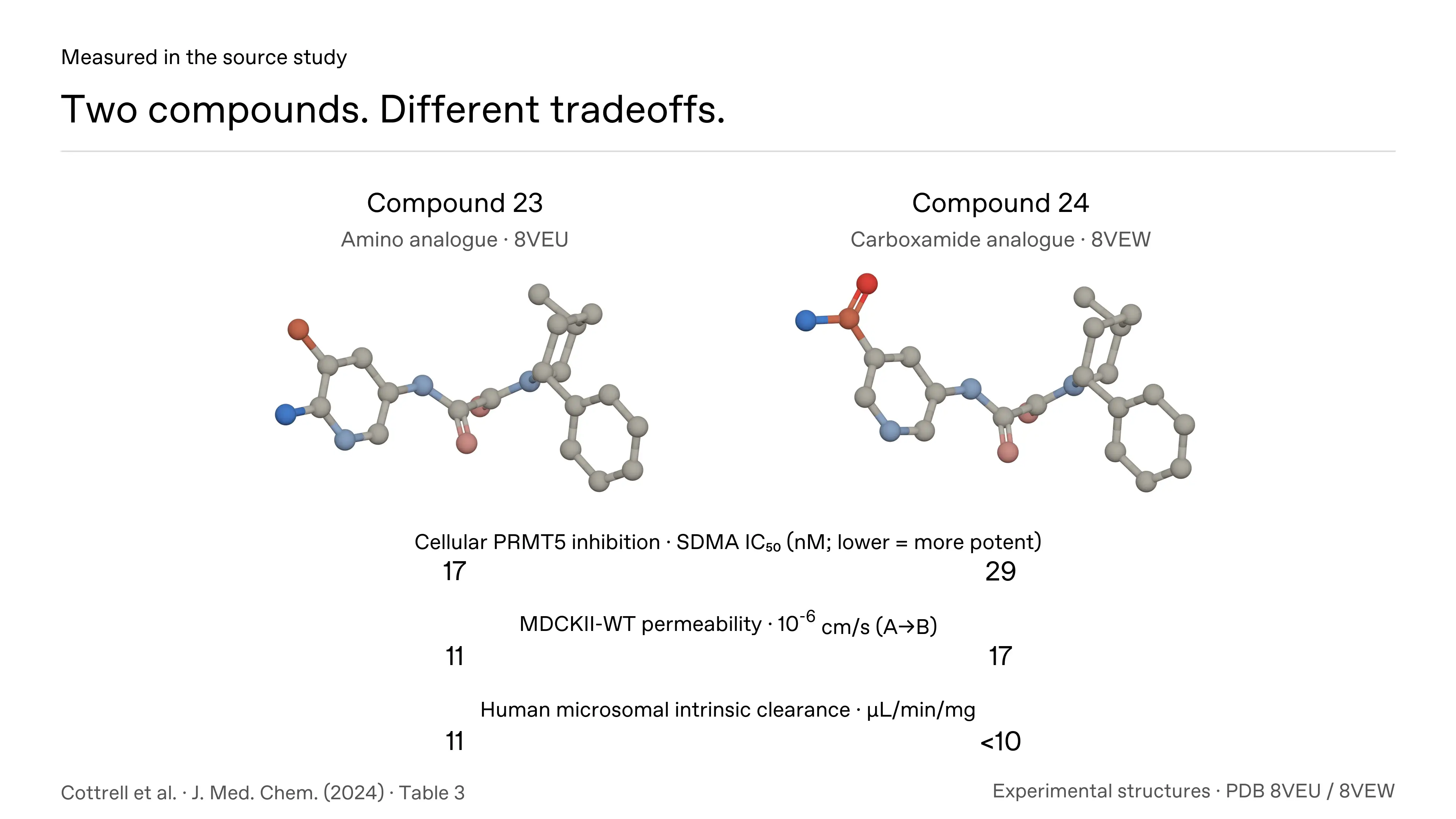
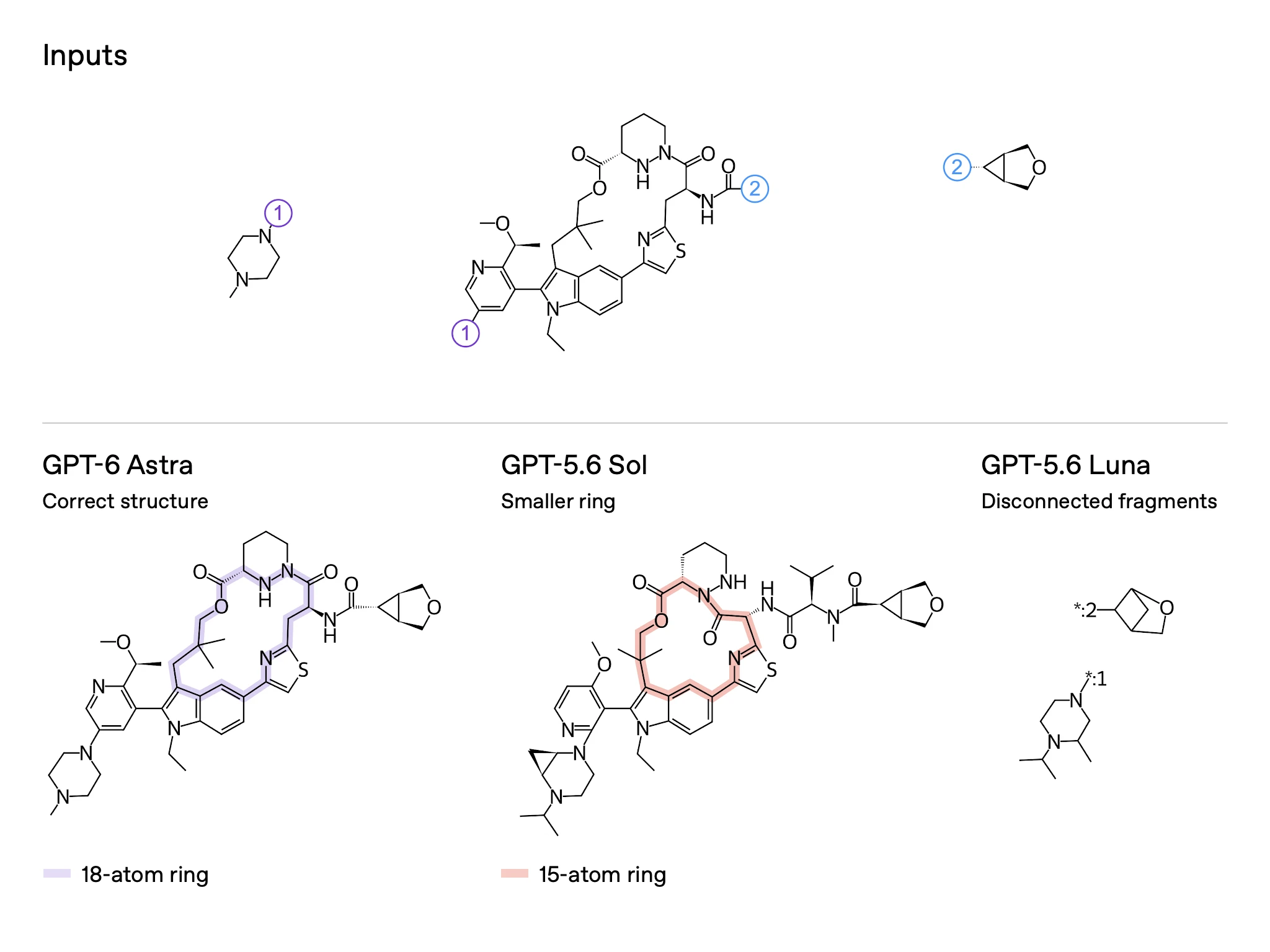
One problem focuses on PRMT5, a protein arginine methyltransferase studied as an oncology target. The model must compare inhibitors whose potency, permeability, and metabolic clearance move in different directions. The rubric evaluates both reconstruction of the molecular structures and agreement between predicted and experimental measurements.
Scores stall below 50%
OpenAI’s published leaderboard tops out at 49.7%. Its system card addendum reports mean rubric scores of 49.6% for GPT-Rosalind-6 and 28.9% for GPT-Rosalind-5.5 at the highest reasoning budget tested.
| Model | Reasoning budget | Mean rubric score |
|---|---|---|
| GPT-Rosalind-6 | Highest tested | 49.6% |
| GPT-Rosalind-5.5 | Highest tested | 28.9% |
A reasoning budget controls how much inference-time computation the model can use before answering. OpenAI generated as many as nine scored responses per problem at each budget, then averaged the credit awarded under the benchmark’s rubrics. The resulting percentage measures rubric credit, so it cannot be interpreted as the probability that a recommendation is correct.
GPT-6 Astra earned 95.4% of the available credit on the structure-interpretation subtask at the xhigh setting. Within this evaluation, models perform much better at extracting information from molecular drawings than at chaining that information through property prediction, trade-off analysis, and compound selection.
MedChemBench sits behind Rosalind
OpenAI uses MedChemBench to evaluate progress on GPT-Rosalind, its life-sciences model family. According to the company, Rosalind combines coding and tool-use capabilities with specialized performance in medicinal chemistry, genomics, experimental design, and biological analysis.
A previous OpenAI report listed MedChemBench scores of 27.5% for GPT-Rosalind and 25.1% for GPT-5.5. OpenAI has since updated the benchmark and its grading, which prevents a direct comparison between those historical figures and the current GPT-Rosalind-6 result.
The published materials describe MedChemBench as an internal evaluation and provide no public endpoint, SDK, or downloadable task suite. Developers would access GPT-Rosalind through supported OpenAI product surfaces, while using separate evaluations to measure performance on their own chemical series and workflows.
Read the leaderboard carefully
- OpenAI controls the evaluation. The company selects the tasks, defines the rubrics, runs the models, and updates the grading. Independent reproduction would require release of the problems, scoring process, and model settings.
- The benchmark changes over time. Scores from different versions can reflect revisions to tasks or grading alongside changes in model capability.
- Aggregate scores hide specific failures. A high result on structure interpretation can coexist with weak property predictions or poor compound rankings.
- Published examples have limited coverage. Performance on literature and patent problems may differ from results on proprietary scaffolds, sparse assay data, unusual targets, or noisy measurements.
Teams evaluating GPT-Rosalind should build a held-out test set from their own chemical series and score structure extraction, property prediction, compound ranking, and synthesis planning separately. Medicinal chemists should review proposed compounds before synthesis, and experimental evidence should govern progression decisions.