
TU Darmstadt's XQC Beats Bigger AI Models Using 4.5x Fewer Parameters
A principled fix to the critic's optimization landscape yields state-of-the-art sample efficiency across 70 control tasks with 4.5x fewer parameters.
 Pro
Takeaways
- XQC replaces scaling with better critic conditioning, hitting SOTA on 70 continuous control tasks with a simple SAC extension.
- Hessian eigenvalue analysis shows BN, WN, and cross-entropy loss cut the condition number by orders of magnitude.
- Cross-entropy gradients are provably bounded by sqrt(2); MSE gradients are not, which destabilizes the effective learning rate.
- 4.5x fewer parameters, 5x fewer FLOP/S than SIMBA-V2; over 100x fewer than BRC; 60% higher training FPS.
- Beats SIMBA-V2, BRO, MR.Q, BRC, CrossQ+WN, and SAC on HumanoidBench, DMC, MyoSuite, and MuJoCo with one hyperparameter set.
- Code and per-task curves available at the official project page.
Deep reinforcement learning has been drifting toward a familiar recipe: bigger critics, more exotic architectures, and more updates per environment step. A new algorithm called XQC, from a team at TU Darmstadt, Freiburg, Oxford, and hessian.AI, pushes back on that trend by asking a sharper question: what if the real bottleneck is not model size but the shape of the loss landscape the critic has to descend?
The authors study the eigenvalues of the critic's Hessian and find that a specific combination of three well-known ingredients (batch normalization, weight normalization, and a distributional cross-entropy loss) collapses the condition number of the optimization problem by orders of magnitude. Plugged into soft actor-critic, that combination beats or matches every recent scaling-heavy baseline on 70 continuous control tasks while using roughly a quarter of the parameters.
Why the critic's curvature matters
In actor-critic RL, the critic is trained to minimize the Bellman error, but the target it chases is itself a moving function of the critic's own weights. The larger the condition number, the less effective gradient descent with a fixed learning rate will be due to the large range in curvature per dimension. When targets shift and gradients bootstrap off stale predictions, an ill-conditioned landscape amplifies every instability.
The condition number is simply the ratio between the largest and smallest absolute eigenvalues of the Hessian. A well-conditioned problem looks like a round bowl; an ill-conditioned one looks like a long, narrow valley where gradient descent zig-zags. The paper argues that most recent RL architectures have been unwittingly optimizing in that narrow valley.
What the Hessian analysis actually showed
The team took the DeepMind Control Suite dog-trot task, a high-dimensional continuous control benchmark, and ran 12 architectural combinations for a million steps each. They then computed the critic Hessian's eigenspectrum at 20 checkpoints per run using an efficient JAX implementation of the stochastic Lanczos quadrature algorithm, a numerical method for approximating the spectrum of very large matrices without materializing them.

The pattern was consistent. Architectures employing BN consistently produce more compact and stable eigenspectra throughout training, with eigenvalues remaining bounded within a moderate range and free of significant outliers. In stark contrast, LN architectures suffer from large, growing outlier eigenvalues, signifying sharp curvature that can destabilize training. Similarly, the CE loss significantly improves loss landscape conditioning over an MSE. Correlating condition numbers with final return revealed a clean trend: lower condition numbers produced higher scores, and the three techniques compounded when combined.
Why cross-entropy behaves better than MSE
Distributional critics, popularized by C51, predict a categorical distribution over returns instead of a scalar. The XQC paper gives a crisp optimization reason for why this helps, beyond the usual argument about richer targets. The authors prove that the gradient of an MSE loss with respect to predictions can grow without bound, while the cross-entropy gradient is bounded by the square root of 2, because it is the difference of two probability vectors on a simplex.
That bounded gradient matters when paired with weight normalization. The effective learning rate, defined roughly as the raw learning rate divided by the parameter norm, is what a scale-invariant network actually experiences. If the parameter norm grows during training (as it usually does), the effective learning rate drifts toward zero and the network loses plasticity. Weight normalization keeps the denominator fixed; the CE loss keeps the numerator (the gradient norm) fixed. Together they hold the effective learning rate approximately constant throughout training.
The XQC recipe
XQC is a minimal extension of soft actor-critic. The critic architecture is deliberately plain:
- Batch normalization on the input and after every linear layer, with the order swapped so that normalization comes after ReLU. A joined forward pass automatically calculates the BN running statistics on the joined (s, a) and (s', a') distribution, which is what makes BN work inside the RL loop.
- Weight normalization by projecting each dense layer's weights to the unit sphere after every gradient step.
- A C51-style categorical critic with 101 atoms trained with cross-entropy, and reward normalization by the running standard deviation of returns to keep Q-values inside the categorical support.
- Four hidden layers of 512 units. No skip connections, no exotic blocks.
Results across 70 tasks
The authors evaluated on 55 proprioceptive tasks (HumanoidBench, DMC, MyoSuite, MuJoCo) and 15 vision-based DMC tasks, running 10 seeds per environment with a single set of hyperparameters. XQC matches or beats SIMBA-V2, BRO, MR.Q, BRC, CrossQ+WN, and SAC across all four proprioception benchmarks, with the largest gaps on the hardest suites (HumanoidBench and DMC-hard) where ill-conditioning bites hardest.

Efficiency is where the paper really lands. XQC achieves competitive sample efficiency while requiring roughly 4.5x fewer parameters than SIMBA-V2. This parameter efficiency directly results in high computational efficiency with about 5x fewer FLOP/S than SIMBA-V2 and BRO and more than 100x fewer FLOP/S than BRC. Training throughput on a single RTX 4090 is about 60% higher than SIMBA-V2 on the MuJoCo humanoid.
On pixel-based DMC tasks, XQC drops directly into the DRQ-V2 codebase using the same convolutional encoder and hyperparameters, isolating the gains to the MLP critic. It clearly outperforms DRQ-V2 on the difficult humanoid environments, where the sample budget is the binding constraint.
Ablations and scaling behavior
Every component contributes. Removing batch normalization causes the largest drop, followed by swapping cross-entropy for MSE, and then removing weight normalization. Halving the learning rate to compensate for LN's higher effective learning rate makes performance worse, not better, which lines up with the conditioning story rather than a simple learning-rate mismatch.
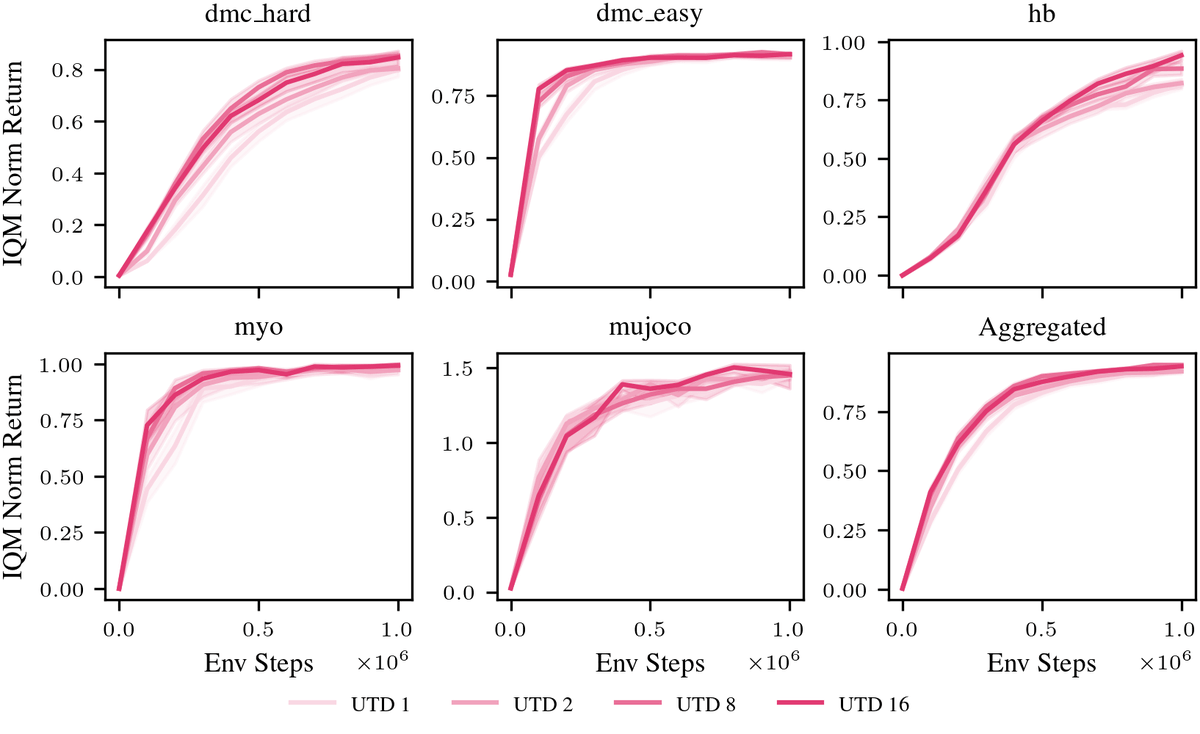
XQC also scales stably. Increasing the update-to-data ratio from 1 to 16, widening layers, or deepening the network all improve or preserve performance rather than destabilizing it. That matters for practitioners with spare compute who want to trade FLOPs for sample efficiency without babysitting hyperparameters.
Where it fits and where it doesn't
XQC is designed for off-policy, continuous-control problems where samples are expensive: robotics learning on hardware, simulation-heavy tuning, and any setting where a million environment steps is a lot. It is not a language-model recipe, and the analysis assumes an actor-critic loop with bootstrapped targets. The vision experiments deliberately reuse the DRQ-V2 encoder, so gains on pure-pixel tasks come from the MLP critic; larger vision backbones were not the focus.
The code is available on the project page, and the full paper includes the Hessian analysis, proofs, per-task training curves, and hyperparameters. For anyone doing off-policy continuous control, the practical takeaway is small: reorder your normalization, add weight projection, switch to a categorical critic, and expect the optimizer to do noticeably less fighting with itself.