
Tsukuba's BC-HG Cracks Bi-Level AI Training Without Costly Oracle Access
A new hypergradient trick lets a leader agent optimize environment design or policy without controlling how the follower learns, using only interaction samples.
 Pro
Takeaways
- BC-HG estimates leader hypergradients in decentralized bi-level RL using only ordinary interaction samples, no oracle needed.
- The paper uses a Boltzmann covariance identity to avoid needing multiple trajectories from the same state.
- First hypergradient method for 2-player Markov games in decentralized settings under entropy regularization.
- Beats HPGD and So-BiRL on Four-Rooms, thermal control, toy Markov game, and bi-level LQR benchmarks.
- Code is open source at github.com/akimotolab/BC-HG, accepted to ICAPS 2026.
- Best fit when follower runs fixed entropy-regularized RL and leader can only read, not modify.
Bi-level reinforcement learning shows up whenever one agent's decisions shape another agent's world. Designing warehouse layouts for robot fleets, tuning reward signals for RLHF, and shaping environments for autonomous vehicles all fit the pattern: a leader picks parameters, and a follower solves a Markov decision process conditioned on those parameters. The awkward part is that the leader usually cannot rewrite the follower's learning algorithm. It can only watch the outcome and try to nudge things in a better direction.
A team from the University of Tsukuba, RIKEN AIP, and LY Corporation has a new method for exactly this decentralized case. Their paper, Sample-Efficient Hypergradient Estimation for Decentralized Bi-Level Reinforcement Learning, accepted at ICAPS 2026, introduces BC-HG (Boltzmann Covariance HyperGradient), an actor-critic algorithm that estimates the leader's gradient from ordinary trajectory samples, even in continuous-state tasks. The code is open source.
The gradient nobody could estimate cheaply
The core object here is the hypergradient, meaning the gradient of the leader's objective that accounts for how the follower's optimal policy shifts when the leader changes its parameters. Two prior methods, HPGD from Thoma et al. (2024) and So-BiRL from Yang, Gao, and Yuan (2025), derive hypergradients under similar decentralized assumptions, but both require multiple trajectories starting from the same state with different follower actions. That is a benign requirement in a small gridworld and a fatal one in a continuous-state task where you never see the same state twice.
HPGD sidesteps this by assuming access to an oracle that can generate trajectories from arbitrary initial states and actions, which is rarely realistic when the leader has no control over the follower. So-BiRL truncates the hypergradient to a first-step approximation, which loses signal. Neither scales gracefully as the leader's decision space grows.
The Boltzmann covariance trick
The paper's key move is algebraic. Under entropy regularization, the follower's optimal policy is a Boltzmann distribution over soft Q-values, which lets the authors rewrite the troublesome term in the hypergradient as a covariance. Concretely, they define a quantity called the Benefit:
B_L(s, b) = Q_L(s, b) - E_{b ~ g*(.|s)}[Q_L(s, b)]A positive Benefit means the follower's action b at state s is good for the leader. The rewritten hypergradient then weights the gradient of the follower's Q-function by this Benefit, averaged over sampled transitions. The upshot is that you no longer need two trajectories from the same state to estimate a difference. One trajectory is enough, and the estimator remains unbiased because the covariance identity is exact, not an approximation.
The authors also extend this derivation to 2-player Markov games, which they claim is the first hypergradient formulation for that setting under entropy regularization. In the game version, the leader has its own policy and the Benefit is conditioned on both the state and the leader's action.
How BC-HG works in practice
The algorithm is an actor-critic loop. Each outer iteration proceeds as follows:
- The follower computes its best response to the current leader parameters (via soft value iteration, Riccati iteration, or whatever the follower's built-in algorithm is).
- A batch of trajectories is sampled under the follower's best response.
- The leader's critic is updated (SARSA or TD-style) to estimate the leader's Q-function.
- The Benefit is computed at each sampled transition using the critic and the follower's policy.
- The follower's Q-gradient with respect to leader parameters is estimated as a discounted cumulative gradient along trajectory suffixes.
- The leader's parameters are updated with the resulting hypergradient.
The method assumes a white-box follower, meaning the leader can read the follower's policy and value functions, but does not intervene in how the follower learns them. That is a realistic middle ground for scenarios like tuning environment parameters around a robot fleet whose control stack you cannot modify.
What the experiments show
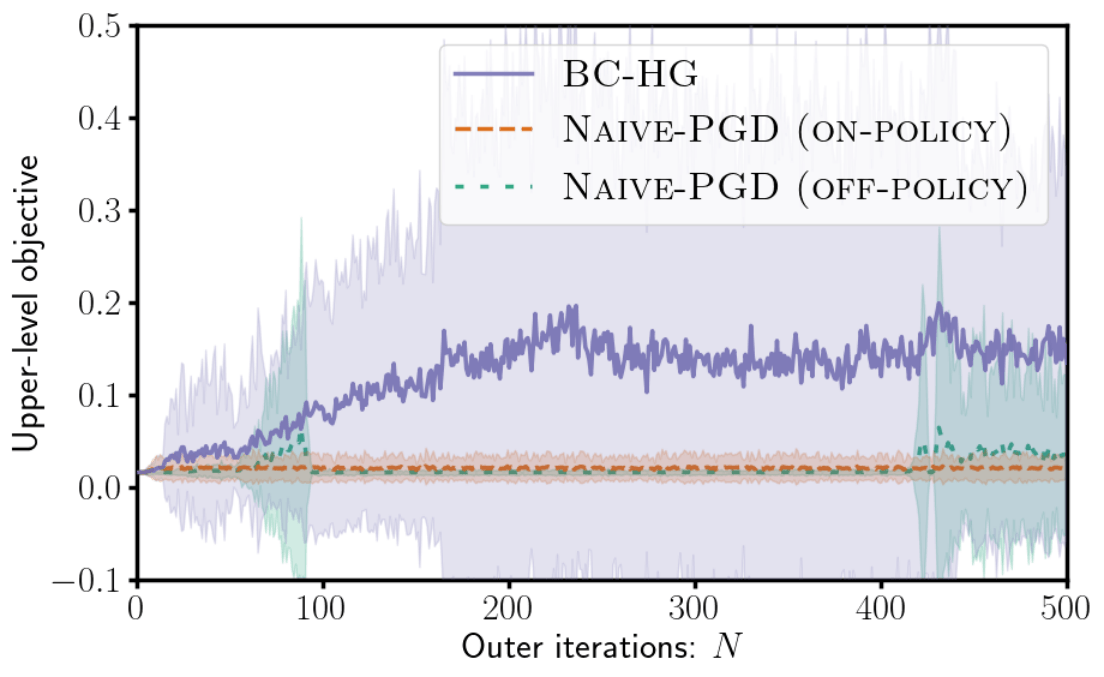
The authors evaluate BC-HG on four settings: a discrete Four-Rooms task, a continuous 4-zone building thermal control problem, a toy Markov game, and a bi-level LQR game.

On Four-Rooms, BC-HG matches or beats HPGD (Oracle) despite not having oracle access, and cleanly outperforms the other baselines. Performance of HPGD variants without the oracle degrades as entropy regularization weakens, because low entropy makes it harder to see the same state visited with different follower actions, which those methods rely on. BC-HG holds up because it never needed that assumption.
The building thermal control task is where scalability matters. BC-HG achieves the highest convergence in the fewest iterations, while HPGD shows slower improvement or degradation because estimating the follower's value gradient as a vector-valued function gets expensive with 8-dimensional leader parameters. In the toy Markov game, BC-HG discovers a mixed leader strategy that induces a favorable follower behavior; baselines get stuck picking the wrong action probability and lose reward.
When it is useful, and when it is not
BC-HG fits problems with these properties:
- The leader chooses environment parameters or a policy that shapes what the follower optimizes.
- The follower runs its own entropy-regularized RL algorithm, which the leader cannot modify.
- The state space is continuous or too large for repeat-visit tricks.
- The leader has read access to the follower's policy and value function at each iteration.
The limits are also clear. The method assumes the follower reaches its optimal policy at each outer step, which is why the LQR and gridworld tasks are natural fits (the best response has a closed form). Extending this to genuinely suboptimal or black-box followers is called out as future work. Entropy regularization is a hard requirement, since the whole derivation leans on the Boltzmann form of the optimal follower policy.
For anyone working on environment design, incentive alignment, reward shaping, or Stackelberg-style multi-agent problems where you cannot rewrite the follower, this is a practical upgrade over prior hypergradient methods. It swaps an unrealistic oracle assumption for a covariance identity, and the empirical gap on continuous-state tasks is large enough to matter.