
T-CQL Beats Clinician Ventilator Policies by 4 Points on Digital Twin Patients
A new offline reinforcement learning framework combines a Transformer encoder with conservative Q-learning to suggest ventilator settings, tested on 98 simulated ICU patients.
 Pro
Takeaways
- Researchers propose T-CQL, a Transformer-based Conservative Q-Learning framework for automated mechanical ventilation decision support.
- Adds uncertainty-scaled conservatism penalty and sequence-consistency regularizer on top of standard CQL for offline safety.
- Trained on MIMIC-III and MIMIC-IV covering 11,585 patients and 994,080 hours of pressure-controlled ventilation.
- Evaluated on 98 mechanistic digital twins simulating cardiopulmonary physiology, not on real ICU patients.
- Achieved 47.96% safety compliance versus 43.88% for the MIMIC clinician policy replayed in the simulator.
- Highlights that Fitted Q-Evaluation disagrees with simulator results, arguing for mechanistic in-silico validation in critical care RL.
A team from the University of Warwick, Chongqing University, Hainan University, and RWTH Aachen has published a paper introducing T-CQL, an offline reinforcement learning framework that proposes ventilator settings for patients with acute respiratory failure. The system was evaluated against clinician-derived policies using retrospective ICU data and a physiological simulator built from 98 digital twin patients. On that simulator, it produced a modest improvement in safety-constraint compliance over the recorded clinician actions.
The framing matters here. This is a research proposal for a decision support tool with in-silico validation, not a demonstration that an algorithm outperforms doctors at the bedside. No real patients were treated. What the paper does show is that combining a Transformer sequence encoder with a conservative offline RL objective produces recommendations that stay closer to established lung-protective guidelines than prior offline RL baselines.
Why ventilator tuning is hard to automate
Mechanical ventilation saves lives but can also cause ventilator-induced lung injury (VILI) when pressures or volumes are set too aggressively. A recent study found that important oxygen saturation targets were only achieved 40% of the time, and adherence to lung-protective guidelines sits in a similar range. The clinical reality is that busy ICU staff manually adjust settings across many patients, and personalized moment-to-moment tuning is difficult to sustain.
Prior machine learning attempts have run into three recurring issues, which the authors call out directly:
- They treat ventilation as a static classification problem instead of a sequential one, ignoring how oxygenation, respiratory rate, and heart rate drift over hours.
- They lean on 90-day mortality as the reward signal, which is sparse and blind to early signs of lung injury.
- They validate policies using Fitted Q-Evaluation (FQE) on the same static dataset used for training, which is vulnerable to distribution shift when the policy diverges from clinician behavior.
What T-CQL actually is
T-CQL extends Conservative Q-Learning, an offline RL method that penalizes Q-values for actions unseen in the training data to avoid overconfident recommendations. The authors bolt on three additions:
- A Transformer encoder that ingests a window of past patient states, concatenating the current-step embedding with an averaged history embedding before feeding an MLP that predicts Q-values across a 13,440-way discrete action space (combinations of PEEP, FiO2, respiratory rate, I:E ratio, and pressure support).
- An adaptive conservatism coefficient. A parallel uncertainty head estimates epistemic uncertainty as the variance across time-step embeddings, and the CQL penalty is scaled exponentially by that uncertainty. Familiar states get a mild penalty, out-of-distribution states get a much stronger one.
- A sequence-consistency regularizer that drops the most recent step from the history and forces the Q-values on the shortened sequence to match the full one, similar to consistency losses used in semi-supervised learning.

The reward function is where clinical knowledge enters. Instead of only rewarding 90-day survival, non-terminal transitions get an intermediate reward based on normalized improvements in the APACHE-II severity score and in driving pressure (peak inspiratory pressure minus PEEP), a well-established marker of VILI risk. Terminal steps still give plus or minus one based on survival.
Data and the digital twin evaluation
Training used MIMIC-III and MIMIC-IV, filtered to adult patients receiving at least two consecutive hours of pressure-controlled ventilation, aggregated into two-hour windows. The resulting dataset covers 11,585 patients and 994,080 hours of ventilation, split 80/20 for training and testing.
For evaluation, the authors run FQE and then a second, more interesting test: they deploy the learned policy on 98 mechanistic digital twins of ARF patients. These twins are not neural networks trained on data. They are a physiologically detailed cardiopulmonary simulator that models airflow, alveolar gas exchange, blood transport, and tissue exchange as mass-conserving differential equations, developed and validated over years of prior work. Initial conditions such as lung compliance and airway resistance are drawn from a parameter space calibrated against real patient data from Aachen University Hospital.
The results, honestly stated
On the simulator, T-CQL hit a safety-constraint compliance rate of 47.96 plus or minus 1.15 percent, compared with 43.88 plus or minus 0.15 percent for the clinician policy recorded in MIMIC and 41.83 percent for BCQ. Compliance is defined as simultaneously keeping PaO2 above 60 mmHg, PaCO2 below 60 mmHg, and peak inspiratory pressure at or below 35 cmH2O. Driving pressure was reduced from baseline 44.90 percent of the time under T-CQL, versus 37.76 percent for clinicians.
A few important caveats sit inside those numbers:
- The clinician baseline is derived from MIMIC actions replayed inside the simulator, not clinicians actually treating the simulated patients. The digital twin cannot ask a physician for a fresh judgment.
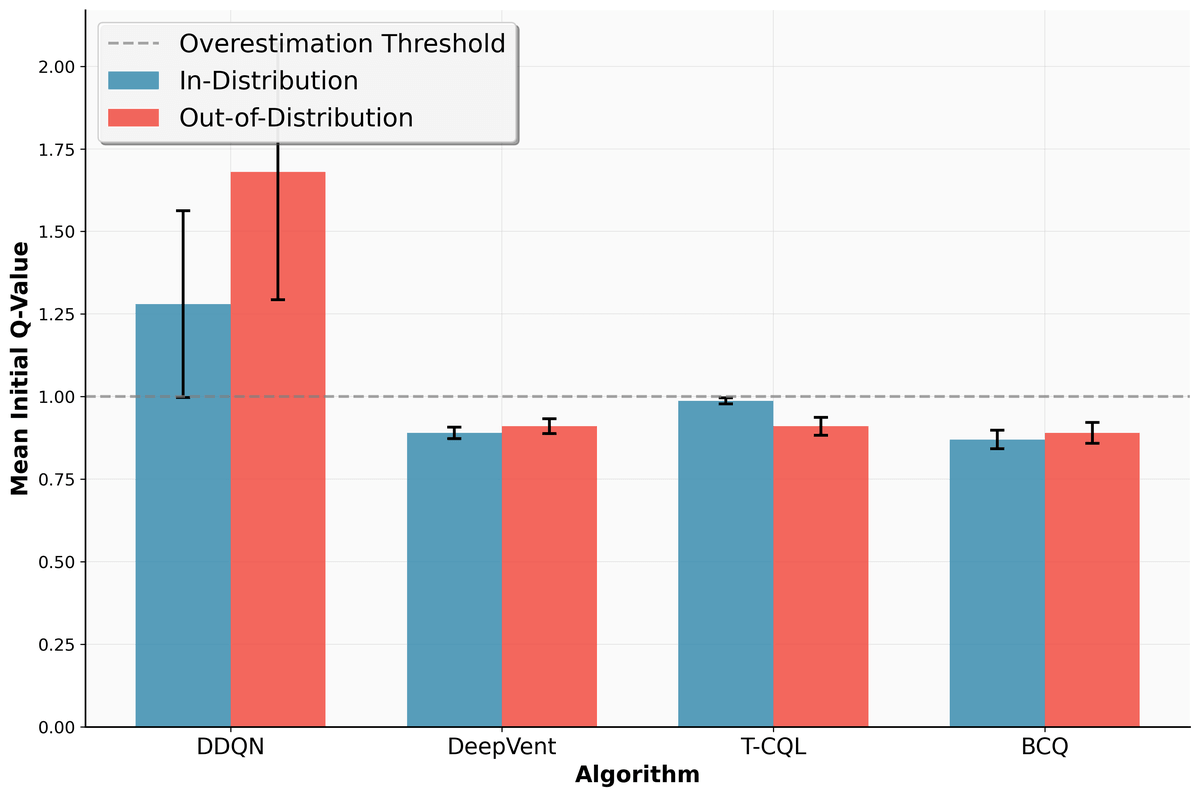
- DDQN, an offline RL method without a distribution constraint, achieved only 22.45 percent compliance and showed clear Q-value overestimation on out-of-distribution states, which is why the authors dropped it from later comparisons.
- FQE and simulator results disagreed. Prior offline RL baselines scored well on FQE but poorly on the digital twin. T-CQL is the only method that scored well on both, which the authors present as evidence that FQE alone is not a reliable performance signal.

The action distribution plots show T-CQL clustering around clinician-preferred ranges: PEEP of 5 to 10 cmH2O, FiO2 of 45 to 55 percent, respiratory rates of 20 to 22 breaths per minute, and I:E ratios of 1:3 to 1:2. Interestingly, an external cohort of RWTH intensivists tended toward more aggressive PEEP settings than the MIMIC physicians, illustrating that clinician policies themselves vary between institutions.
What is genuinely new here
The real methodological contribution is not a headline win over doctors. It is twofold.
First, the paper argues that retrospective off-policy evaluation is inadequate for critical care RL, and it demonstrates the gap by showing offline RL methods that look strong on FQE fall apart on a physics-based simulator. A recent survey on RL in critical care medicine confirmed that all RL-based technologies for critically ill patients rely on retrospective off-policy evaluation, so pushing the field toward mechanistic simulator validation is a meaningful shift.
Second, the uncertainty-scaled CQL penalty addresses a known weakness of standard CQL: uniform conservatism makes policies overly timid in familiar states and only mildly cautious in truly novel ones. Scaling by per-state epistemic uncertainty gives a principled state-dependent safety filter that could carry over to other high-stakes offline RL problems, from anesthesia dosing to vasopressor titration.
What this is not useful for yet
No code or trained model release is mentioned in the paper. The evaluation is entirely in-silico, and the improvement over the clinician baseline is on the order of four percentage points on a synthetic cohort of 98 patients. Anyone reading this as a ready-to-deploy autopilot for ICU ventilators is reading it wrong. The authors themselves position T-CQL as a clinician-in-the-loop decision support tool intended to standardize best practice, not replace bedside judgment. Prospective clinical validation, regulatory review, and integration into ICU workflows would all need to happen before any of this touches a real patient.
For practitioners working on offline RL in healthcare, the more transferable takeaways are the uncertainty-scaled conservatism, the shift away from mortality-only rewards toward physiologically grounded intermediate signals like driving pressure, and the use of a mechanistic digital twin as a stress test that catches distribution-shift failures FQE misses.