
PGH Beats Classical Optimizers 19x by Smoothing Probability, Not Loss
A new arXiv paper reframes nonconvex optimization as continuation in probability space, using Boltzmann-weighted gradients to escape bad local minima.
 Pro
Takeaways
- New arXiv paper introduces Probabilistic Gaussian Homotopy, a continuation framework smoothing the Boltzmann distribution instead of the objective.
- Gradient is a Boltzmann-weighted average of perturbed gradients, exponentially biasing descent toward low-energy regions.
- Proven equivalent to a soft-min (posterior-mean) Moreau envelope, bridging Gaussian homotopy, proximal methods, and diffusion.
- PGHO algorithm uses Monte Carlo estimation with just K=4 samples per step, parallelizes trivially.
- On Ackley at dim=10, hits target in 205 function evaluations vs 3,894 for classical Gaussian homotopy.
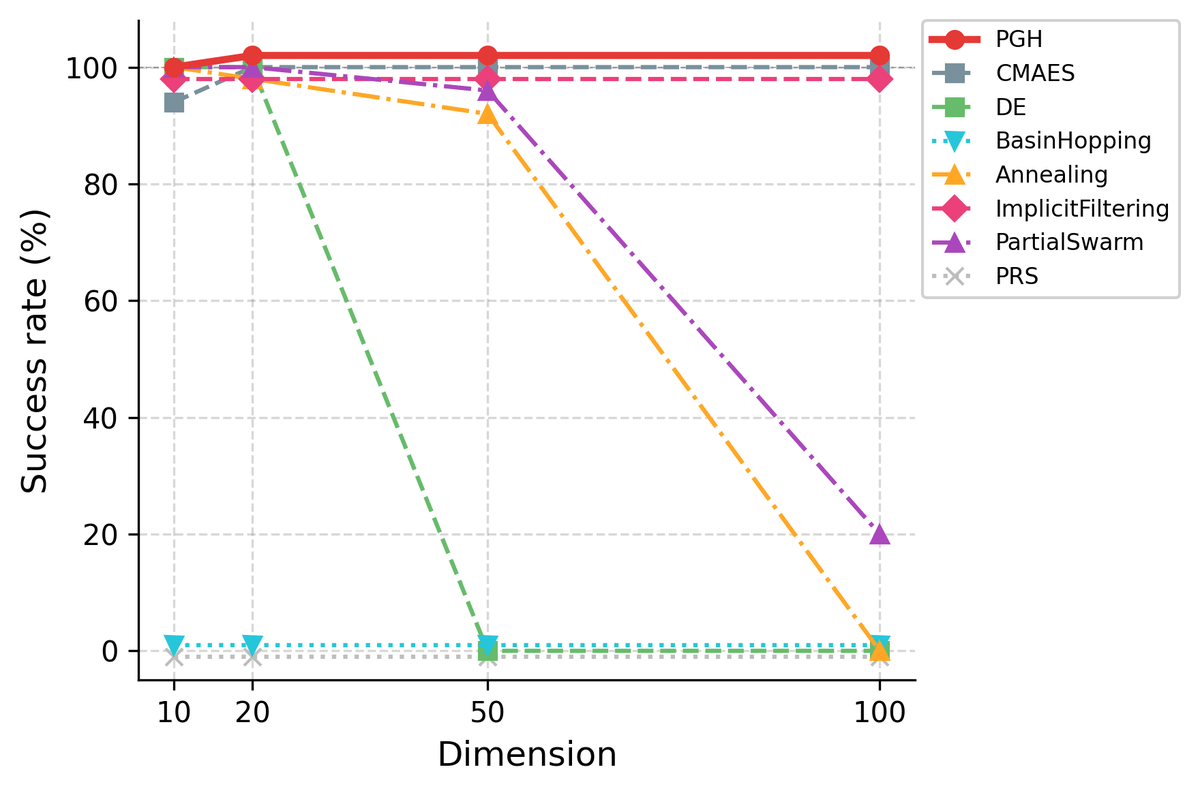
- Maintains high success rate as dimension grows where CMA-ES, basin hopping, and annealing degrade sharply.
Nonconvex optimization is a graveyard for gradient descent. Landscapes littered with local minima, flat plateaus, and narrow basins tend to trap first-order methods, which is why fields from sparse recovery to neural training lean on heuristics like simulated annealing or evolutionary search. A new paper by Eshed Gal, Samy Wu Fung, and Eldad Haber introduces Probabilistic Gaussian Homotopy (PGH), a continuation framework that smooths the probability distribution induced by an objective rather than the objective itself, and reports order-of-magnitude speedups over classical global optimizers on standard benchmarks.
The trap of objective-space smoothing
The classical trick for taming nonconvexity is Gaussian homotopy: convolve the loss with a Gaussian kernel to blur the landscape, then gradually shrink the kernel while tracking the minimizer. The strategy tracks minimizers while gradually decreasing the smoothing, and gradients correspond to a uniform average of gradients in a Gaussian neighborhood. That uniform averaging is the weak point. Competing basins contribute equally to the descent direction, which may blur structural differences between low- and high-energy regions.
Put simply: if you sample points around your current position, classical smoothing treats a nearby deep valley the same as a nearby hill. The gradient average has no sense of which neighbors are actually good.
Smoothing the distribution, not the loss
PGH flips the object of smoothing. Any objective f(x) induces a Boltzmann density p(x) ∝ exp(-f(x)/λ) where low-loss points get high probability. Instead of smoothing f directly, the authors smooth its induced probability distribution and track the evolution of high-probability regions as the smoothing vanishes. The resulting gradient is a Boltzmann-weighted average of perturbed gradients rather than a uniform one.

Concretely, the gradient estimator draws Monte Carlo samples z_k from a standard normal and weights their gradients by exp(-f/λ). Perturbations with lower objective value contribute exponentially more to the descent direction, biasing dynamics toward low-energy regions and naturally emphasizing promising basins while suppressing high-energy perturbations. Same samples, radically different signal.
A bridge between three literatures
The theoretical payoff of the paper is showing that PGH is not a new heuristic but the missing link between three well-known frameworks:
- Classical Gaussian homotopy, which averages uniformly in objective space.
- Moreau envelopes, the proximal-operator workhorse that computes a MAP-style hard minimum.
- Score-based diffusion, which implicitly defines a Gaussian homotopy in probability space.
The authors prove that under the scaling β(t)² = λ(t), PGH reduces to a finite-temperature (soft-min) Moreau envelope, where hard minimization is replaced by Gaussian-weighted averaging. They also show a Bayesian identity: gradient descent on the probabilistic envelope corresponds exactly to a posterior-mean update. Where classical Moreau smoothing tracks the MAP estimator, PGH tracks the posterior mean, which stays well-defined in regimes where MAP is unstable.
The algorithm, in practice
The implementation, called PGHO, is short enough to fit in a slide. For each of T homotopy steps and a batch of B particles:
- Draw
KGaussian perturbationsz_{i,j}. - Evaluate
fat the perturbed pointsα(t)x + β(t)z. - Form the log-sum-exp (soft-min) energy over samples.
- Take a gradient step, using either plain SGD or Adam.
Each step costs K gradient evaluations, but all samples and particles parallelize trivially. The homotopy parameter is annealed from a flat landscape at t=0 to the original objective at t=1. In the reported experiments, K is small: all PGH runs use K = 4 Monte Carlo samples per step, with the exception of PGH-GD on Levy where K = 16 is used to reduce variance.
Benchmark numbers
The authors test PGH-GD and PGH-Adam against eight global optimizers on the standard Ackley, Griewank, Alpine1, and Levy functions at dimension 10, measuring the mean number of function evaluations to reach f(x) < 5×10⁻². The method is the fastest across these benchmarks, consistently reaching the target tolerance with substantially fewer evaluations than the competing baselines.

Selected results:
| Function | PGH-GD | Classical GH | CMA-ES | Basin Hopping |
|---|---|---|---|---|
| Ackley | 205 | 3,894 | 804 | no success |
| Griewank | 183 | 3,248 | 1,088 | 14,120 |
| Alpine1 | 192 | 3,479 | 1,176 | no success |
| Levy | 3,067 | 3,141 | 817 | no success |
More striking is the scaling. PGH maintains a high success rate across all dimensions on Ackley, while competing methods degrade significantly in higher dimensions. Global optimizers usually fall off a cliff as n grows; the probabilistic aggregation appears to preserve a stable descent signal.
Sparse recovery holds up too
The authors also test on ℓ₀-regularized sparse recovery using a smooth 1 - exp(-x²/τ²) surrogate for the counting penalty, with signals of dimension 10,000 and 100 nonzeros observed through a sensing matrix at 15% sampling. Compared head-to-head against vanilla GD and Adam on the same objective, both PGH variants obtain lower objective values, with the improvement particularly visible in the intermediate range of the regularization parameter where the balance between fitting the measurements and enforcing sparsity is most delicate.
What it is and isn't good for
PGH is not a drop-in replacement for SGD on your transformer. It is aimed at problems where the loss is differentiable but riddled with local minima, and where you can afford K parallel function evaluations per step. Good fits include:
- Global optimization of low- to moderate-dimensional analytic objectives (physics inversion, calibration).
- Nonconvex inverse problems like
ℓ₀-style sparse recovery or phase retrieval. - Any setting where you would otherwise reach for CMA-ES, basin hopping, or simulated annealing but want gradient information in the loop.
The main caveats: cost scales linearly with the number of Monte Carlo samples K, the homotopy schedule and initial learning rate need per-problem tuning (the paper reports learning rates ranging from 10⁻¹ to 5×10¹), and if your problem is already convex or benign, plain gradient descent will beat it. No code repository is linked in the paper itself, but the algorithm is compact enough to reproduce directly from the pseudocode.
The deeper contribution is conceptual. By recasting diffusion-style Gaussian smoothing as a continuation mechanism for optimization, the paper suggests that many of the techniques developed for generative modeling, annealed noise schedules, score functions, posterior means, have direct analogs as global optimizers. That is a bridge worth watching.