
Penn State's Q-EarlySettled-LowCost Solves a Decade-Old RL Efficiency Problem
Two new Q-learning algorithms crack a long-standing open problem: near-optimal regret, linear burn-in cost, and logarithmic policy switching — all at once.
 Pro
Takeaways
- First algorithm to simultaneously achieve near-optimal regret, burn-in cost linear in S and A, and logarithmic policy switching cost for model-free RL.
- Two algorithms released: Q-EarlySettled-LowCost (single-agent) and FedQ-EarlySettled-LowCost (federated, M agents).
- Burn-in cost drops from Õ(S⁶A³H²⁸) to Õ(SAH¹⁰) — linear in S and A, a massive practical improvement for large state spaces.
- Key innovation: surrogate reference functions resolve a "double non-adaptiveness" problem that blocked combining LCB-based early settlement with round-based policy updates.
- Regret improves over prior state-of-the-art Q-EarlySettled-Advantage by a log(SAT) factor; federated version eliminates superlinear S,A dependence of FedQ-Advantage.
- Limitation: results are for tabular MDPs only; extension to function approximation and continuous state spaces remains open.
Training a reinforcement learning agent is expensive. Every time you change the policy , the set of rules the agent follows , you pay a real cost: you have to redeploy hardware, reset environments, or in a federated setting, synchronize across dozens of machines. At the same time, you need enough data before the algorithm starts performing well. These two pressures , keeping policy switches rare while also warming up fast , have been pulling against each other for years. A new paper from Penn State closes that gap for the first time.
The triangle nobody could close
The theoretical study of RL efficiency usually focuses on regret , how much reward you lose compared to an optimal policy over time. The information-theoretic lower bound for tabular MDPs (environments with a finite number of states and actions) is Ω(√(H²SAT)), where S is the number of states, A the number of actions, H the horizon length, and T the total steps. Model-free algorithms , those that learn value functions directly without building an explicit model of the environment , are preferred in practice because they use far less memory. But hitting that lower bound while also keeping two other costs low has proven elusive:
- Burn-in cost: how many samples you need before the regret bound actually kicks in. Prior near-optimal algorithms like UCB-Advantage required a burn-in that scaled as
Õ(S⁶A³H²⁸), superlinear in S and A, making them impractical for large state spaces. - Switching cost: the total number of times the policy changes. Algorithms like Q-EarlySettled-Advantage achieved a linear burn-in but paid for it with a switching cost that grew linearly with T , meaning the policy changed on almost every episode.
No existing model-free algorithm had managed to achieve all three simultaneously: near-optimal regret, burn-in linear in S and A, and a switching cost that only grows logarithmically with T. The new paper by Haochen Zhang, Zhong Zheng, and Lingzhou Xue answers this open question affirmatively with two algorithms.
What they built
The paper introduces Q-EarlySettled-LowCost for single-agent RL and its federated counterpart FedQ-EarlySettled-LowCost for settings with M parallel agents coordinated by a central server. Both are model-free Q-learning algorithms. The key results:
- Regret bound:
Õ(√(H²SAT)), matching the information-theoretic lower bound up to logarithmic factors, and actually improving on the prior state-of-the-art Q-EarlySettled-Advantage by a factor oflog(SAT). - Burn-in cost:
Õ(SAH¹⁰), linear in both S and A, a dramatic improvement over UCB-Advantage'sÕ(S⁶A³H²⁸). - Switching cost:
O(H³SA log(T/(HSA))), logarithmic in T, beating Q-EarlySettled-Advantage's linear switching cost. - For the federated version, the communication cost (total scalars exchanged between agents and server) also grows only logarithmically with T.
| Algorithm | Near-optimal regret | Log switching cost | Linear burn-in |
|---|---|---|---|
| UCB-Advantage | ✓ | ✓ | ✗ |
| Q-EarlySettled-Advantage | ✓ | ✗ | ✓ |
| Q-EarlySettled-LowCost (this work) | ✓ | ✓ | ✓ |
How it works
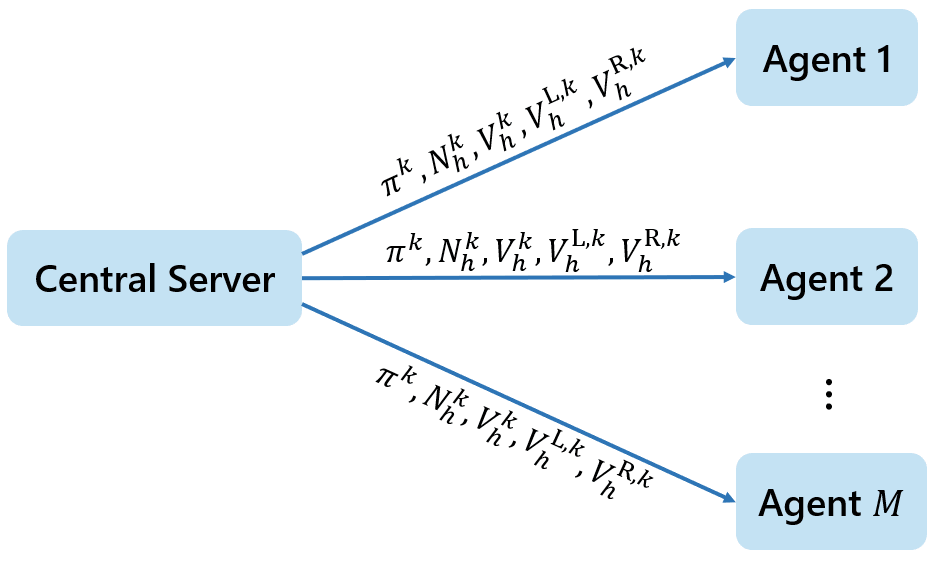
The algorithm runs in rounds rather than updating the policy after every episode. Within each round, agents collect trajectories under a fixed policy. The policy only changes at the end of a round , this is what keeps the switching count logarithmic. The trigger for ending a round is event-based: a round terminates when any state-action-step triple (s, a, h) has been visited enough times relative to how many times it was visited before that round started.
The core technical machinery combines three ideas:
- UCB + LCB pairing. The algorithm maintains both an Upper Confidence Bound estimate
Q_h^U(optimistic) and a Lower Confidence Bound estimateQ_h^L(pessimistic) for each Q-value. The gapV_h^k - V_h^{L,k}serves as a certificate of how well the value function is known. - Reference-advantage decomposition. Rather than estimating the full Q-function from scratch, the algorithm decomposes it into a reference function (a stable baseline) and an advantage (the deviation from that baseline). This is a variance-reduction technique borrowed from stochastic optimization. The reference function is only updated when the LCB-UCB gap drops below a threshold β , this is the "early settlement" that gives the algorithm its name and is what makes the burn-in cost linear.
- Surrogate reference functions. The key technical obstacle was that combining round-based updates (which create non-adaptive weights) with LCB-based reference settlement (which creates a non-adaptive settled reference function) produces a weighted sum of random variables where neither the weights nor the variables adapt to the data , making standard concentration inequalities inapplicable. The authors introduce a surrogate reference function defined as
V̂_h^{R,k}(s) = max{V_h*(s), min{V_h*(s) + β, V_h^{R,k}(s)}}. This proxy adapts to the learning process, reducing the double non-adaptiveness problem to a single one that can be handled by existing round-wise approximation techniques.
A rough sketch of the single-agent version in pseudocode:
# Each round k:
# 1. Broadcast current policy π^k to agents
# 2. Agents collect trajectories until trigger condition fires
# 3. Server aggregates statistics and updates:
#    - Q_h^U (UCB estimate)
#    - Q_h^L (LCB estimate)
#    - Q_h^R (reference-advantage estimate)
#    - Q_h^k = min(Q_h^U, Q_h^R, Q_h^{k-1})  # never increase
# 4. Update reference V_h^R only if V_h^k - V_h^L <= beta
#    (early settlement via LCB)
# 5. New policy: π_h^{k+1}(s) = argmax_a Q_h^{k+1}(s,a)
The real breakthrough
The logarithmic improvement in regret over Q-EarlySettled-Advantage might sound minor, but logarithmic factors in T matter enormously in practice , they determine how quickly the algorithm converges to near-optimal behavior. More importantly, the surrogate reference function technique is a new analytical tool that cleanly separates two sources of statistical difficulty that previously had to be handled with incompatible methods. This opens a path for future work on federated RL with heterogeneous agents, function approximation, and offline settings.
The federated version is particularly relevant for large-scale applications. Prior near-optimal federated algorithms like FedQ-Advantage required a burn-in of Õ(MS³A²H¹²) , superlinear in S and A , making them impractical for text-based games or recommender systems with large state spaces. FedQ-EarlySettled-LowCost reduces this to Õ(MSAH¹⁰), linear in both S and A.
Where it applies , and where it doesn't
This work is most directly useful for:
- Tabular MDPs with large state/action spaces where the superlinear burn-in of prior algorithms was a hard blocker.
- Federated RL deployments where communication bandwidth is constrained and policy redeployment across agents is expensive , robotics fleets, distributed sensor networks, multi-hospital clinical decision systems.
- Batch/offline-adjacent settings where you want to minimize how often you push a new policy to production.
The limitations are equally important to understand. This is a tabular result , the guarantees apply to MDPs with finite, enumerable state and action spaces. Real-world problems with continuous or high-dimensional state spaces require function approximation (neural networks, linear features), and extending these results there remains open. The H¹⁰ dependence on the horizon is also quite large; for long-horizon problems this burn-in cost can still be prohibitive. The paper also assumes on-policy data collection, so it doesn't directly apply to off-policy or offline RL settings.
Benchmarks and experiments
The theoretical results are validated on synthetic tabular MDPs with two configurations: (H,S,A) = (5,3,2) and (7,10,5). For the single-agent case, Q-EarlySettled-LowCost consistently achieves the lowest regret among all seven model-free baselines tested. Plotting Regret(T)/log(T/H+1) against episode count shows the curves flattening , confirming the gap-dependent logarithmic regret bound. The switching cost curves similarly flatten, confirming the O(log T) bound empirically. For the federated case with M=10 agents, FedQ-EarlySettled-LowCost outperforms all three federated baselines.
Code availability
The authors include code for the numerical experiments as supplementary material with the paper submission on arXiv. The code reproduces the regret and switching cost figures using the hyperparameter settings described in the paper (c_b = √2, c_b^R = 2, β = 0.05). No pre-trained models are released, as the work is theoretical with synthetic experiments. The gap-dependent bounds , which show that in MDPs with a clear best action (positive suboptimality gap), regret grows only logarithmically in T rather than as √T , are also verified empirically and match the best known bounds from prior work.