
NavThinker Teaches Robots to Imagine Crowds Before Moving Through Them
A new framework teaches robots to imagine how humans will react before moving, cutting collisions and hitting state of the art on social navigation benchmarks.
 Pro
Takeaways
- NavThinker couples an action-conditioned world model with DD-PPO reinforcement learning for social robot navigation.
- World model runs in Depth Anything V2 patch feature space with depth and trajectory decoders.
- Two think-ahead mechanisms: future feature fusion into observations, and social reward shaping from predicted human paths.
- Hits 59.46% success on Social-HM3D, beating Falcon by 3.2 points and cutting human collisions.
- Transfers zero-shot to Social-MP3D and deploys on a real Unitree Go2 quadruped with a RealSense depth camera.
- Code and details at the project page and arxiv paper.
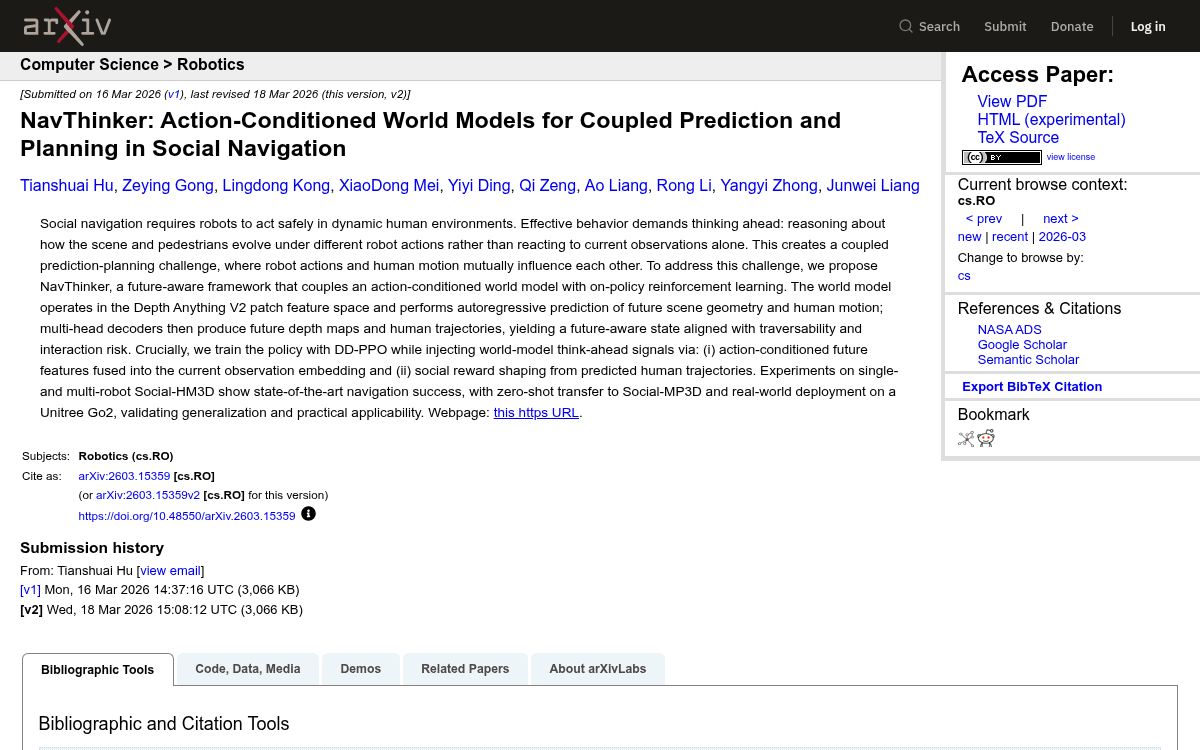
Getting a robot to walk politely through a crowd is one of those problems that looks trivial until you actually try it. Pedestrians dodge the robot, the robot dodges them back, and their decisions loop into each other in ways that pure reaction cannot handle. A new paper called NavThinker tackles this by giving the policy something closer to imagination: an action-conditioned world model that simulates how humans and geometry will evolve under each candidate move, then feeds that lookahead back into a reinforcement-learned planner.
The team reports state-of-the-art results on the Social-HM3D benchmark, zero-shot transfer to a different dataset, and a working deployment on a Unitree Go2 quadruped. Code and project details live on the paper's webpage.
Why social navigation keeps breaking classical planners
Reactive methods often focus on instantaneous observations, leading to short-sighted decisions and the "freezing robot" problem in dense crowds. Proactive methods try to predict human movement, but many treat those predictions as fixed, ignoring how the robot's own future actions might change the scene. Real pedestrians do not follow a script, they react to whatever the robot does next, and that decoupling is where planners fall apart.
Prior work has tried to close the loop with bilevel optimization or joint trajectory planning, but those approaches get expensive fast as crowds grow. NavThinker's authors argue that a learned world model, plugged into on-policy reinforcement learning, gives you the coupling without the compute blow-up.
Imagine, then act
The framework has two halves that talk to each other. On one side sits a world model that predicts what the scene and the people in it will look like a few steps into the future, conditioned on the action the robot is considering. On the other side sits a policy trained with DD-PPO that consumes those imagined futures as part of its input.

Rather than compressing everything into a global latent vector like Dreamer-style models, the world model operates in the Depth Anything V2 patch feature space and performs autoregressive prediction of future scene geometry and human motion; multi-head decoders then produce future depth maps and human trajectories. That patch-feature choice matters because it preserves spatial structure, so the robot can tell which part of the frame will be blocked, not just that something is nearby.
How the world model is built
The pipeline breaks down like this:
- Frozen encoder: A frozen Depth Anything V2 ViT turns each depth frame into patch embeddings, giving spatially rich features that generalize across environments.
- Causal transformer transition model: A ViT-based causal transformer takes the patch tokens plus an encoded action token and autoregressively predicts the next frame's patch features, using a sliding-window mask so each frame only attends to its recent history.
- Three decoder heads: A DPT-style depth decoder reconstructs future depth maps, a trajectory decoder predicts human positions over a future horizon from a pooled global feature, and a small MLP predicts scalar reward.
- Latent consistency loss: Predicted patch features are pushed to match what the frozen encoder would produce for the real next frame, keeping imagined rollouts anchored to something meaningful.
The trajectory decoder does double duty. It anchors the world model to interaction dynamics during training, and it also feeds the policy's reward function at deployment time.
Two think-ahead mechanisms wired into the policy
Rather than training the policy entirely inside imagined rollouts, which is known to compound modeling errors, NavThinker keeps DD-PPO grounded in real observations and injects the world model's foresight in two specific places:
- Action-conditioned future feature fusion: For each candidate action in the discrete action set (forward, turn left, turn right, stop), the world model rolls forward one step. Those imagined latents are concatenated and fused with the current observation embedding before being handed to the actor-critic.
- Trajectory-based social reward shaping: Predicted human trajectories under the chosen action feed a social cost term, penalizing the policy when its imagined future puts it too close to a person. This is what actually couples prediction to planning, so the policy learns to pick actions whose predicted human responses stay safe.
What the numbers say
On single-robot Social-HM3D, NavThinker hits 59.46% success rate and 55.00% SPL (success weighted by path length), beating the previous future-aware baseline Falcon by 3.2 points on success and cutting human collisions from 41.22% to 39.09%. The ablations are more informative than the headline table:
| Configuration | SR | SPL | H-Coll |
|---|---|---|---|
| Base policy (no lookahead) | 43.36 | 36.27 | 47.33 |
| + Lookahead imagination | 55.87 | 49.36 | 39.19 |
| + Trajectory reward shaping | 59.46 | 55.00 | 39.09 |
Lookahead fusion alone is worth roughly 12 points of success rate. That is a big signal that giving the policy explicit "what happens if I do this" features is doing real work, not just adding parameters. The trajectory reward adds another 3.6 points and drops collisions further.

The team also introduces a multi-robot version of the benchmark where multiple robots independently run the same policy without any communication. NavThinker widens its lead there, pushing success from 13.64% (base) to 30.04% and team success from 13.44% to 16.30%. Denser interactions are exactly where you would expect think-ahead to pay off, and the ablation numbers back that up.
Generalization and real-world deployment
Two more results are worth flagging. Trained only on Social-HM3D, the model transfers zero-shot to Social-MP3D, a different set of photo-realistic scenes, and stays competitive with methods tested in-distribution. On the hardware side, the team mounts an Intel RealSense D455i on a Unitree Go2 quadruped and runs inference on a server, streaming depth frames out and actions back. The robot navigates around groups of people while keeping distance, which is the practical bar this line of research aims at.
Where this fits, and where it does not
NavThinker is useful if you are building indoor mobile robots (delivery, hospital, service) that need to move through spaces with unpredictable humans and you already have a depth sensor. The patch-feature world model is comparatively lightweight because it reuses a frozen encoder and only trains a causal transformer and decoders on top.
Some honest limits worth noting:
- The action space is discrete with four choices. Continuous velocity control would need extension.
- Inputs are depth-only. The authors mark RGB and semantic fusion as future work, so anything requiring scene understanding beyond geometry (reading signs, recognizing intent from posture) is out of scope.
- Success rates in the high 50s and low 30s (multi-robot) mean this is state of the art on a hard benchmark, far from a solved problem. Roughly 39% human collision rate is still a lot of bumping.
- The real-world demo runs client-server, so on-device latency on the Go2 alone is not established.
The bigger contribution is architectural. Most world-model RL work either trains entirely in imagination (fragile) or uses world-model features as static context (misses the coupling). By keeping DD-PPO on real experience and querying the world model per candidate action for both features and reward shaping, NavThinker points at a middle path that other embodied-decision problems could copy, well beyond social navigation.