
Forecast-Aware Cooperative Planning Cuts Robot Team Mission Cost by 42%
A new paper introduces forecast-aware planning for multi-robot teams facing moving threats, using Markov risk propagation to pre-position support and cut expected mission cost.
 Pro
Takeaways
- New arXiv paper proposes forecast-aware cooperative planning for multi-robot teams under stochastic adversarial risk (2603.14697).
- Models adversaries as first-order Markov stay-move processes over graph edges to generate time-indexed edge-risk forecasts.
- Scores support-node candidates by combining forecasted risk potential with robot path overlap.
- Uses Lazily-Expanded A* on a temporal graph, preserving admissibility while pruning risk evaluations.
- Consistently beats Random and TCGRE baselines, approaching a No Risk oracle across stay probabilities 0.2 to 0.8.
- Limitations: assumes known adversary dynamics and centralized planning; no public code released yet.
Coordinating a team of robots through territory patrolled by adversaries is essentially a scheduling problem where the cost of every road keeps changing. A new arXiv paper by Manshi Limbu, Xuan Wang, Gregory J. Stein, Daigo Shishika, and Xuesu Xiao proposes a planner that stops reacting to risk and starts forecasting it, using a Markov model of adversary movement to place support robots where danger is about to appear rather than where it currently sits.
The framework, called Forecast-Aware Cooperative Planning, targets a specific gap in multi-robot path finding. Existing support-based frameworks assume static risk landscapes and fail to account for predictable temporal trends, so the paper integrates stochastic risk forecasting with anticipatory support allocation on temporal graphs.
Why static risk maps break down
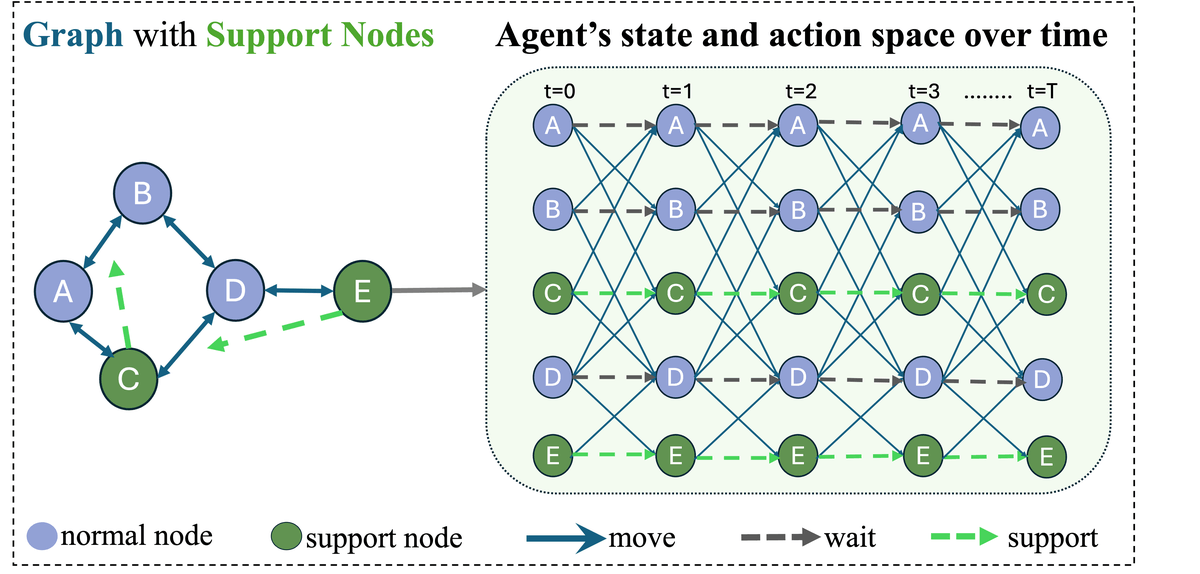
In cooperative missions like convoy protection or search-and-rescue, robots can lower total team cost through support coordination: one robot temporarily stops moving to cover a teammate crossing a risky edge, such as by providing overwatch or jamming. Previous work like TCGRE assumed the risky edges were fixed. Once adversaries start patrolling, that assumption falls apart.
A myopic planner that only reasons about current risk estimates cannot exploit predictable temporal trends, so support actions may be deployed too early, too late, or at locations that cease to be risky, leading to redundant detours and higher total mission cost.

Adversaries as a Markov walk on edges
The core technical move is treating each adversary as a first-order Markov process living on the edges of the graph, not the nodes. At each step, an adversary either stays on its current edge or moves to an adjacent edge sharing a common node. Those transitions define a first-order Markov chain over the edge set.
Given an edge-to-edge transition matrix Θ, the planner propagates the initial occupancy distribution forward across a horizon T. The probability that at least one of M independent adversaries occupies edge (u,v) at time t becomes a time-indexed risk forecast that feeds directly into the cost of traversing that edge.
Scoring support positions before the fight starts
Once risk is forecast across the horizon, the system decides where to pre-position support robots. Candidate support nodes are restricted to a k-hop neighborhood of any edge expected to become risky, then ranked by a score combining two factors:
- Normalized Path Overlap: how many robots' shortest paths pass through the candidate node, biasing support toward high-traffic corridors.
- Normalized Risk Potential: a softmax over the cumulative forecasted risk on nearby edges, weighted by proximity.
The top-s candidates per risky edge become the support-edge mapping. Planning then runs on the resulting temporal graph using a Lazily-Expanded A* search, where risk penalties are only computed when an edge is actually expanded. The heuristic assumes base traversal costs and applies risk penalties only upon expansion, cutting computation in sparse-risk settings while preserving A* optimality. Because the heuristic is risk-blind, it remains admissible.

How it performs against the baselines
The team tested on randomly generated graphs of 5 to 20 nodes, with 2 to 4 robots against 4 adversaries, sweeping adversary stay probabilities from 0.2 (highly mobile) to 1.0 (static). Each configuration ran over 20 independent trials. The comparisons include a No Risk oracle, No Support, Random support allocation, and the earlier TCGRE baseline, which allocates support only to edges that are risky in the initial snapshot.
The headline results:
- Forecast-aware consistently achieves the lowest expected team cost among all support-allocation strategies and remains closest to the No Risk oracle across stay probabilities 0.2, 0.5, and 0.8, with methods converging in the fully static case where temporal forecasting adds nothing.
- In a 5-node qualitative example with stay probability 0.8, forecast-aware traversal reduced team cost by roughly 42% (21.20 to 12.30) and shortened completion time by one step versus the No Support baseline.
- No Support triggers timeouts in larger settings such as 4-agent teams on 10-, 15-, and 20-node graphs, because the planner cannot find valid low-risk trajectories without support coordination.
- On the smallest 5-node graph, Random allocation performs nearly as well as forecast-aware because almost every node is within k=2 hops of a risky edge.
An ablation validates the forecast itself. Comparing expected team cost against 500 Monte Carlo rollouts of adversary trajectories, the realized cost closely tracks the expected cost, with bounded deviations of at most 1.0 across all settings. That calibration matters because the whole planner reduces edge cost to an expectation over the forecast.
Where it fits and where it does not
This is fundamentally a planner for centralized teams operating in graph-abstracted environments where adversary or hazard dynamics can be modeled as a known Markov chain. Convoy protection, area denial, and patrol-heavy inspection missions are natural fits. It is also a clean extension point for prior work in the TCGRE line, which it collapses to at 100% stay probability.
The authors are explicit about the limits. Current limitations include reliance on known adversary dynamics and centralized planning, which restrict application under partial observability or when adversary transition models must be estimated online. There is no released code or model referenced in the paper, so anyone wanting to reproduce the pipeline will need to rebuild the Lazy A* planner and scoring rule from the algorithm listing. Planned extensions include online estimation of adversary dynamics, decentralized coordination, and scenarios with reactive rather than stochastic opponents.
The real contribution here is the argument that support coordination should be treated as a forecasting problem, and that a fairly cheap Markov propagation over edges is enough to move performance close to an oracle that knows the future. For anyone building coordinated autonomy under adversarial pressure, that reframing is worth internalizing even before the code arrives.