
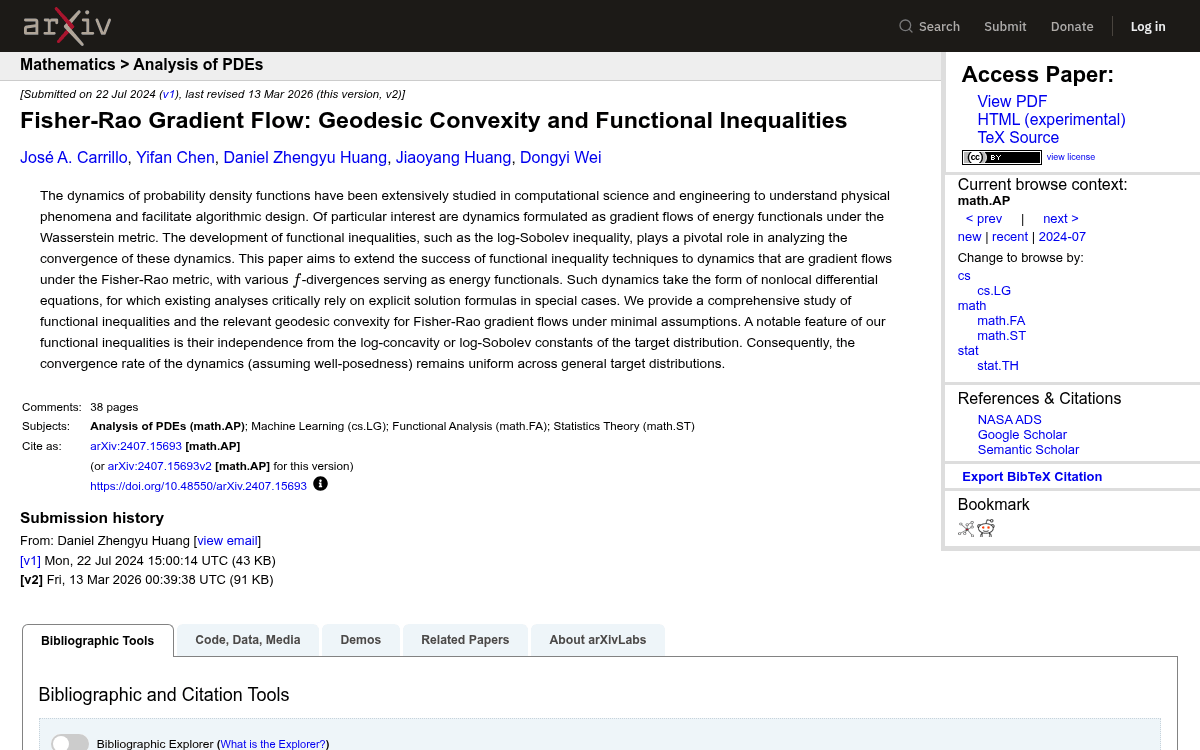
Fisher-Rao Flows Beat Langevin Sampling With Target-Independent Convergence
New theory shows why Fisher-Rao gradient flows converge at rates that do not depend on how nasty the target distribution is.
 Pro
Takeaways
- New paper builds functional inequality theory for Fisher-Rao gradient flows of general f-divergences.
- Convergence rates are uniform and independent of the target distribution's log-Sobolev constant.
- Proves KL divergence fails geodesic convexity and standard gradient dominance under Fisher-Rao geometry.
- Introduces a novel dual gradient dominance condition that has no known Wasserstein analog.
- For KL flow, forward plus reverse KL decays as exp(-t) with rate constant 1.
- Provides sufficient conditions on f for f-divergences to satisfy strong geodesic convexity.
Sampling from a probability distribution known only up to a normalization constant is one of the workhorse problems in Bayesian inference, uncertainty quantification, and variational methods for training neural networks. The dominant tool has been Langevin dynamics, which can be interpreted as a gradient flow of the KL divergence under the Wasserstein metric. But its convergence rate depends on the log-Sobolev constant of the target, which becomes tiny for anisotropic or multimodal distributions. A new paper from Carrillo, Chen, Huang, Huang, and Wei, published in the SIAM Journal on Mathematical Analysis, systematically builds the missing convergence theory for an alternative that dodges this problem entirely.
Why Fisher-Rao instead of Wasserstein
The Fisher-Rao gradient flow is a different way to evolve a probability density toward a target. Instead of moving mass around like Wasserstein flows do, it takes the form of a mean-field birth-death equation with a nonlocal interaction term that allows global movement of mass. That non-locality is what makes it appealing for multimodal targets: probability mass can teleport between modes rather than diffuse across low-density valleys.
The Fisher-Rao gradient flow of the KL divergence has a striking property already documented in prior work: it converges to the target at rate O(exp(-t)), and the exponential convergence rate here is uniform and independent of the target distribution. Compare this to Wasserstein flows where the rate depends on the log-Sobolev constant of the target, which can be very small for anisotropic or multimodal distributions.
The gap this paper closes
The existing convergence proofs had a serious limitation. Most existing proofs of the uniform convergence of the Fisher-Rao gradient flow rely on the explicit formula of the solution, which is specific to the KL divergence as the energy functional. In other words, the theory only worked because someone could write down the solution in closed form. That approach does not extend to other divergences or to more general settings.
For Wasserstein flows, the standard machinery is functional inequalities: the log-Sobolev inequality, Talagrand's inequality, and geodesic convexity in the sense of McCann's displacement convexity. This paper asks whether the same machinery can be built for Fisher-Rao flows with arbitrary f-divergences as the energy functional.
Three main results, one of them surprising
The authors work through the analysis and land on three findings:
- The KL divergence is not geodesically convex under Fisher-Rao geometry, and it does not satisfy the gradient dominance condition (the Polyak-Lojasiewicz inequality) either. This holds for any target distribution, and even fails in arbitrarily small KL neighborhoods of the target. Constructive counterexamples are given using both Gaussian densities and indicator-function-based constructions.
- Geodesic convexity and gradient dominance can be recovered for other f-divergences under explicit conditions on
f. Sufficient conditions includexf'(x)being concave, and a more explicit form involvingx^2 f''(x)being bounded below. Whenf''(x) = x^pwithpless than or equal to -2, the corresponding f-divergence is strongly geodesically convex. - A new dual gradient dominance condition saves the KL case. This is the paper's main technical contribution: a functional inequality that bounds the time derivative of one f-divergence by a combination of that divergence and the original energy functional. To the authors' knowledge, this dual type of inequality has no analog in the Wasserstein setting.
The dual gradient dominance trick
The core idea is that even though KL fails the standard gradient dominance condition along its own Fisher-Rao flow, one can pick a different divergence to track. Two choices work particularly well:
- Using the reverse chi-squared divergence as the dual gives general results for any f-divergence with
f''(1) > 0, with a constant depending only onf. - Using the star-conjugate
xf(1/x)as the dual gives tighter, explicit constants. For the KL case this dual is the reverse KL, and the inequality holds with constant exactly 1.
Concretely, for the Fisher-Rao gradient flow of the KL divergence, if the initial density satisfies KL[p0||p*] + KL[p*||p0] < infinity, then the sum of forward and reverse KL divergences decays as exp(-t), with no dependence on the target.
Why this matters for practice
The Fisher-Rao flow is not just a theoretical curiosity. It sits at the heart of birth-death samplers, kernel-based samplers, and ensemble methods for Bayesian inverse problems, and it is also the reaction component of Wasserstein-Fisher-Rao flows used in Gaussian mixture learning and multimodal generative modeling. Concurrent applied work by the same group and collaborators uses Fisher-Rao flows to build derivative-free Bayesian inference algorithms that beat MCMC on multimodal posteriors.
The theoretical caveat is that all results assume well-posedness of the gradient flow, which is left for future work. The authors also note that commonly used particle-based initializations in sampling often violate this condition, and that Gaussian, Gaussian mixture, or kernel density approximations may be needed for the dual inequality initial conditions to hold. This is a pure theory paper, so there is no code to run and no benchmarks to compare against.
What the analysis provides is a rigorous foundation showing that Fisher-Rao samplers should exhibit target-independent convergence for a broad class of energy functionals, not just the special case of KL where the solution happens to be computable in closed form.