
Ericsson Cuts Wireless AI Training Delays 28% With Smarter Digital Twin Data Mixing
A hierarchical RL system uses a digital network twin to cut real-network data collection delays by 28% while keeping antenna performance high
 Pro
Takeaways
- Core idea: A hierarchical RL system automatically decides how much training data to pull from a live 5G network vs. its digital twin, reducing real-network overhead.
- 28% delay reduction: The proposed method cuts physical network data collection delay by up to 28.01% vs. a vanilla PPO baseline.
- Two-level design: A fast Robust-RL agent adjusts antenna tilt angles; a slow PPO agent controls the real-vs-simulated data mix each training epoch.
- Noise robustness: The first-level agent uses adversarial worst-case loss to train effectively on noisy digital twin data, improving reward by 38.51% over standard PPO.
- Formal convergence: The authors prove the second-level PPO converges to a stationary point under standard smoothness conditions.
- No code released: The paper is simulation-only with no public implementation; the preprint is available on arXiv.
Training AI models for live wireless networks is expensive -- not in GPU-hours, but in airtime. Every time a reinforcement learning agent needs a real data sample to learn from, it has to interact with the physical network: users transmit, signals are measured, and the overhead accumulates. A new paper from researchers at the University of Miami and Ericsson Research tackles this problem head-on, proposing a smarter way to blend real and simulated data during RL training for antenna control.
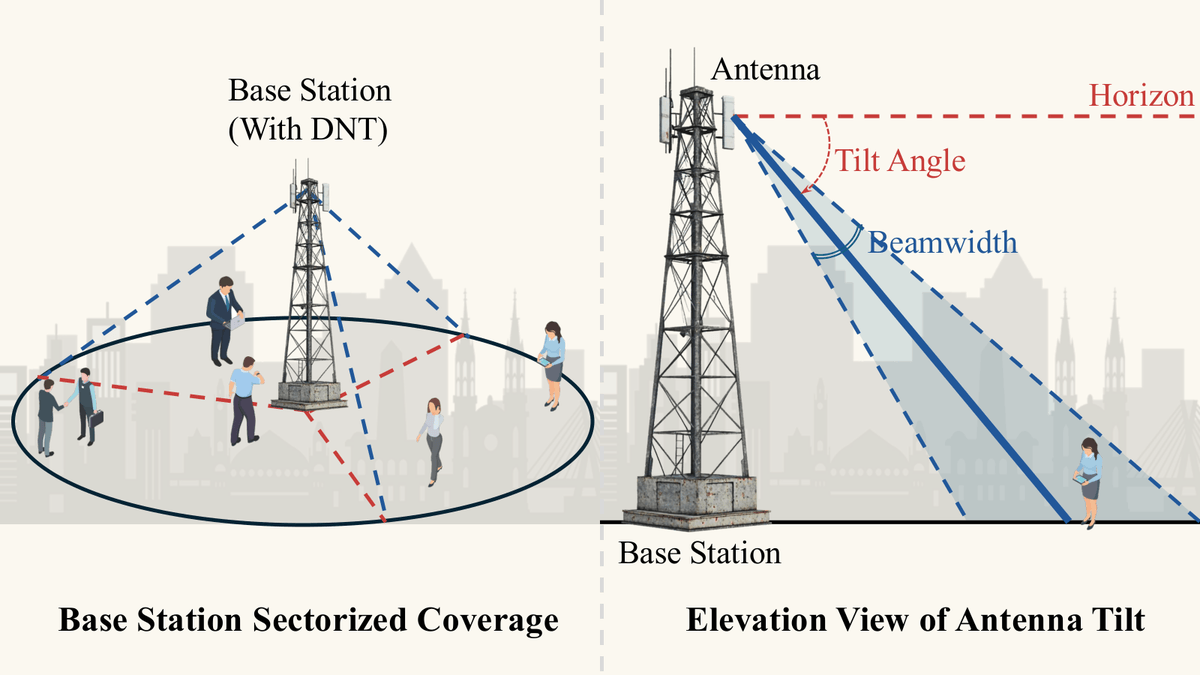
The work investigates a digital network twin (DNT) assisted deep learning framework, where a base station equipped with multiple antennas serves mobile users and must continuously adjust its antenna tilt angles to maximize their data rates. The twist: instead of always pulling training data from the live network, the system learns when to do so and when to rely on its virtual replica instead.
The real cost of training on real data
Due to user mobility, the base station cannot accurately track network dynamics like wireless channels and user positions, which is why a reinforcement learning approach is used to dynamically adjust the antenna tilt angles. But RL training requires lots of experience tuples -- (state, action, reward) transitions -- and collecting those from a live network means users must upload data to the base station continuously, consuming uplink bandwidth and introducing latency.
Digital twins can generate synthetic datasets to train AI models without the overhead caused by real-life data collection. The catch is that data collected from the physical network is more accurate than data from the DNT -- the twin's simulated user positions and channel conditions drift from reality over time. Using too much synthetic data degrades the RL model; using too little wastes the twin's main advantage. The right ratio changes dynamically as the network evolves, and no prior work had a principled way to find it on the fly.
A two-level RL stack
The paper's core contribution is a hierarchical reinforcement learning framework -- two RL agents stacked on top of each other, each operating at a different time scale and solving a different sub-problem.

- Level 1 -- Robust-RL (fast loop): Adjusts antenna tilt angles every few time slots. It trains on a mix of real and synthetic data, and its loss function is specifically designed to be robust to the noise introduced by DNT-generated samples.
- Level 2 -- PPO (slow loop): Watches the Level 1 agent's training progress (its loss and average reward) and decides what fraction of the next training batch should come from the real network versus the twin. It operates epoch-by-epoch, on a much longer timescale.
The key insight is that these two decisions -- how to tilt the antenna and where to get training data from -- have very different natural timescales. Antenna adjustments need to react to users moving around in seconds. Data collection strategy can be revised once per training epoch. Unlike traditional single-level RL algorithms such as DQN, the hierarchical design lets the second-level PPO adjust the data collection ratio on a large timescale using training feedback from the first-level robust-RL.
Making the RL robust to noisy twins
The Level 1 agent uses a technique called robust adversarial loss, borrowed from adversarial robustness research. The idea: instead of training the policy to perform well under the data it actually sees, it trains the policy to perform well under the worst-case perturbation of that data -- a pessimistic inner adversary that assumes DNT errors are as bad as they could possibly be.
Formally, the loss function blends two terms:
- A standard PPO clipped surrogate loss, measuring normal performance.
- An adversarial loss that substitutes the actual policy with a worst-case policy -- the one that minimizes the probability of taking good actions and maximizes the probability of taking bad ones, given the noise bounds of the DNT.
The balance between the two is controlled by a hyperparameter kappa. Higher kappa means the agent trains more aggressively against worst-case noise, which helps when the twin is inaccurate but can slow convergence when the twin is reliable.
The Level 2 PPO never touches noisy DNT data directly -- it only observes the Level 1 agent's training statistics. This clean separation means the outer loop can use a standard PPO without any robustness modifications, keeping the architecture simple.
What the simulations show
The authors tested three configurations in a simulated cellular network with 10 users, 3 antenna sectors, and a 50-meter coverage radius:
- Proposed (PPO + Robust-RL): Second-level PPO controls the data ratio; first-level Robust-RL controls tilt angles.
- PPO + PPO: Same hierarchical structure, but vanilla PPO at both levels (no robustness to DNT noise).
- Random + Robust-RL: The data collection ratio is chosen randomly each epoch; only the tilt angle agent is robust.

The proposed method reduces the physical network data collection delay by up to 28.01% compared to the hierarchical RL that uses vanilla PPO as the first level, and by 1x compared to the baseline that selects the data collection ratio randomly. The second-level PPO in the proposed method also achieves a 77.81% higher average episode return than the PPO+PPO baseline, because the robust first-level agent provides cleaner, more reliable training signals upward. At the first level, the Robust-RL improves average episode reward by 38.51% over vanilla PPO, thanks to its ability to train effectively on noisy DNT data.

Scaling tests show the advantage holds as the number of users grows from 5 to 25 -- the proposed method consistently outperforms both baselines, with the gap widening at higher user counts. The authors also provide a formal convergence proof showing the second-level PPO converges to an approximate stationary point, given standard smoothness and bounded-reward conditions.
Where this fits and what it can't do
This work is directly relevant to self-optimizing network (SON) and RAN Intelligent Controller (RIC) deployments, where operators want to run RL-based optimization loops without the cost of continuous live-network interaction. In digital twin-assisted RAN architectures, AI agents can propose configuration adjustments within the twin, where outcomes are assessed against KPIs, and only changes that demonstrate safety and performance gains are deployed back to the physical network. This paper operationalizes that loop with a principled data-mixing strategy.
Practical use cases include:
- Antenna tilt and beamwidth optimization in dense urban deployments where user mobility is high and real-data collection is expensive.
- Any RL-based network control task where a digital twin exists but has non-negligible simulation error -- coverage optimization, handover policy tuning, power control.
- Scenarios where uplink bandwidth is scarce and collecting training transitions from users carries a real cost.
The limitations are worth noting. The simulation uses a relatively simple random-walk mobility model and a small 3-cell, 10-user scenario. The DNT error is modeled as uniform noise with known bounds -- a cleaner assumption than what operators face with real twins that may have structured, time-varying drift. There is also no code or pre-trained model released alongside the paper, so replication requires building the simulation environment from scratch. The framework also assumes the base station has full knowledge of several physical parameters (path loss exponent, beamwidths, transmit power) that may require calibration in practice.
The deeper contribution here is the framing itself: treating the data collection ratio as a policy decision, not a fixed hyperparameter. As digital twins become standard infrastructure for 5G and 6G network management, the question of how much to trust the twin at any given moment -- and how to automatically answer that question during training -- will matter more and more. This paper gives one concrete, theoretically grounded answer.