
CMU Fixes Three Broken Guarantees Behind GP-PSRL's Regret Bounds
A new proof finally gives GP-based reinforcement learning the tight, clean regret bound it deserves — without assuming bounded state spaces or strong kernel smoothness.
 Pro
Takeaways
- GP-PSRL now has a Bayesian regret bound of Õ(H√(γ_T · T)) — the first to simultaneously handle unbounded state spaces, true GP priors, and square-root information-gain dependence.
- Three prior failures are fixed: unbounded states, sub-optimal rates from confidence-set arguments, and restrictions to RKHS-ball priors that excluded GP priors.
- A recursive application of the Borell-Tsirelson-Ibragimov-Sudakov inequality proves that visited states stay within a ball of radius ~√(d log T) with high probability.
- The chaining method replaces single-step discretization, enabling tight bounds under only Hölder-continuous kernels — covering all Matérn and squared exponential kernels.
- For Matérn kernels, the rate specializes to Õ(H · d^((ν+1)/2) · T^((ν+d)/(2ν+d))), matching best-known GP bandit rates as a special case.
- No code released; the contribution is theoretical, but the tools are modular and applicable to future PSRL variants. Paper on arXiv.
Gaussian process posterior sampling reinforcement learning (GP-PSRL) has long been a practical workhorse for continuous control: sample a plausible dynamics model from your GP posterior, plan optimally under it, collect data, repeat. The algorithm works well in practice, but its theoretical foundations have been shaky. Every existing regret bound carried at least one embarrassing flaw , either a bloated dependence on the information gain, an assumption that the state space is bounded (which contradicts Gaussian noise), or a requirement that the kernel be four-times differentiable. A new paper from researchers at Carnegie Mellon, Oxford, and TU Darmstadt fixes all three problems at once.
Three open wounds, one paper
The work by Hamish Flynn, Joe Watson, Ingmar Posner, and Jan Peters identifies three distinct failures in the prior literature and addresses each with a new mathematical tool.
- Unbounded state spaces. Because system states are corrupted by Gaussian noise, the set of possible states is unbounded. If this is not properly accounted for, kernel-dependent quantities such as the maximum information gain can grow linearly with the number of time steps. Prior analyses either assumed a compact state space or produced vacuous bounds.
- Sub-optimal rates. Most regret bounds for GP-PSRL use an argument in which one constructs confidence sets that contain the true MDP and all the sampled MDPs. One can then show that the Bayesian regret of PSRL is as good as the worst-case regret of any optimistic algorithm. However, due to the difficulty of constructing confidence sets for functions in reproducing kernel Hilbert spaces, this approach results in regret bounds that have at least linear dependence on the maximum information gain.
- Limited priors. Many existing regret bounds allow for limited choices of the prior. Approaches based on the "PSRL is as good as optimism" argument only allow for priors with support contained within a ball of the RKHS associated with the kernel function. In particular, this does not include Gaussian process priors.
The main result
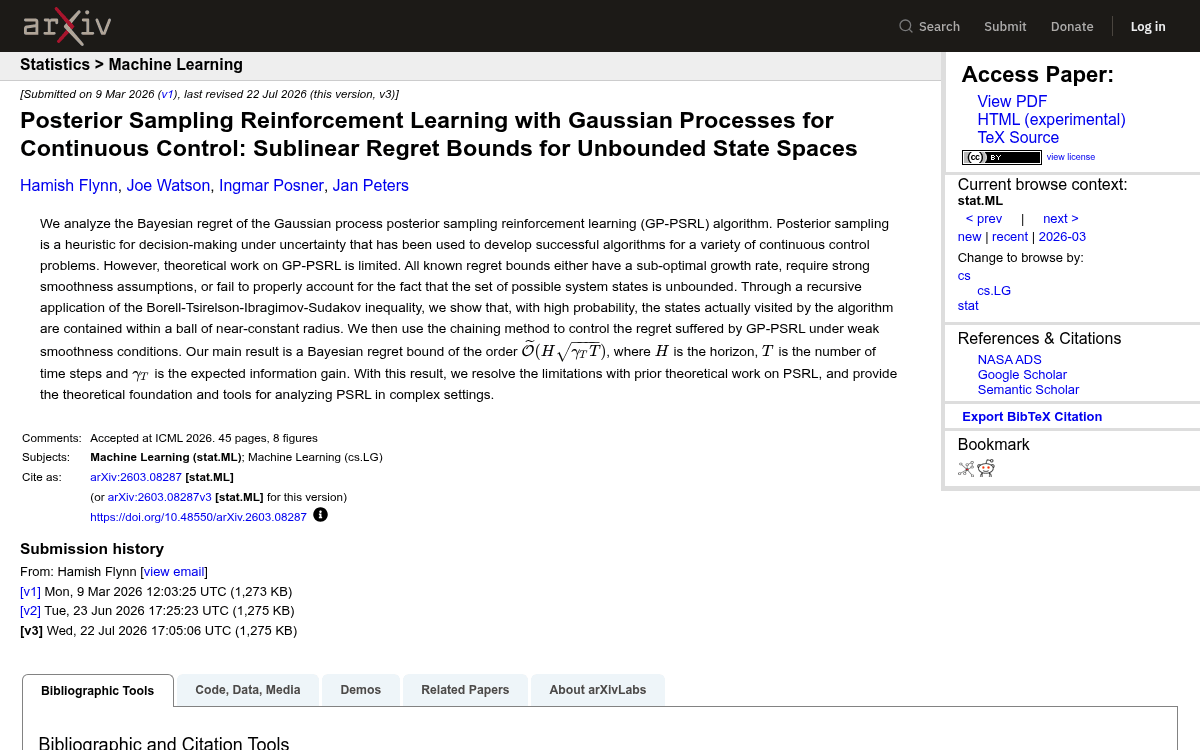
The main result is a Bayesian regret bound of the order Õ(H√(γ_T · T)), where H is the horizon, T is the number of time steps, and γ_T is the expected information gain.
The tilde hides polylogarithmic factors. This is the first bound for GP-PSRL that simultaneously handles unbounded state spaces, uses a true GP prior (not just an RKHS ball), and achieves square-root dependence on the information gain rather than linear dependence.
The expected information gain γ_T , rather than the more pessimistic maximum information gain Γ_T , is a key improvement. The maximum information gain takes a worst-case supremum over all possible trajectories; the expected version averages over the trajectories actually generated by the algorithm. For a well-behaved algorithm that eventually stops exploring redundant regions, γ_T can be substantially smaller than Γ_T.
How the proof works
The proof has two main pillars, each requiring a new technical contribution.
Pillar 1: Containing the states. The core challenge is that an unbounded state space makes standard GP supremum arguments break down. The authors resolve this with a recursive application of the Borell-Tsirelson-Ibragimov-Sudakov (BTIS) inequality , a classical result that says the supremum of a Gaussian process is sub-Gaussian.
Through a recursive application of the BTIS inequality, they show that, with high probability, the states actually visited by the algorithm are contained within a ball of near-constant radius.
Concretely, the radius grows only as √((d_s + d_a) log T), which is nearly constant relative to T. The argument works by induction on the episode step: if the current state is bounded, the next state is sub-Gaussian (since it equals the GP dynamics evaluated at a bounded point, plus Gaussian noise), and its norm can therefore be bounded with high probability.
Pillar 2: Tight estimation error via chaining. Once states are confined to a ball, the authors need to bound the cumulative model estimation error , how much the sampled dynamics f^(n) differs from the true dynamics f* across all visited state-action pairs.
They use the chaining method to control the regret suffered by GP-PSRL under weak smoothness conditions.
The chaining method (also called Dudley's entropy integral) bounds the expected supremum of a Gaussian process by integrating the square root of the metric entropy of the index set. This is strictly more powerful than single-step discretization, which is what prior work used and which required four-times differentiable kernels. The new approach only requires the kernel to be bounded and Hölder continuous , conditions satisfied by both the squared exponential and all Matérn kernels.
Specialization to Matérn kernels
For Matérn kernels with smoothness parameter ν and combined state-action dimension d = d_s + d_a, the bound specializes to a concrete polynomial rate in T. The regret scales as Õ(H · d^((ν+1)/2) · T^((ν+d)/(2ν+d))). As ν → ∞ (approaching the squared exponential kernel), the exponent of T approaches 1/2, recovering the near-optimal √T rate. This matches the best known rates even in the simpler setting of Gaussian process bandits, which is a strong sanity check.
What this means in practice
GP-PSRL is already used for robotics and other continuous control problems because it naturally handles uncertainty and produces diverse exploration behavior. The new theory matters for practitioners in several ways:
- Kernel choice is now justified. You can use Matérn-1/2, Matérn-3/2, or Matérn-5/2 kernels , previously excluded by smoothness requirements , and still have theoretical guarantees. Smoother kernels give better rates.
- No bounded-state assumption needed. Real physical systems with Gaussian process noise do not have bounded state spaces. The theory now matches the practice.
- The bound is tight in the right quantity. Dependence on
γ_T(expected information gain) rather thanΓ_T(maximum information gain) means the bound is less pessimistic for algorithms that explore efficiently. - The tools generalize. The BTIS-based state confinement argument and the chaining-based estimation error bound are modular. They can be applied to analyze other PSRL variants in more complex settings.
Experiments confirm the rates
The authors validate the theory on a 2D navigation task with a goal state, a central obstacle, and state boundary barriers. They run GP-PSRL with squared exponential and Matérn kernels (ν = 1/2, 3/2, 5/2) over 100 episodes with horizon 20, across 20 random seeds. The empirical results confirm two predictions: smoother kernels produce lower regret, and the log-log growth rate of cumulative regret matches the theoretical exponents from Corollary 4.13 closely. The linear scaling with H is also confirmed empirically across horizons 20 through 160.
No code has been released alongside the paper, but the algorithm itself , GP-PSRL , is straightforward to implement using standard GP libraries combined with any optimal control solver. The theoretical contributions are proof techniques rather than a new algorithm.
What remains open
The authors are candid about limitations. The current analysis gives Bayesian regret bounds, which average over the random draw of the true MDP from the GP prior. Extending to worst-case (frequentist) regret , where the true dynamics is a fixed function in an RKHS ball , would require replacing the key symmetry argument (Lemma 4.8) with something that works when the sampled and true MDPs do not share the same conditional distribution. The authors suggest that "optimistic" or "feel-good" variants of posterior sampling may be the right path forward, but this remains future work. The assumption that the kernel is uniformly bounded also excludes the linear kernel, which would require additional stability arguments.
For the GP-PSRL practitioner, the takeaway is simple: the algorithm you were already running now has a clean theoretical certificate , and that certificate is tight enough to be informative about how kernel choice and horizon length affect sample efficiency.