
Boston University Fixes SGDM's Broken Theory With One Random Line of Code
A Boston University team proves that multiplying each SGDM update by an exponential random scalar yields optimal convergence on non-smooth, non-convex losses.
 Pro
Takeaways
- New ICML paper closes the gap between SGDM's theory and its use on non-smooth losses like ReLU networks.
- Fix: multiply each SGDM update by an exponentially distributed random scalar with mean 1.
- Achieves optimal O(c^(1/2) * epsilon^(-7/2)) convergence rate, with a matching lower bound proven in the paper.
- Same algorithm automatically recovers optimal rates for smooth and second-order smooth objectives without modification.
- On ResNet-18 / CIFAR-10, random scaling matches vanilla SGDM: 94.4% vs 94.6% test accuracy.
- Framework hints that plugging AdaGrad into the same conversion could theoretically recover Adam.
Every deep learning practitioner has trained a network with stochastic gradient descent with momentum (SGDM) and watched the loss go down. What most people don't realize is that the classical convergence theory backing this workflow doesn't actually apply to modern networks. A new ICML paper from Qinzi Zhang and Ashok Cutkosky at Boston University shows that a single line of code, scaling each update by an exponentially distributed random number, closes that theoretical gap while barely changing behavior in practice.
The gap between theory and what we actually train
The paper starts from an uncomfortable observation. Popular training algorithms are based on stochastic gradient descent with momentum (SGDM), for which classical analysis applies only if the loss is either convex or smooth. Neural networks are neither. Modern deep learning models frequently incorporate a range of non-smooth architectures, including elements like ReLU, max pooling, and quantization layers. Those components create kinks and jumps in the loss surface that break the Taylor-series arguments underlying almost every convergence proof.
To understand why this matters, you need to know how convergence is measured in this regime. For smooth non-convex problems, the standard target is an epsilon-stationary point, a place where the gradient norm is small. Once the loss stops being smooth, that criterion is hopeless: in the worst-case it is actually impossible to find a neighborhood around an epsilon-stationary point. The field has since moved to a relaxed notion called a Goldstein stationary point, which asks for a small ball around your parameters where the average gradient is small. Prior work by Cutkosky et al. (2023) developed an online-to-non-convex conversion (O2NC) technique that converts online convex optimization (OCO) algorithms to non-smooth non-convex stochastic optimization algorithms, but the resulting algorithms look nothing like SGDM.
The one-line fix
The authors introduce a slightly relaxed convergence target they call a (c, epsilon)-stationary point, and then build a new framework called Exponentiated O2NC around it. When you plug the simplest possible online learning algorithm, online gradient descent, into this framework, something surprising happens: the update rule collapses into standard SGDM with one tweak. In their notation:
m_{t+1} = beta_tilde * m_t + (1 - beta_tilde) * g_t
x_{t+1} = x_t - s_{t+1} * eta_tilde * m_{t+1}   # s ~ Exp(1)
The only difference from vanilla SGDM is that s_{t+1}, an independent draw from an exponential distribution with mean 1, multiplies each step. That's it. In PyTorch, it's a one-liner before optimizer.step().
Why exponential and not, say, uniform or Gaussian? The exponential distribution has a magical property the authors exploit: by scaling an exponential random variable to the update, we directly establish a linear equation that the expected change in F equals the expected inner product of the gradient with the step, effectively eliminating any additional error that Taylor approximation might incur. In other words, exponential scaling replaces the smoothness assumption with an exact identity in expectation. It also means the algorithm can evaluate gradients at the actual iterates rather than at an awkward intermediate point that earlier O2NC methods required.
Does it hurt training?
A fair concern is whether random scaling makes training noisier. The authors point out that s_n from Exp(1) satisfies E[s_n] = 1 and P(s_n less than or equal to 5) is at least 0.99, so with high probability, the scaling factor behaves like a constant scaling on the update. Occasional large jumps are the price for the theoretical guarantee.
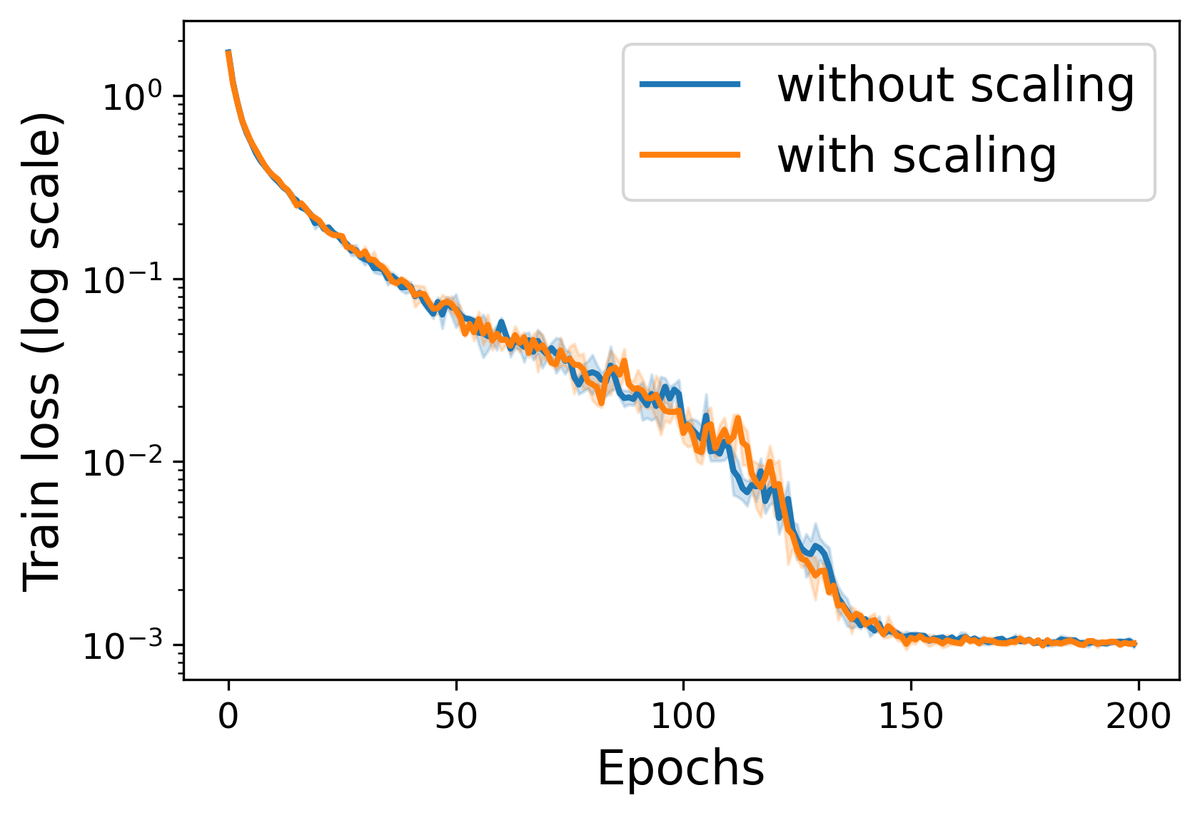
To check empirically, they trained ResNet-18 on CIFAR-10 with hyperparameters tuned for standard SGDM (learning rate 0.01, momentum 0.9, weight decay 5e-4) and reused them verbatim for the randomly-scaled version.

Across three trials, the best-iterate numbers were essentially tied: test accuracy 94.6 plus or minus 0.1 percent without scaling versus 94.4 plus or minus 0.2 percent with scaling, and train accuracy at 100 percent for both. The curves overlap almost everywhere.
What the framework actually delivers
Beyond the empirical parity, the theoretical contributions are what make this notable:
- Optimal rates without smoothness. The algorithm finds a (c, epsilon)-stationary point in O(c^(1/2) * epsilon^(-7/2)) iterations, and the paper proves a matching lower bound.
- Automatic adaptation. The same algorithm, unchanged, recovers the optimal O(epsilon^(-4)) rate on smooth objectives and the optimal O(epsilon^(-7/2)) rate on second-order smooth ones, just by choosing c differently in the analysis.
- Cleaner reduction. Gradients are evaluated at the actual iterates, and there are no artificial constraints on the update norm, both improvements over the original O2NC framework.
- A pathway to Adam. The authors note that plugging AdaGrad into the same framework should recover something like Adam, connecting to concurrent work showing Adam is FTRL in disguise.
What it doesn't do
This is a theory paper, not a new state-of-the-art optimizer. The experiments are limited to a single vision benchmark, and the empirical difference from SGDM is within noise. There's no evidence yet that random scaling improves accuracy, speed, or stability on large language models or diffusion training. The value lies in the analysis: it tells us that SGDM is essentially already the right algorithm for non-smooth losses, provided you accept a tiny amount of injected randomness on each step.
For practitioners, the immediate takeaway is reassurance. The optimizer you've been trusting on ReLU-heavy networks isn't just working by luck. The paper also opens a concrete research direction: instantiate the Exponentiated O2NC framework with more sophisticated online learners and see what modern optimizers fall out. If Adam really does emerge from AdaGrad plugged into this pipeline, we would finally have a unified story for why the empirical hierarchy of deep learning optimizers looks the way it does.