
Prefect Rebuilds FastMCP 3.0 to Power 70% of all MCP Servers
Prefect ships FastMCP 3.0, a ground-up architectural redesign of the most widely used MCP framework, now powering 70% of all MCP servers
 Pro
Takeaways
- FastMCP 3.0 ships: Prefect releases a ground-up architectural redesign of the most widely used MCP framework, downloaded a million times a day.
- New architecture: Everything is now composed from three primitives — Components, Providers, and Transforms — replacing a tangle of independent subsystems.
- Five built-in providers: LocalProvider, FileSystemProvider (with hot-reload), OpenAPIProvider, ProxyProvider, and SkillsProvider for serving agent skills over MCP.
- Major new features: Per-component OAuth authorization, component versioning, session-scoped state with Redis backend, native OpenTelemetry tracing, and background tasks.
- Minimal breaking changes:
@mcp.toolstill works; main changes are async state methods and removal of theenabledparameter on components. - Enterprise layer: Prefect Horizon adds SSO, tool-level RBAC, audit logs, and a private MCP registry on top of the open-source framework. Docs | GitHub
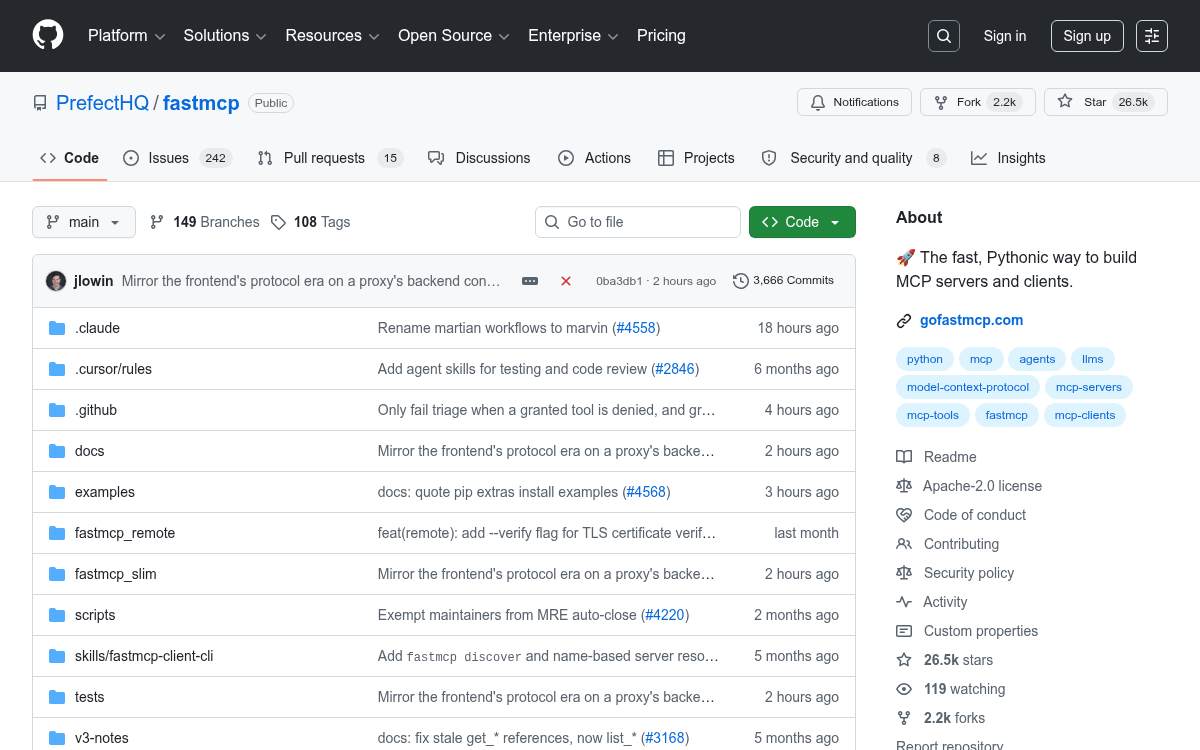
FastMCP, the Python framework powering the majority of the MCP ecosystem, just shipped its largest release. Prefect's Jeremiah Lowin announced FastMCP 3.0 as a complete architectural redesign: a rethinking of how MCP servers are built, not a feature drop. The release also moves the project from the personal jlowin/fastmcp repo to PrefectHQ/fastmcp, making it an officially Prefect-backed product.
What FastMCP already was
FastMCP 1.0 proved the concept so well that Anthropic made it the foundation of the official MCP Python SDK. FastMCP 2.0 introduced the infrastructure needed to build a real server ecosystem, arriving alongside the MCP hype wave. Today, FastMCP is downloaded a million times a day, with some version of it powering 70% of all MCP servers.
As the framework grew, v2 became reactive: new infrastructure bolted on to match demand, features hacked in so developers wouldn't have to build them themselves. The result was a collection of independent subsystems, each with its own code, its own mental model, and its own edge cases.
One architecture for everything
FastMCP 3 is built around a single question: what if all of these features are just different combinations of the same primitives? The answer is a three-concept architecture:
- Components are the atoms: tools, resources, prompts. What clients actually interact with.
- Providers answer "where do components come from?" A provider is anything that can list components and retrieve them by name. Your decorated functions are a provider. A directory of files is a provider. A remote MCP server is a provider. An OpenAPI spec is a provider. A FastMCP server is itself a provider, which means you can nest servers inside servers, indefinitely.
- Transforms are middleware for the component pipeline. They intercept the flow of components from providers to clients and can modify what passes through. Rename a tool, add a namespace prefix, filter by version, hide components by tag: these are all transforms. Transforms compose by stacking, each one processing the output of the previous.
The practical payoff: FastMCP 3 ships more features with less code, and you can combine features in ways the team never anticipated. Want to proxy a remote server, filter its tools by tag, rename them, and expose them only to authenticated users? That's a Provider, three Transforms, and some auth middleware. Each piece is independent and testable.
Five built-in providers
FastMCP 3 ships five built-in providers covering the most common patterns:
- LocalProvider delivers the classic
@mcp.tooldecorator experience, now reusable across multiple servers. - FileSystemProvider discovers tools from directories with hot-reload, removing the coupling between tool files and the server instance.
- OpenAPIProvider wraps REST APIs. Previously one of FastMCP 2's most popular but most abused features, it now composes cleanly with ToolTransforms so you can curate the output rather than blindly exposing every endpoint.
- ProxyProvider proxies remote MCP servers, letting you expose another server's components as if they were local.
- SkillsProvider delivers agent skills as resources, exposing the instruction files used by Claude Code, Cursor, and Copilot over MCP so any client can discover and download them.
You can write your own by subclassing Provider. A database, a Kubernetes cluster, a custom API: anything that can list and retrieve components qualifies.
New capabilities in 3.0
Beyond the architecture, 3.0 ships a substantial set of new features:
- Per-component authorization: granular authorization on individual components, async auth checks that can hit databases or external services, and server-wide policies via AuthMiddleware.
- Component versioning: serve multiple versions of a tool side-by-side using
@tool(version="1.0"). FastMCP automatically exposes the highest version to clients while preserving older versions for legacy compatibility. - Session-scoped state: state persists across tool calls within a session via
ctx.get_state()/ctx.set_state(), with pluggable backends including Redis for distributed deployments. - OpenTelemetry tracing: native tracing with MCP semantic conventions, so every tool call and resource read is traced with standardized attributes out of the box.
- Background tasks: long-running operations via Docket integration, backed by SQLite or Postgres, with horizontal scaling support.
- Tool timeouts:
@mcp.tool(timeout=30.0)limits foreground execution time, returning MCP error code-32000on breach. - ResourcesAsTools / PromptsAsTools transforms: expose non-tool components to tool-only clients, keeping servers rich while staying compatible with limited MCP hosts.
The CLI also got a significant upgrade. fastmcp list and fastmcp call let you query and invoke tools on any MCP server from your terminal. fastmcp discover scans your editor configs (Claude Desktop, Cursor, Goose, Gemini CLI) and finds all configured servers by name. fastmcp generate-cli reads a server's schemas and writes a standalone typed CLI where every tool becomes a subcommand with flags and help text. fastmcp install registers your server with Claude Desktop, Cursor, or Goose in one command.
Daily-use improvements
Three quality-of-life changes worth knowing:
- Decorators return functions. In v2,
@mcp.toolreplaced your function with a tool object. In v3, your function stays callable, so you can invoke it directly in tests without spinning up a server. - Hot reload.
fastmcp run server.py --reloadwatches files and restarts automatically.fastmcp devincludes it by default. - Automatic threadpool. Synchronous tools now run in a threadpool automatically. Three concurrent calls to a 10-second blocking function take roughly 10 seconds total, not 30.
The surface API is deliberately unchanged. A minimal FastMCP 3 server looks identical to before:
from fastmcp import FastMCP
mcp = FastMCP("Demo")
@mcp.tool
def add(a: int, b: int) -> int:
    """Add two numbers"""
    return a + b
if __name__ == "__main__":
    mcp.run()
And here's the new Provider and Transform composition in action:
from fastmcp import FastMCP
from fastmcp.server.providers import FileSystemProvider
from fastmcp.server.transforms import Namespace
provider = FileSystemProvider("./tools/", reload=True)
provider.add_transform(Namespace("myapi"))
mcp = FastMCP("server", providers=[provider])
Upgrading from v2
The @mcp.tool() decorator still works exactly as before. What changed is everything underneath. The team published three upgrade guides for users coming from FastMCP 2, from the MCP Python SDK, and from the low-level SDK, each with a copyable LLM prompt to help automate migration.
The main breaking changes to watch for:
- State methods are now async:
await ctx.get_state()instead ofctx.get_state() - Auth providers require explicit configuration (no more auto-loading from env vars)
- The
enabledparameter on components is removed; usemcp.enable()/mcp.disable()instead - If
import fastmcpfails after apipupgrade from 3.2 or earlier, runpip install --force-reinstall fastmcp(uv is unaffected)
The enterprise layer: Prefect Horizon
FastMCP 3.0 is free and open-source under Apache 2.0. For teams running it in production, Prefect is also shipping Prefect Horizon, an enterprise MCP gateway built on top of FastMCP. It covers:
- Deploying FastMCP servers from GitHub with branch previews and instant rollback
- A private registry of every MCP your company uses
- SSO and tool-level RBAC
- Audit logs, observability, and governance across your MCP stack
- Remixing approved tools into purpose-built endpoints for teams and agents
FastMCP 3.0 is available now on PyPI via uv pip install fastmcp or pip install fastmcp. The latest patch is v3.4.4, which restores HTTP deployment compatibility after a security hardening change in 3.4.3 altered default behavior for ASGI and reverse-proxy deployments, and adds Hugging Face OAuth provider support. Full documentation is at gofastmcp.com.