
OpenAI and Cisco's Shirudo Shields Linux Systems From Exploits Without Downtime
OpenAI and Cisco just open-sourced Shirudo, a Linux runtime that lets AI agents write eBPF shields to block exploits without restarting services.
Takeaways
- OpenAI and Cisco open-sourced Shirudo, a Linux runtime for live exploit mitigation via eBPF.
- AI agents generate eBPF shields that block vulnerable code paths without restarting services.
- In testing, a Codex-written shield stopped a Java4Shell exploit against a running Elasticsearch process.
- Shields are cryptographically signed, verified by the eBPF verifier, and attested via TPM hardware.
- Licensed BSD 2-Clause with BPF programs dual-licensed BSD/GPL; VM quickstart available.
- Positioned as a stopgap between CVE disclosure and permanent patch rollout, not a replacement for patching.
OpenAI and Cisco have released Shirudo, an open-source security runtime that lets AI agents generate targeted eBPF protections for running Linux systems. Human operators review and approve each protection before it is signed and loaded, allowing vulnerable services to remain online while teams test and deploy a permanent patch.
The runtime targets the patch gap between a vulnerability disclosure and a completed rollout. During that period, teams often face exploit attempts against production systems while they validate application behavior, compatibility, and rollback plans.
A shield between disclosure and patch
Shirudo calls each temporary protection a shield. A shield blocks the observable input, syscall pattern, or code path associated with an exploit while preserving legitimate traffic that uses the same service.
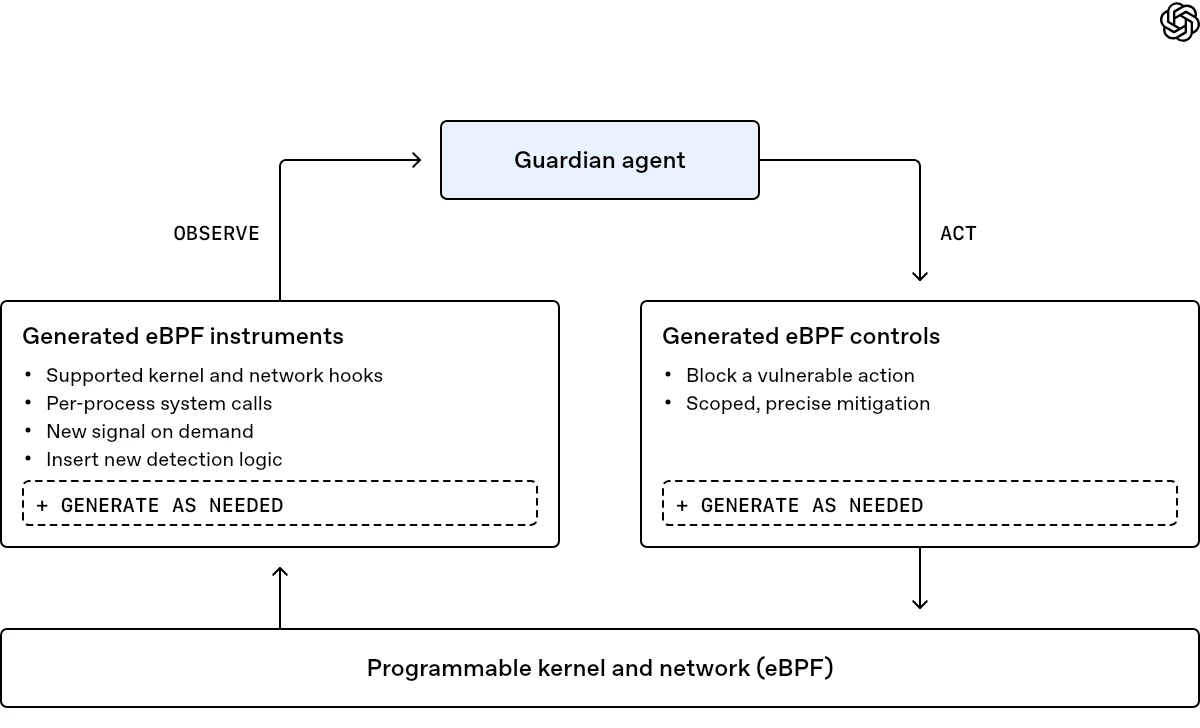
- Investigate: A guardian agent uses eBPF instruments to inspect relevant kernel, process, and network activity.
- Generate: The agent writes a small eBPF program tailored to the vulnerability and affected workload.
- Validate: Operators run the proposed shield in observe-only mode to measure matches and identify false positives.
- Approve: A human reviews the code and its observed effect before enforcement.
- Deploy: Shirudo signs, verifies, and loads the shield into the running system without restarting the protected service.
- Audit and remove: Operators track which protections are active and remove them after the permanent fix reaches production.
OpenAI and Cisco demonstrated the approach with Java4Shell, a Log4Shell-style vulnerability in which crafted input can trigger dangerous behavior in a Java service. Codex generated a shield that added an input check at Java’s Base64 decoder and attached it to a running Elasticsearch process. In the controlled test, the shield rejected the exploit attempt while Elasticsearch continued serving traffic without a restart.
How a shield reaches the kernel
Linux’s extended Berkeley Packet Filter, or eBPF, allows small programs to run at approved hooks in the kernel and around application processes. Security tools use those hooks to observe events and enforce narrow controls without building or loading a conventional kernel module.
| Component | Role | Safety boundary |
|---|---|---|
| Guardian agent | Investigates activity and proposes a vulnerability-specific shield. | Deployment requires human approval. |
| eBPF instruments | Collect kernel, process, and network signals from the affected workload. | Observation can run before enforcement. |
| eBPF controls | Reject behavior that matches the exploit path. | The Linux verifier checks program safety before loading. |
| Signing chain | Establishes the origin and integrity of each shield. | Hosts verify signatures before deployment. |
| Trusted Platform Module | Supports attestable records of protections being loaded or removed. | Operators can verify the state reported by each host. |
The limits of an eBPF shield
Temporary shields work best when an exploit has a stable signal that available eBPF hooks can observe, such as a distinctive input pattern or syscall sequence. Ambiguous triggers increase the risk of blocking valid requests, while vulnerabilities confined to inaccessible application logic may offer no practical enforcement point.
The kernel’s eBPF verifier checks memory access, execution bounds, and other structural safety properties. It cannot determine whether a valid program expresses the intended security policy. A verifier-approved shield can still reject legitimate traffic, miss an exploit variant, or add unacceptable overhead, which makes observe-only testing and human review central to the deployment process.
Production evaluations need workload-specific evidence beyond the controlled Java4Shell demonstration. Teams should verify:
- Linux kernel compatibility and the availability of required eBPF hooks
- False-positive and false-negative rates against representative traffic
- CPU, memory, and latency overhead under peak load
- Rollback behavior if a shield disrupts the application
- Signing-key ownership, revocation procedures, and TPM availability
- Removal of temporary controls after the permanent patch is deployed
Test it without touching production
The source code is available under the BSD 2-Clause license. Its BPF programs are dual-licensed under BSD and GPL so they can load into the mainline Linux kernel under its licensing rules.
The documented VM quickstart covers signing, loading, and verifying a test protection in an isolated environment. Cisco’s Isovalent team, which develops Cilium and contributed to Shirudo’s technical design, also published a hands-on lab.
When shields travel with CVEs
Publishing tested, signed shields alongside vulnerability disclosures could give operations teams a reusable mitigation during patch rollout. Each organization would still validate the shield against its own workload, but a shared artifact could reduce the need for teams to create separate WAF rules, process filters, or kernel controls after every disclosure.
That distribution model requires trusted publishers, signature revocation, kernel compatibility data, clear ownership of generated code, and reliable expiration policies. Shirudo currently provides an open implementation and a controlled proof of concept; OpenAI and Cisco describe automated identification, validation, and fleet-wide deployment as longer-term goals.
