
Polymathic AI Drops 15TB Open-Source Physics Dataset to Train Smarter AI Simulators
PolymathicAI releases 15TB of physics simulation data across 16 domains, giving neural PDE researchers a serious benchmark to work with
 Pro
Takeaways
- 15TB dataset: 16 physics simulation datasets spanning fluid dynamics, astrophysics, acoustics, and more, released by Polymathic AI at NeurIPS 2024.
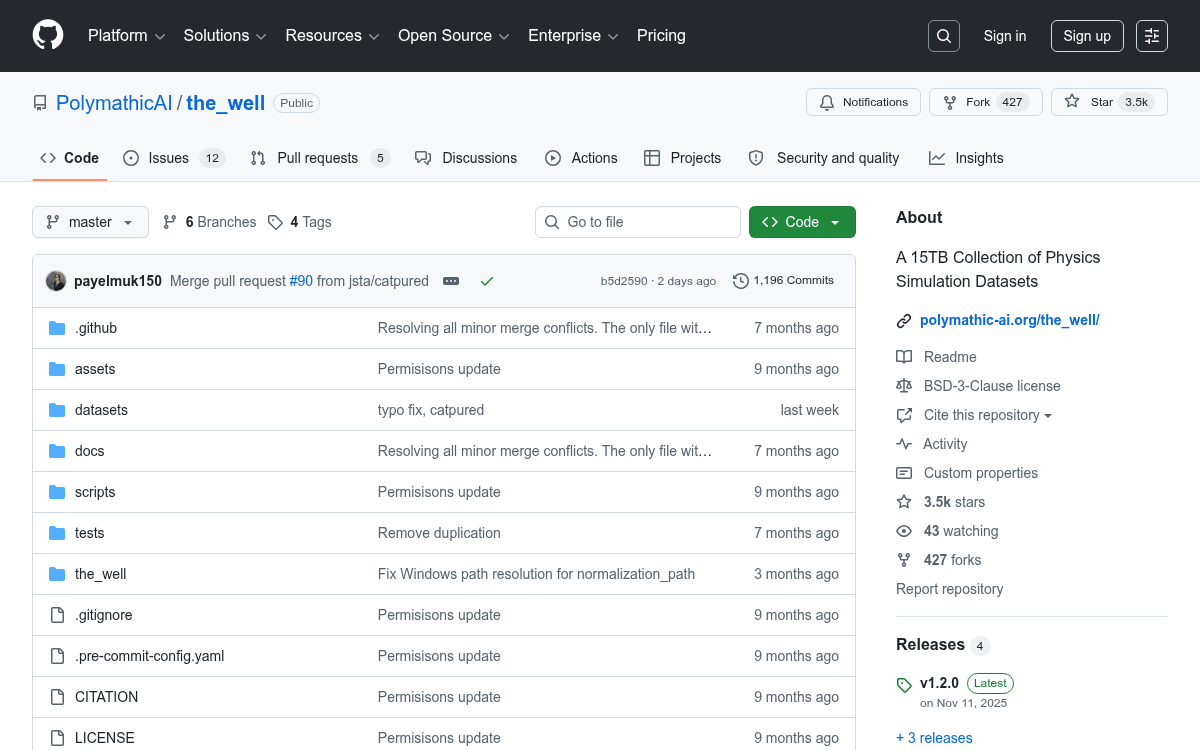
- Free and open: BSD-3 licensed, available via GitHub and Hugging Face, installable with
pip install the_well. - Unified PyTorch interface: Standard DataLoader-compatible API with HuggingFace streaming or local download via CLI.
- Built-in benchmark: Includes FNO, TFNO, U-Net, and CNextU-Net baselines with pre-trained checkpoints on HuggingFace.
- Gaining traction: Already used as the evaluation suite for new architectures like PhysiX and KANO neural operators.
- Limitation: Uniform grids only, fixed resolutions, and 3D datasets require significant compute and disk space (up to 5.1TB per dataset).
The Well is a 15TB open-source collection of physics simulation datasets built specifically for training and benchmarking machine learning surrogate models. Produced by Polymathic AI in collaboration with researchers from the Flatiron Institute, NYU, Princeton, Cambridge, Los Alamos National Laboratory, and eight other institutions, it was published at NeurIPS 2024 and has since become a go-to benchmark in the neural PDE space.
The gap it fills
ML-based surrogate models offer powerful tools for accelerating simulation-based workflows, but standard datasets in this space often cover small classes of physical behavior, making it difficult to evaluate the efficacy of new approaches. The Well is a direct answer to that. Before it, researchers building neural operators or PDE surrogates had to either generate their own data from scratch or work with narrow single-physics benchmarks that couldn't tell you how well a model generalizes.
Modern machine learning relies on massive, curated, and diverse datasets. Natural language processing is built on internet-scale datasets, while vision models have grown to utilize sets containing billions of text-image pairs. Physics ML has been lagging behind that curve. The Well is an attempt to close that gap.
What's inside
The Well draws from domain experts and numerical software developers to provide 15TB of data across 16 datasets covering diverse domains such as biological systems, fluid dynamics, acoustic scattering, as well as magneto-hydrodynamic simulations of extra-galactic fluids or supernova explosions. Individual datasets range from 6.9GB to 5.1TB.
The breadth is genuinely unusual. Here's a sample of what's included:
- Fluid dynamics: Rayleigh-Bénard convection, Rayleigh-Taylor instability, shear flow, turbulent radiative layers (2D and 3D)
- Astrophysics: Supernova explosions (64³ and 128³), post-neutron-star merger, convective envelope of red supergiant stars, magneto-hydrodynamics (MHD at 64³ and 256³)
- Wave physics: Acoustic scattering with discontinuous media, inclusions, and maze geometries; Helmholtz staircase
- Reaction-diffusion: Gray-Scott system with 1,200 trajectories and 1,001 time steps each
- Planetary science: Shallow-water equations on a sphere (
planetswe) - Biology: Active matter simulations
- Viscoelastic flows: Polymer instability at high Weissenberg number
The collection spans diverse regimes, from linear wave propagation and reaction-diffusion to turbulent hydrodynamics, radiative cooling, and relativistic magnetohydrodynamics. Each dataset is stored in HDF5 format with consistent metadata in YAML, standardized coordinate systems, and field normalization conventions.
How the data was built
Every dataset was generated by domain scientists using production-grade simulation codes: Dedalus, Athena++, ASURA-FDPS, Clawpack, and others. The computational cost is staggering. The MHD_256 dataset alone required 48 hours on 64 CPU cores. The turbulence-gravity-cooling dataset took 577 hours across 1,040 cores. The Euler multi-quadrant dataset consumed roughly 80 hours on 160 cores to generate all 10,000 trajectories.
Arrays follow a unified shape of (n_traj, n_steps, H, W, [D]), where n_traj denotes trajectories, n_steps the temporal dimension, and D an optional third spatial axis. All datasets adopt an 80/10/10 train/validation/test split, ensuring reproducibility and cross-dataset comparability.
Getting started
The package is on PyPI and works with standard PyTorch DataLoaders. You can stream directly from Hugging Face or download locally for training:
pip install the_well
from the_well.data import WellDataset
from torch.utils.data import DataLoader
# Stream from HuggingFace
trainset = WellDataset(
    well_base_path="hf://datasets/polymathic-ai/",
    well_dataset_name="active_matter",
    well_split_name="train",
)
train_loader = DataLoader(trainset)
# Or download a specific split locally
# the-well-download --base-path ./data --dataset rayleigh_benard --split train
Downloading individual datasets is selective, so you don't need to pull all 15TB at once. The the-well-download CLI lets you grab just the dataset and split you need.
The benchmark and its baselines
To showcase the dataset, the team provides simple baselines time-boxed to 12 hours on a single NVIDIA H100. These baselines are trained on the forward problem: predicting the next snapshot of a simulation from a short history of 4 time steps. The models used are FNO, Tucker-Factorized FNO (TFNO), U-Net, and a modernized U-Net using ConvNext blocks.
The FNO and U-Net variants, scaled uniformly to approximately 15-20 million parameters, form part of the baseline evaluations. Results underline the diverse challenges posed by the data, showcasing performance discrepancies across spectral and spatial model architectures that highlight the increasing demand for tailored approaches in complex physics simulations.
The authors are explicit that these baselines aren't meant to impress. The models benchmarked in the original paper were designed as simple baselines and should not be considered state-of-the-art. The hope is that the community will build upon these results to develop better architectures for PDE surrogate modeling. Pre-trained checkpoints for all baseline models are available on Hugging Face and can be loaded in a single line:
from the_well.benchmark.models import FNO
model = FNO.from_pretrained("polymathic-ai/FNO-active_matter")
What it's already powering
The Well has quickly become a standard evaluation suite for new neural operator architectures. Recent papers benchmarking against it include PhysiX (a foundation model for physics simulations), KANO (Kolmogorov-Arnold Neural Operators), and work on test-time generalization via operator splitting. PhysiX, for example, trains and evaluates across eight simulation tasks from the Well benchmark, reporting Variance-Weighted Root Mean Squared Error (VRMSE) averaged over all physical channels for each dataset.
By closing the gap between high-fidelity scientific simulations and the limitations of existing ML datasets, the Well fosters the development of models that can generalize across diverse physical systems and scales. That's the real value proposition: not any single dataset, but a shared evaluation surface that makes cross-paper comparisons meaningful for the first time in this space.
Limitations worth knowing
A few practical constraints to keep in mind before diving in:
- Disk space: Even selective downloads are large. The MHD_256 dataset alone is 4.58TB.
- Uniform grids only: All data is provided on structured, uniform grids. If your work involves unstructured meshes or adaptive refinement, you'll need to handle that yourself.
- Fixed resolutions: Each dataset has a fixed spatial resolution. There's no multi-resolution variant built in, which matters for resolution-generalization experiments.
- No real-world data: Everything is simulation-derived. Transfer to real experimental measurements is an open research question.
- 3D datasets are compute-heavy: Training on the 3D turbulence or MHD datasets requires serious GPU resources.
The Well is free, BSD-3 licensed, and available now on GitHub and Hugging Face. If you're working on neural operators, PDE surrogates, or physics foundation models, this is the benchmark your paper should be evaluated on.