
NVIDIA's GPU Operator Brings Pod-Level Visibility to Kubernetes GPU Clusters
NVIDIA GPU Operator v26.3.2 brings Kubernetes 1.36 support, richer GPU metrics with pod-level labels, and a new NRI plugin that simplifies GPU injection across non-standard Kubernetes distributions.
 Pro
Takeaways
- v26.3.2 released: Latest GPU Operator adds Kubernetes 1.36 support and pod-level GPU metric labels via DCGM Exporter.
- Pod metadata in metrics: New
enablePodLabelsandenablePodUIDfields let Prometheus track GPU usage per pod without manual RBAC setup. - NRI Plugin support: CRI-O v1.34+ now supported via the Node Resource Interface, removing the need to modify container runtime config files.
- Driver recovery in seconds: v26.3.0 introduced kernel module reuse on driver container restart, cutting recovery time from minutes to seconds.
- Blackwell & RHEL 10: v26.3.0 added support for GB200 NVL4, RTX Pro 4500 Blackwell, K3s, and RHEL 10.0/10.1.
- Free & open source: Install via Helm from GitHub; Apache 2.0 licensed operator, NVIDIA terms apply to bundled images.
Running GPUs on Kubernetes has never been simple. Before tools like the GPU Operator existed, every node needed manual driver installs, custom container runtime configs, and hand-crafted device plugin setups. One bad kernel update and your entire GPU fleet could go dark. NVIDIA's GPU Operator was built to solve exactly that, and its latest release, v26.3.2, continues pushing that vision forward with better observability, broader platform support, and a smarter way to inject GPUs into containers.
What the GPU Operator Actually Does
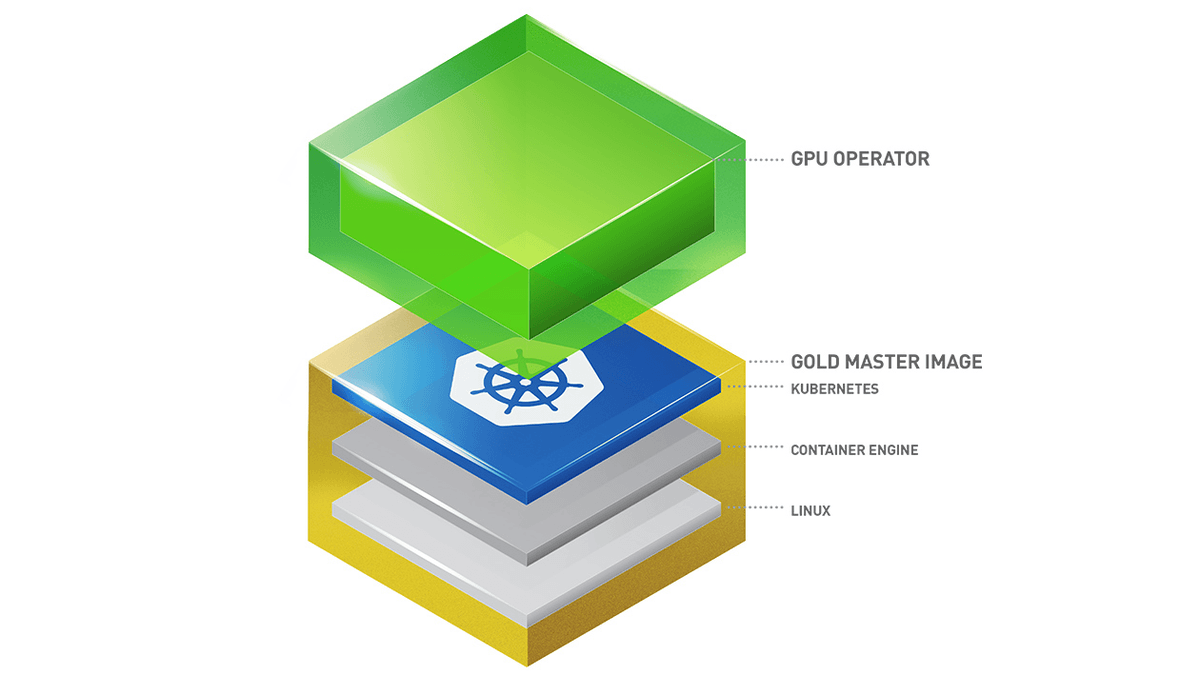
Kubernetes provides access to special hardware resources like NVIDIA GPUs through the device plugin framework, but configuring and managing nodes with these hardware resources requires configuration of multiple software components such as drivers, container runtimes, and other libraries, which are difficult and prone to errors. The NVIDIA GPU Operator uses the operator framework within Kubernetes to automate the management of all NVIDIA software components needed to provision GPUs.
The components it manages include:
- NVIDIA drivers (to enable CUDA)
- The Kubernetes device plugin for GPU resource scheduling
- The NVIDIA Container Toolkit (runtime hooks)
- Automatic node labeling using GPU Feature Discovery (GFD)
- DCGM-based GPU monitoring and metrics export
- MIG (Multi-Instance GPU) manager for partitioning large GPUs
The GPU Operator allows administrators of Kubernetes clusters to manage GPU nodes just like CPU nodes. Instead of provisioning a special OS image for GPU nodes, administrators can rely on a standard OS image for both CPU and GPU nodes and then rely on the GPU Operator to provision the required software components for GPUs.
What's New in v26.3.2
Version 26.3.2 adds support for Kubernetes 1.36 , keeping the Operator current with the latest upstream Kubernetes releases. The headline feature for platform teams is a significant upgrade to GPU metrics observability.
The release adds support for including Kubernetes pod metadata in DCGM Exporter GPU metrics, configurable through new fields under spec.dcgmExporter in the ClusterPolicy custom resource. The enablePodLabels field adds pod labels as Prometheus label dimensions on the GPU metrics, and enablePodUID adds the pod UID as a Prometheus label dimension.
In practice, this means your Prometheus dashboards can now answer questions like "which specific pod is consuming the most GPU memory?" without having to cross-reference separate data sources.
When either field is set to true, the GPU Operator automatically provisions a cluster-scoped ClusterRole and ClusterRoleBinding that grants the DCGM Exporter service account get, list, and watch access to pods across the cluster, removing the need to manually set environment variables or hand-create RBAC resources for the DCGM Exporter service account.
One important caveat for large clusters:
it is recommended to configure the podLabelAllowlistRegex field (a list of regular expressions) to limit which pod labels are emitted as Prometheus dimensions, in order to reduce Prometheus cardinality.
If your pods carry dozens of labels, emitting all of them as metric dimensions will explode your Prometheus storage.
The release also adds
support for setting custom annotations on the DCGM Exporter DaemonSet through the new spec.dcgmExporter.annotations field in the ClusterPolicy custom resource.
The NRI Plugin: A Quieter but Important Change
Version 26.3.2 adds support for the Node Resource Interface (NRI) Plugin with CRI-O v1.34 or later. The NRI plugin (Node Resource Interface) is a standard interface for container runtimes that lets plugins hook into container lifecycle events without modifying the runtime's own configuration files.
This matters because the traditional approach to GPU injection required modifying containerd's config.toml or CRI-O's config directly.
NVIDIA GPU Operator v26.3.x recommends using the Node Resource Interface (NRI) specification, which simplifies operations: no extra environment variables need to be passed and it does not require changing containerd configuration.
This is particularly valuable for distributions like k3s, k0s, and RKE2 that configure containerd in non-standard ways.
What Came in v26.3.0 (The Foundation)
The 26.3.x series started with a major v26.3.0 drop that introduced several architectural improvements worth knowing about. The biggest reliability fix: NVIDIA improved driver resiliency when the driver container is removed. In previous versions, the NVIDIA Driver would unload the kernel modules and perform the driver compilation process, which could take several minutes to complete. In v26.3.0, if there is no change to the CUDA driver version in the ClusterPolicy, the NVIDIA Driver will reuse the kernel modules that are available on the node, reducing the time to recover from driver container removal from minutes to seconds.
Other notable additions in v26.3.0:
- Added support for dynamic MIG config generation. By default, the MIG Manager will automatically generate a per-node ConfigMap with the default MIG profiles for the available GPUs on the node, replacing the previous static ConfigMap.
- Added support for the NVIDIA Driver Custom Resource Definition (CRD), enabling multiple driver types and versions on different nodes or multiple operating system versions on nodes.
- Added support for KubeVirt with GPU passthrough on Ubuntu 24.04 LTS.
- Added support for K3s.
- Added support for new operating systems including Rocky Linux 9.7, Red Hat Enterprise Linux 10.0 and 10.1, and Red Hat Enterprise Linux 9.7.
- Added support for NVIDIA GB200 NVL4 and NVIDIA RTX Pro 4500 Blackwell Server Edition.
Known Limitations to Watch
No release is perfect. A few things to be aware of before upgrading:
-
Pod specifications that set
spec.hostUsers: falseto enable Kubernetes user namespaces are not supported. As a workaround, omit thehostUsersfield or setspec.hostUsers: truefor any pods that request GPUs. -
When GPUDirect RDMA is enabled, the
nvidia-peermemcontainer may fail to restart after the driver pod restarts without a node reboot and without any driver configuration changes. The workaround is settingFORCE_REINSTALL=truein the ClusterPolicy. - The new NVIDIADriver CRD feature does not support upgrades from earlier versions and is recommended for new installations only.
Getting Started
The current patch release is v26.3.2. Installing is a two-step Helm process:
# Step 1: Add the NVIDIA Helm repo
helm repo add nvidia https://helm.ngc.nvidia.com/nvidia \
    && helm repo update
# Step 2: Deploy the GPU Operator
helm install --wait --generate-name \
    -n gpu-operator --create-namespace \
    nvidia/gpu-operator \
    --version=v26.3.2
The Operator is free and open-source under the Apache 2.0 license, though the container images it deploys (drivers, toolkit, etc.) are subject to NVIDIA's product-specific terms. Full documentation, including platform support matrices and advanced configurations for EKS, AKS, GKE, and OpenShift, is available in the official docs.
If you're running GPU workloads at scale on Kubernetes, the 26.3.x series is a meaningful upgrade. The pod-level metric labels alone will save significant debugging time, and the NRI-based GPU injection path makes the Operator considerably less fragile on the growing number of lightweight Kubernetes distributions used in edge and on-prem deployments.