
NVIDIA Rebuilds NeMo Retriever to Ingest PDFs, Audio, and Video for RAG
NVIDIA rebrands its nv-ingest document extraction tool as NeMo Retriever Library, expanding scope to audio, video, and a cleaner Python API for multimodal RAG pipelines.
 Pro
Takeaways
- Renamed: NVIDIA's
nv-ingestdocument extraction tool is now officially called NeMo Retriever Library, with a new Python API. - Expanded scope: Now handles PDFs, DOCX, PPTX, HTML, audio, video, images, and more — not just PDFs.
- New extraction method: Nemotron Parse offers VLM-powered PDF parsing for complex layouts via
extract_method="nemotron_parse". - Chainable Python API: New lazy-execution
nemo_retrieverlibrary replaces oldnv-ingestAPIs with a cleaner.files().extract().embed().vdb_upload().ingest()pattern. - Modular NIM stack: Core NIMs ship by default; Nemotron Parse, Omni 30B captioner, and Parakeet ASR are opt-in to avoid pulling ~62 GiB of weights unintentionally.
- Open source, Apache 2.0: Latest stable release is 26.3.0; requires Python 3.12+ and NVIDIA GPUs for full pipeline mode.
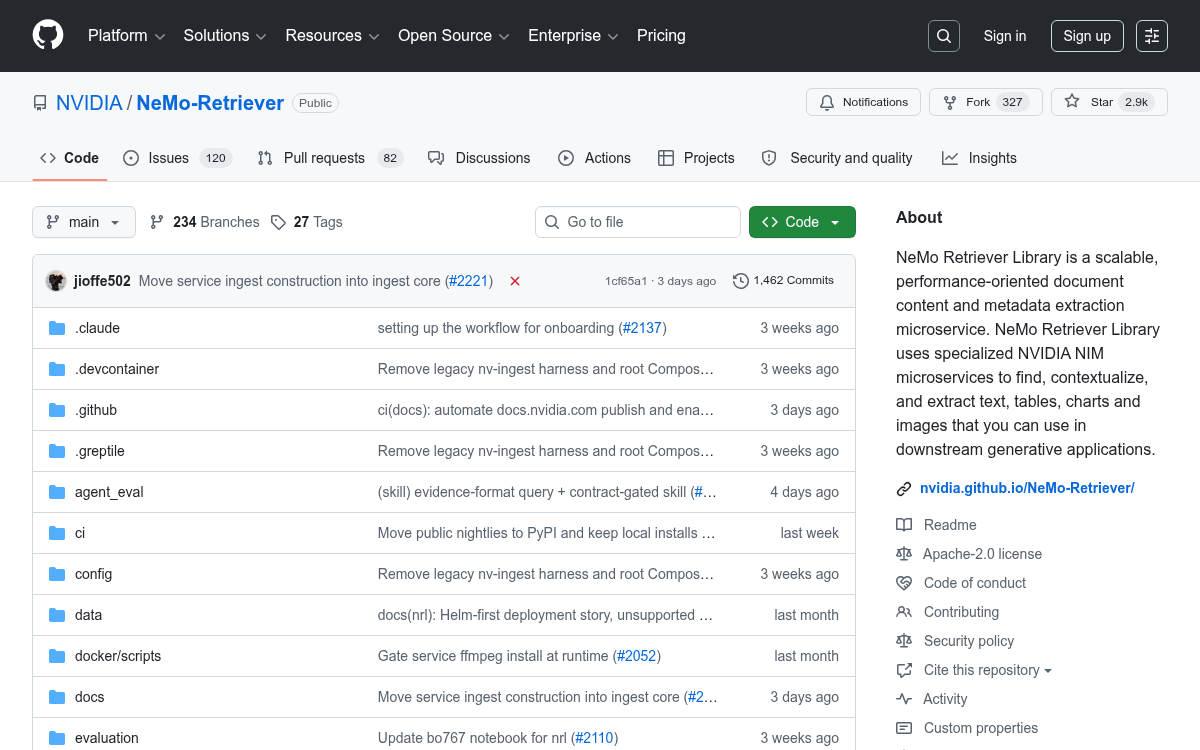
NVIDIA has consolidated and rebranded its document ingestion infrastructure under a new name: NeMo Retriever Library. What started as nv-ingest , a microservice for cracking open PDFs and pulling out structured content , has grown into a full multimodal extraction framework that handles everything from Word docs and PowerPoints to audio files and video. The rename reflects a meaningful expansion in both scope and API design.
NVIDIA Ingest (nv-ingest) has been renamed NeMo Retriever Library.
The old nv-ingest APIs are being phased out in favor of a cleaner nemo_retriever Python library, and the repo's README now points developers toward the new interface as the forward-looking path.
What it actually does
NVIDIA NeMo Retriever Library (NRL) is a high retrieval accuracy, performant, and scalable framework for content and metadata extraction from various media types , PDFs, HTML, Word docs, PowerPoint, audio, video, and image files. It supports both NVIDIA NIM microservices and a range of models to find, contextualize, and extract text, tables, charts, infographics, and transcripts for use in downstream generative and retrieval-augmented applications.
NeMo Retriever Library enables parallelization of splitting documents into pages where artifacts are classified , such as text, tables, charts, and infographics , extracted, and further contextualized through optical character recognition (OCR) into a well-defined JSON schema. From there, NeMo Retriever Library manages computation of embeddings for the extracted content and stores them in LanceDB.
A pipeline you can actually chain
The new nemo_retriever library ships a chainable Python API built around a lazy execution model , you define your pipeline steps, and nothing runs until you call .ingest(). Here's the basic pattern:
from nemo_retriever import create_ingestor
ingestor = create_ingestor(run_mode="batch")
ingestor = (
  ingestor.files(["report.pdf", "slides.pptx"])
  .extract(
    extract_text=True,
    extract_charts=True,
    extract_tables=True,
    extract_infographics=True
  )
  .embed()
  .vdb_upload()
)
dataset = ingestor.ingest()  # executes the full pipeline
The run_mode="batch" option uses Ray under the hood for distributed processing, returning a ray.data.Dataset. For smaller workloads, run_mode="inprocess" returns a plain pandas DataFrame.
The library builds a GPU-accelerated, multimodal RAG ingestion pipeline that parses PDFs, HTML, text, audio, and video into LanceDB vector embeddings, integrates with Nemotron RAG models (locally or via NIM endpoints), and includes Ray-based scaling with built-in recall evaluation.
What's new in the expanded scope
The rebranding isn't purely cosmetic. Several meaningful additions have landed across recent releases:
- Audio and video ingestion , The pipeline now parses audio and video , with the Parakeet ASR NIM available as an opt-in component for audio transcription.
- Nemotron Parse ,
PDFs can use pdfium or Nemotron Parse as an alternate extraction method
via
extract_method="nemotron_parse", which uses a vision-language model for higher-fidelity layout understanding on complex documents. - Llama Nemotron VLM captioning , Support was added for Llama Nemotron VLM 8B NIM for image captioning.
- Custom VDB and pipeline stages , Support was added for custom vector database implementations and custom Lambda stages , letting teams plug in their own storage backends or processing logic.
- MIG and time-slicing support , The Helm deployment now supports Multi-Instance GPU (MIG) configurations, allowing a single physical GPU to be partitioned across multiple pipeline workers.
- Multimodal embeddings ,
New documentation covers multimodal embedding
via the
llama-3.2-nemoretriever-1b-vlm-embed-v1model, which embeds images and text into the same vector space for cross-modal retrieval.
Deployment: library vs. microservice
There are two ways to run NeMo Retriever Library, and the choice matters for your scale:
- Library mode , Install
pip install nemo-retrieverand run everything in-process or via Ray on local GPUs. Best for workloads under ~100 PDFs or for development and evaluation. - Microservice / Helm mode , Deploy the full pipeline on Kubernetes using the provided Helm charts.
A plain
helm installreconciles the four core NIMs , page_elements, table_structure, OCR, and VLM embed , with every other NIM (the VL reranker, Nemotron Parse, Omni 30B, and the Parakeet audio ASR NIM) disabled by default. This avoids pulling large model weights unless you explicitly opt in.
The library integrates with LangChain, LlamaIndex, and Haystack out of the box, and NVIDIA maintains full documentation covering deployment options, benchmarking, and the API reference.
Where it fits , and where it doesn't
Nemotron Retriever models deliver fast, accurate document understanding by extracting multimodal structured information, generating high-quality embeddings, and rank-ordering the most relevant documents. They provide scalable, high-speed retrieval that enhances data quality for LLM training, boosts agent and retriever performance, and streamlines document workflows.
The library is a strong fit for enterprise RAG pipelines that need to ingest messy, real-world documents , financial reports with embedded charts, technical manuals with complex tables, or meeting recordings that need to be searchable. It is less suited for simple text-only ingestion where lighter tools like LangChain's document loaders or Unstructured.io would add less operational overhead. Running the full NIM stack requires NVIDIA GPUs, and the Omni 30B captioning model alone demands significant VRAM , worth checking the support matrix before planning your deployment.
The repo is available now under the Apache 2.0 license, with the latest stable release being 26.3.0.
To use Nemotron Parse with PDFs, install the client dependencies with pip install "nemo-retriever[nemotron-parse]".
Python 3.12 or later is required.