
Google's Massive Open Research Monorepo Just Hit 38,000 Stars
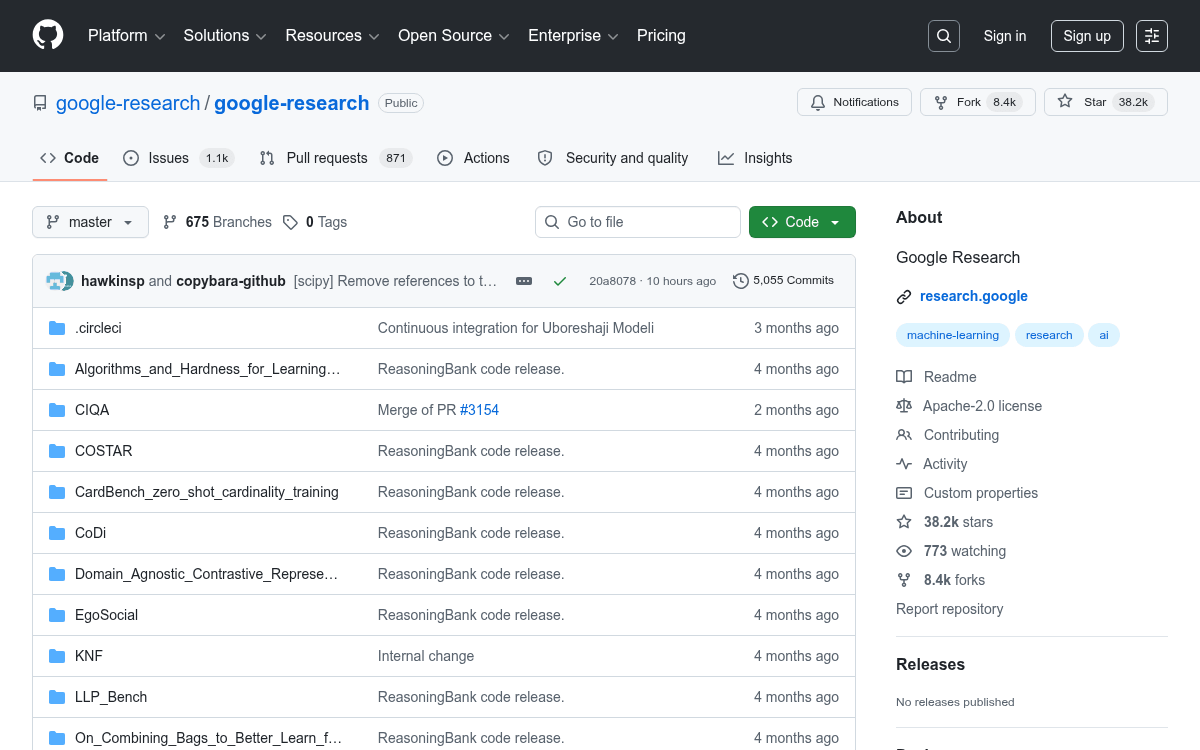
Google's sprawling research monorepo has quietly grown to 38k+ stars and thousands of project subfolders spanning nearly every corner of ML.
 Pro
Takeaways
- google-research/google-research is Google's public monorepo, now past 38k stars and 8.4k forks.
- Hundreds of paper-accompanying projects including ALBERT, AutoML-Zero, ZipNeRF, Charformer, CoDi, and BBF.
- Language mix is roughly 48% Jupyter Notebook and 45% Python with 5,000+ commits on master.
- Datasets released under CC BY 4.0, code under Apache 2.0, with over 1,000 open issues.
- Maintainers recommend downloading single subdirectories via github.dev instead of cloning the full repo.
- Larger active projects like TimesFM and Kauldron live in separate repos under the same org.
If you have ever chased down a Google paper and wondered where the reference code went, there is a decent chance it landed in one enormous shared repository. google-research/google-research is the catch-all monorepo where research teams across Google drop the code that accompanies their publications, and it has now crossed 38,000 stars with more than 8,400 forks.
The repo is not a single project. It is closer to a public shelf where hundreds of independent research folders sit side by side, each with its own README, dependencies, and reproduction scripts. It contains code released by Google Research, with datasets released under CC BY 4.0 and source files released under Apache 2.0.
What actually lives inside
Browsing the top-level directory listing feels like scrolling a conference proceedings. A quick sample of the folders currently checked in:
albert- the lite BERT variant that once held SOTA on GLUE and SQuADautoml_zero- evolving ML algorithms from scratch using only basic math opscamp_zipnerf- anti-aliased neural radiance fields for 3D scene reconstructionautoregressive_diffusion- hybrid diffusion models that generate tokens in learned orderscharformer- a Transformer that learns its own subword tokenization end to endbigger_better_faster- the BBF agent that hit human-level Atari with far fewer samplesandroid_in_the_wildandandroid_control- datasets for training UI-navigating agentsCardBench_zero_shot_cardinality_training- learned cardinality estimation for databasesKNF- Koopman Neural Forecaster for non-stationary time seriesCoDi- any-to-any composable diffusion across text, image, audio, and video
The language breakdown reflects that mix: roughly 48% Jupyter Notebook and 45% Python, with small pockets of C++, JavaScript, and Java for the projects that need them. Over 5,000 commits have landed on master across the repo's life.
Why the monorepo shape matters
Most companies fragment research code across dozens of one-off repos that go stale the moment the paper ships. Google's approach is the opposite: dump everything in one tree so that citations, issue tracking, and licensing stay consistent. The trade-off is a repository that is genuinely huge, which is why the maintainers explicitly warn against cloning the whole thing. They recommend downloading only the subdirectory of interest by switching the URL from github.com to github.dev and right-clicking the folder in the file panel to download it.
If you do need a working tree to submit a pull request, a shallow clone is the sane path:
git clone git@github.com:google-research/google-research.git --depth=1
cd google-research/albert   # or whichever project you want
What it is good for, and where it falls short
The repo shines as a reference implementation archive. If you are reproducing a Google paper, comparing against a published baseline, or pulling apart a technique like AutoML-Zero's evolutionary search or ZipNeRF's anti-aliased sampling, the original authors' code is usually the closest thing to ground truth you will find. Datasets that ship alongside code, like Android in the Wild for GUI agents or CardBench for query optimization, are also directly usable.
Where it falls short is production readiness. Each folder is essentially a research snapshot, often tied to a specific TensorFlow or JAX version, with minimal maintenance after the associated paper cycle ends. The repo currently carries over a thousand open issues, many of them dependency drift and reproduction questions that never got resolved. Treat the code as a scientific artifact, not a library you can pip install and forget.
The bigger picture
Not every Google research release lands here. Bigger, actively maintained projects tend to graduate into their own top-level repos under the google-research org, including TimesFM, a pretrained time-series foundation model for forecasting, along with Kauldron, WeatherBenchX, and the connectomics tooling. There is also a separate google-research-datasets org that hosts standalone datasets like Objectron and WIT.
Read together, the ecosystem is a reminder that a lot of the ideas showing up in today's frontier systems, from character-level Transformers to composable diffusion, have working code sitting in public folders that anyone can pull down and run. It is worth bookmarking, even if you only visit when a specific paper sends you there.