
Ant Group's LingBot-World Turns a Single Image Into a Playable Open-Source World
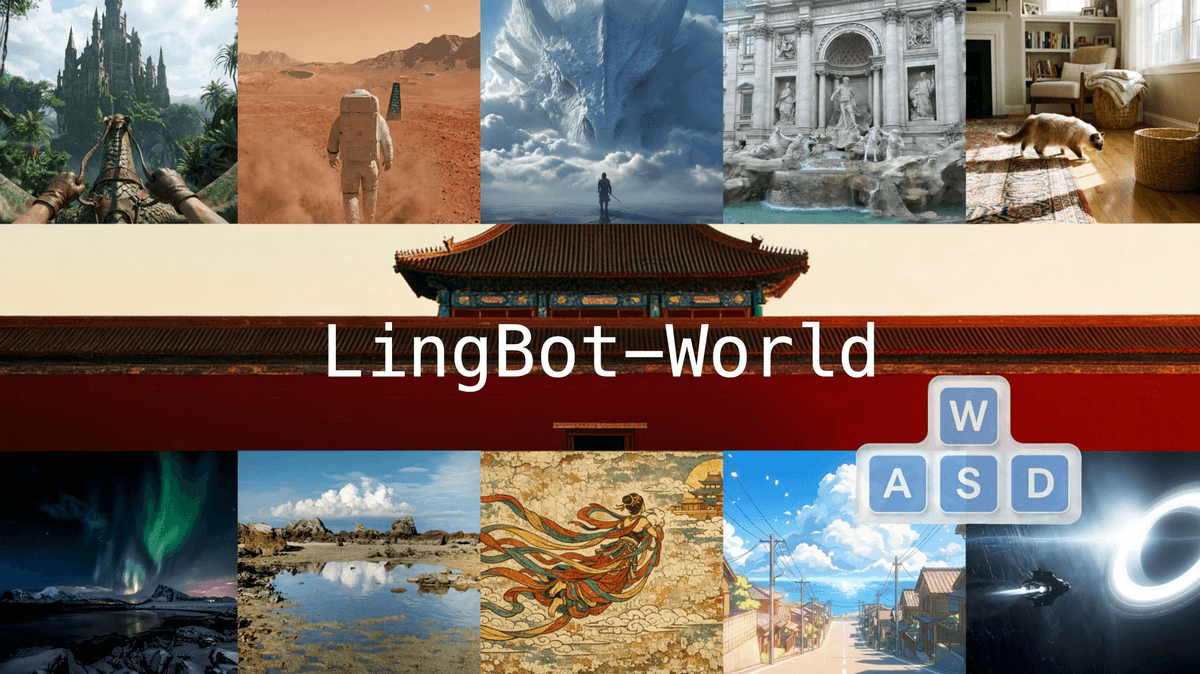
Robbyant's LingBot-World is a fully open-source interactive world simulator that generates controllable video environments in real time, with sub-second latency and up to 10 minutes of coherent generation.
 Pro
Takeaways
- Robbyant (Ant Group) open-sourced LingBot-World, a real-time interactive world simulator built on video generation with sub-1-second latency at 16 FPS.
- The model generates navigable environments from a single image, controlled by keyboard inputs (W/A/S/D) and camera poses, without pre-built 3D assets.
- A three-stage training pipeline evolves a 14B Wan2.2 base into a 28B MoE world model, then distills it into a fast causal autoregressive variant for streaming generation.
- LingBot-World outperforms Yume-1.5 and HY-World 1.5 on VBench benchmarks, scoring 0.8857 on dynamic degree versus 0.7612 and 0.7217 for competitors.
- Three model variants are available on HuggingFace: Base (Cam), Base (Act), and Fast; a 4-bit quantized version exists for limited GPU setups.
- Key limitations include high GPU requirements (8 GPUs recommended), scene drift over very long runs, and no support for fine-grained object interaction or multi-agent simulation.
LingBot-World, released by Robbyant, the embodied AI unit inside Ant Group, is an open-source world simulator that turns a single image into a navigable, interactive video environment. You press W to move forward, A to strafe left, and the model generates what comes next in real time. It is not a video player. It is closer to a game engine that runs entirely inside a neural network.
From passive video to interactive world
Most video generation models produce a fixed clip and stop. Most text-to-video models generate short clips that look realistic but behave like passive movies. They do not model how actions change the environment over time. LingBot-World is built differently. It is built as an action-conditioned world model that learns the transition dynamics of a virtual world, so that keyboard and mouse inputs, together with camera motion, drive the evolution of future frames.
The practical result: it supports real-time interactivity, achieving a latency of under 1 second when producing 16 frames per second. At that speed, it is fast enough to feel responsive. LingBot-World leads the industry in applicable scenarios, generation duration, dynamic content, and resolution.
The three things that make it different
LingBot-World maintains high fidelity and robust dynamics in a broad spectrum of environments, including realism, scientific contexts, cartoon styles, and beyond. It enables a minute-level horizon while preserving contextual consistency over time, which is also known as long-term memory. It supports real-time interactivity, achieving a latency of under 1 second when producing 16 frames per second.
The long-term memory property is the most technically interesting. One of the most interesting properties of LingBot-World is emergent memory. The model maintains global consistency without explicit 3D representations such as Gaussian splatting. When the camera moves away from a landmark such as Stonehenge and returns after about 60 seconds, the structure reappears with consistent geometry. When a car leaves the frame and later reenters, it appears at a physically plausible location, not frozen or reset. The world keeps running even when you are not looking at it.
The model also handles diverse visual styles without breaking. LingBot-World maintains quality across visual styles because of its training approach. The model learned from three data sources simultaneously: real-world video teaches physical world appearance and behavior, game recordings teach how humans interact with virtual environments, and Unreal Engine synthetic data covers extreme camera angles and movement patterns that are difficult to capture naturally.
How it was built: three stages of training
The team built LingBot-World through a progressive three-stage pipeline, starting from a 14B-parameter Wan2.2 image-to-video diffusion model as the foundation. The architecture uses a Mixture-of-Experts (MoE) design, where two 14B-parameter experts handle different phases of the diffusion process, giving a 28B total model size while keeping inference cost comparable to a single 14B model.
- Stage I (Pre-training): Establishes a general video prior for high-fidelity texture and scene generation across open-domain content.
- Stage II (Middle-training): Injects world knowledge by training on extended sequences up to 60 seconds, progressively building long-term memory and action controllability. Action signals are injected into the transformer blocks using adaptive layer normalization, with camera poses encoded as Plücker embeddings and keyboard inputs as multi-hot vectors.
- Stage III (Post-training): Converts the bidirectional diffusion model into a causal autoregressive system using block causal attention and KV caching, enabling streaming generation. Few-step distillation with adversarial training then compresses this into the fast, low-latency variant.
The data pipeline is equally deliberate. To address the scarcity of high-quality interactive data for world model training, LingBot-World adopts a hybrid data acquisition strategy combining real-world footage, game engine recordings with synchronized keyboard inputs, and synthetic Unreal Engine renders with precise camera trajectories. A hierarchical captioning system then annotates each clip with three layers of description: a global narrative, a static scene description, and dense time-aligned event captions, which helps the model learn to decouple camera motion from scene content.
The model lineup
Three model variants are available, each targeting a different use case:
| Model | Control Signals | Resolution | Best For |
|---|---|---|---|
| LingBot-World-Base (Cam) | Camera poses | 480P / 720P | High-quality offline generation |
| LingBot-World-Base (Act) | Keyboard actions (W/A/S/D) | 480P / 720P | Action-conditioned simulation |
| LingBot-World-Fast | Camera poses | 480P / 720P | Real-time interactive use |
The Fast variant uses KV caching to process video chunk-by-chunk instead of all at once, enabling streaming generation. For users with limited GPU memory, a community-contributed 4-bit quantized version of the Base model is also available on HuggingFace.
Getting started
The codebase is built on top of Wan2.2. Getting up and running requires cloning the repo, installing dependencies, and downloading model weights from HuggingFace. Inference is launched via torchrun across multiple GPUs. A basic generation command looks like this:
torchrun --nproc_per_node=8 generate.py \
  --task i2v-A14B \
  --size 480*832 \
  --ckpt_dir lingbot-world-base-cam \
  --image examples/00/image.jpg \
  --action_path examples/00 \
  --dit_fsdp --t5_fsdp \
  --ulysses_size 8 \
  --frame_num 161 \
  --prompt "A soaring journey through a fantasy jungle..."
The Act variant also accepts a human-readable action string, making it easy to script specific movement sequences without preparing pose files:
--action_string "w-10,a-10,d-10,iw-15,none-10,j-10,l-10,s-15"The model requires enterprise-grade GPUs for full resolution inference. Eight GPUs are recommended for the standard multi-GPU inference setup. Consumer hardware will experience significant limitations. Setting frame_num to 961 generates approximately one minute of video at 16 FPS.
Where it beats the competition
The team benchmarked LingBot-World against Yume-1.5 and HY-World 1.5 using VBench on 100 generated videos each longer than 30 seconds. LingBot-World scored 0.8857 on dynamic degree versus 0.7612 and 0.7217 for the two baselines, while also leading on imaging quality (0.6683) and aesthetic quality (0.5660). Temporal smoothness was competitive with the best baseline.
While systems like Genie 3 and Mirage 2 have made strides, they often compromise on dynamic degree or remain closed-source. LingBot-World distinguishes itself by offering a general domain capability, a long generation horizon, and a high dynamic degree in real-time, all while being fully open-source.
What it cannot do yet
The paper is candid about the gaps. The limitations section lists several open problems:
- Memory stability: Long-term consistency is emergent from the context window, not from an explicit memory module, so it degrades over very long runs.
- Drift: Scenes gradually lose their original structure as generation length increases, making truly infinite gameplay still out of reach.
- Action space: The model handles navigation and basic camera movement but lacks fine-grained object interaction, like picking up a specific item from a table.
- Hardware requirements: Running the full model requires enterprise-grade multi-GPU setups, which limits who can experiment with it.
- Single-agent only: Multi-agent simulation is not yet supported.
What this unlocks
Designed for embodied intelligence, autonomous driving, and game development, LingBot-World offers a high-fidelity, highly dynamic, and real-time controllable digital sandbox for simulation and training. The practical use cases are concrete:
- Robot learning: Generate diverse training environments from a single image without building physical setups or 3D assets.
- Autonomous driving: Simulate novel road scenarios with controllable camera trajectories for data augmentation.
- Game prototyping: Explore procedurally generated worlds driven by a text prompt and keyboard input.
- 3D reconstruction: The model's emergent spatial consistency makes it possible to extract point clouds from generated video, providing geometric data for downstream tasks.
- Action agent training: The team fine-tuned a Qwen3-VL-2B model on image-action pairs to predict exploration sequences, which then drive the world model, closing the loop between perception and action.
LingBot-World also demonstrates strong zero-shot generalization. With just a single real-world image or a game screenshot as input, LingBot-World can generate an interactive video stream without requiring additional scene-specific training or data collection, significantly lowering deployment and operational costs across diverse environments. The code, weights, and technical report are all publicly available under the Apache 2.0 license.