
Ant Group's LingBot-Vision Beats a 7B Model With Just 1B Parameters
Ant Group's Robbyant open-sourced a 1B-parameter ViT backbone that treats object boundaries as a pretraining signal, matching 7B DINOv3 on depth benchmarks.
 Pro
Takeaways
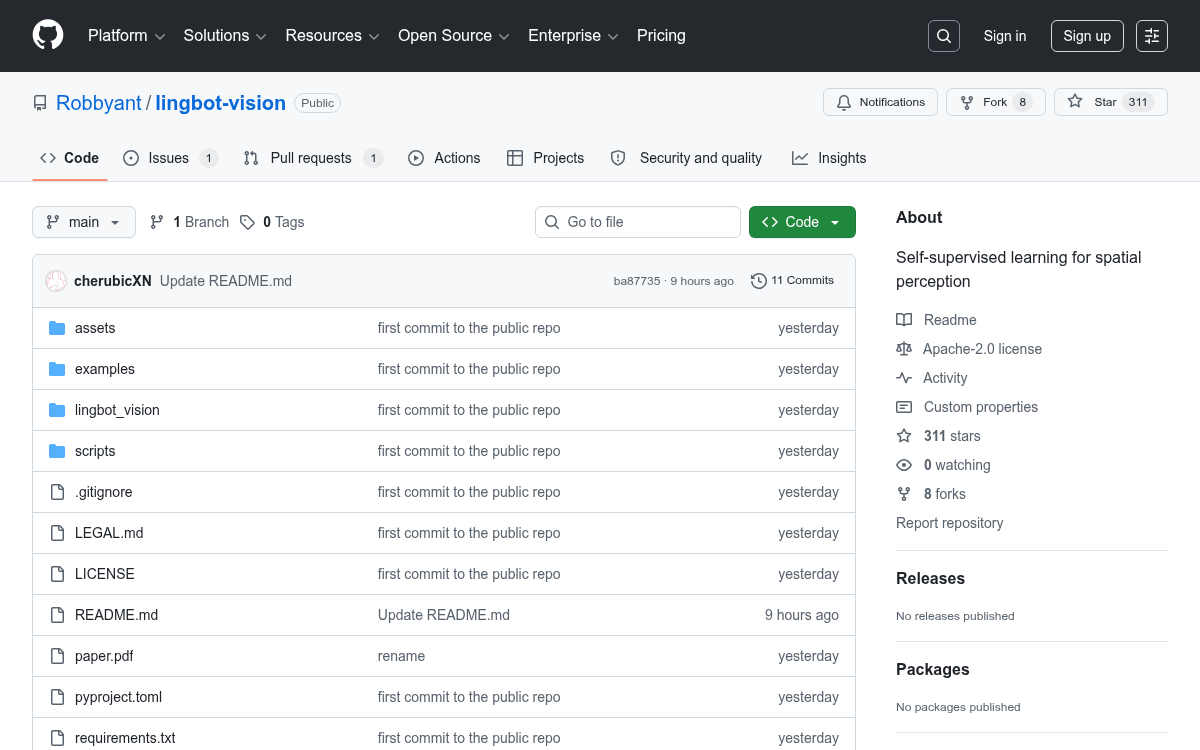
- Robbyant (Ant Group) open-sourced LingBot-Vision, a 1.1B ViT backbone for dense spatial perception under Apache 2.0.
- New pretraining objective, masked boundary modeling, treats object boundaries as the primary self-supervised signal.
- Matches or beats 7B DINOv3 on NYU-Depth v2 while using an order of magnitude less training data.
- Four sizes released on Hugging Face: ViT-S, ViT-B, ViT-L, ViT-g, all distilled from the giant teacher.
- Powers LingBot-Depth 2.0, which halves RMSE on hard indoor scenes (0.132 to 0.062) and tops 12 of 16 benchmarks.
- Read the technical report for the boundary field categorical reparameterization details.
Robbyant, the embodied AI arm of Ant Group, has open-sourced LingBot-Vision, a family of self-supervised Vision Transformer backbones designed specifically for dense spatial perception. Most vision foundation models are trained for semantic invariance: they learn to answer what is in an image while discarding the fine-grained spatial structure that robots depend on. LingBot-Vision inverts that priority, treating boundaries as a native pretraining signal rather than a downstream output, and the payoff is a 1B-parameter backbone that matches or surpasses models up to 7x larger on dense spatial tasks, including the 7B DINOv3.
The release ships alongside LingBot-Depth 2.0, a depth completion model that uses LingBot-Vision as its encoder. Together they target one of robotics' oldest failure modes: glass, mirrors, and transparent surfaces that traditional depth cameras cannot see.
Boundaries as a first-class training signal
The core innovation is a pretraining objective called masked boundary modeling. The authors advocate a boundary-centric view of self-supervised pretraining, in which boundaries are native learning signals rather than downstream outputs, and show they can be bootstrapped from raw images without human labels, external edge detectors, or pretrained backbones.
Mechanically, it is a self-distillation setup with a twist. Masked boundary modeling is a self-distillation framework that forces teacher-discovered boundary tokens into the student's masked set and routes masked tokens by geometry, turning the conflict between semantic abstraction and geometric sensitivity into cooperation. Instead of masking patches at random the way MAE or DINOv2 do, the teacher first identifies which tokens sit on object boundaries, then the student is forced to reconstruct exactly those hard, geometry-rich regions.
A second trick makes the training stable. Recasting continuous boundary field regression as a per-pixel categorical classification problem enables the application of stabilizing self-supervised learning mechanisms (centering, sharpening) to geometric features. Treating boundaries as classes rather than continuous regression targets lets the model borrow the tricks that made DINO-family training work at scale.

Beating a 7B model with 1B parameters and less data
The scaling story is the more surprising part. Following the data curation pipelines of DINOv2 and DINOv3, the team assembled a corpus of roughly 161M images, selected from 2B raw ones, that combines curated public datasets with retrieval-curated web pools. On this corpus they train LingBot-Vision, a ViT-g/16 backbone of roughly 1.1 billion parameters. They find LingBot-Vision to be training-efficient in terms of both data and optimization budget: it consumes a corpus an order of magnitude smaller than DINOv3's and less than one third of its training samples.
The downstream results are where this matters:
- The 1B backbone posts the best NYU-Depth v2 RMSE in its comparison, ahead of the 7B DINOv3, while training on an order-of-magnitude smaller corpus.
- The advantages survive distillation: the 0.3B ViT-L matches the 7B DINOv3 on NYUv2 with roughly 23x fewer parameters.
- When used for depth completion via LingBot-Depth 2.0, the encoder consistently outperformed DINOv2 and DINOv3 initializations, achieving leading performance on 14 benchmarks, including challenging transparent object scenes.
What LingBot-Depth 2.0 does with it
LingBot-Depth 2.0 is essentially a case study for the backbone. Building upon the success of LingBot-Depth, which pioneered the Masked Depth Modeling technique to resolve depth sensing challenges for transparent and reflective surfaces, LingBot-Depth 2.0 represents a massive scale-up in training data and performance. Trained on 150 million samples, the new model achieves top rankings in 12 out of 16 depth completion benchmarks. Most notably, in the most demanding indoor scenarios with massive depth loss, LingBot-Depth 2.0 halves the depth error compared to its predecessor, reducing RMSE from 0.132 to 0.062.

It demonstrates particularly outstanding performance in traditional failure cases for conventional depth cameras, such as glass, mirrors, and transparent objects. If you have ever tried to run a manipulation policy in a kitchen with glass cabinets or a warehouse with polished floors, you know how much sensor dropout costs you downstream.
Using the models
Everything ships under Apache 2.0. Four sizes are available on Hugging Face: ViT-S (384-dim), ViT-B (768), ViT-L (1024, the recommended default), and ViT-g (1536, 1.1B params). The smaller models are distilled from the ViT-g teacher, so they inherit the boundary-aware features.
The API is intentionally thin. You get a backbone and patch tokens back:
import torch
from lingbot_vision import load_pretrained_backbone, extract_patch_tokens, load_image
backbone, embed_dim = load_pretrained_backbone(variant="large", device="cuda", dtype=torch.bfloat16)
img_norm, _, _ = load_image("examples/example.png", size=512, patch_size=backbone.patch_size, mode="square")
patch_tokens, patch_grid = extract_patch_tokens(backbone, img_norm, "cuda", torch.bfloat16)
# patch_tokens: [B, H*W, C]
The repo lists five target use cases where the frozen patch tokens are meant to slot in:
- Dense feature visualization via PCA of frozen tokens
- Depth estimation with lightweight readout heads on frozen features
- Semantic segmentation where region transitions align with object contours
- Video object segmentation using training-free token matching and label propagation
- Depth completion as the encoder for LingBot-Depth 2.0
What it changes for the field
The interesting claim here is not that a Chinese lab shipped another vision backbone. It is that the DINOv3 recipe of scaling data and parameters is not the only path to better dense features. The findings reveal that boundary modeling goes beyond simple line segments and instead serves as a scalable pretraining principle for learning spatially structured visual representations.
For anyone building perception stacks for robotics, AR, or 3D reconstruction, this suggests two things worth testing. First, swapping a DINOv2 or DINOv3 encoder for LingBot-Vision-Large is nearly free and may materially improve dense heads. Second, the semantic-first pretraining orthodoxy that has dominated since CLIP may be leaving obvious spatial signal on the table. The technical report is worth a read if you are designing your own self-supervised objective.