
Alibaba's Qwen3.8-27B Beats Claude on Coding and Fits on One GPU
Alibaba's Qwen team shipped a 27B open-weight multimodal model claiming Opus 4.6-class coding scores, runs on 17GB of VRAM under Apache 2.0.
 Pro
Takeaways
- Qwen released Qwen3.8-27B, a 27B dense multimodal model under Apache 2.0.
- Native 262K context extends to 1M tokens via YaRN, runs on 17GB VRAM.
- Self-reported benchmarks show it beating Claude Opus 4.6 Max on SWE-bench Pro and OSWorld.
- Hybrid architecture interleaves Gated DeltaNet linear attention with periodic full attention blocks.
- Default xhigh reasoning mode dramatically overthinks simple prompts, burning thousands of tokens.
- Supports vLLM, SGLang, Ollama, Transformers with OpenAI-compatible reasoning_effort dial.
Alibaba's Qwen team dropped a compact multimodal model that fits on a single consumer GPU and, according to its own benchmark card, wrestles with frontier systems many times its size. Qwen3.8-27B is a native vision-language dense model released under Apache 2.0 with a 262K native context window that stretches to a full million tokens. The catch is that nearly every headline number so far comes from the lab that trained it.
Within 38 minutes of release, one observer reported more than 10,000 downloads, and within 24 hours the GGUF build was the number three trending model on Hugging Face with a reported one million total downloads. That kind of adoption on day zero says less about the benchmark table than about the size-to-capability ratio developers think they are getting.
What actually shipped
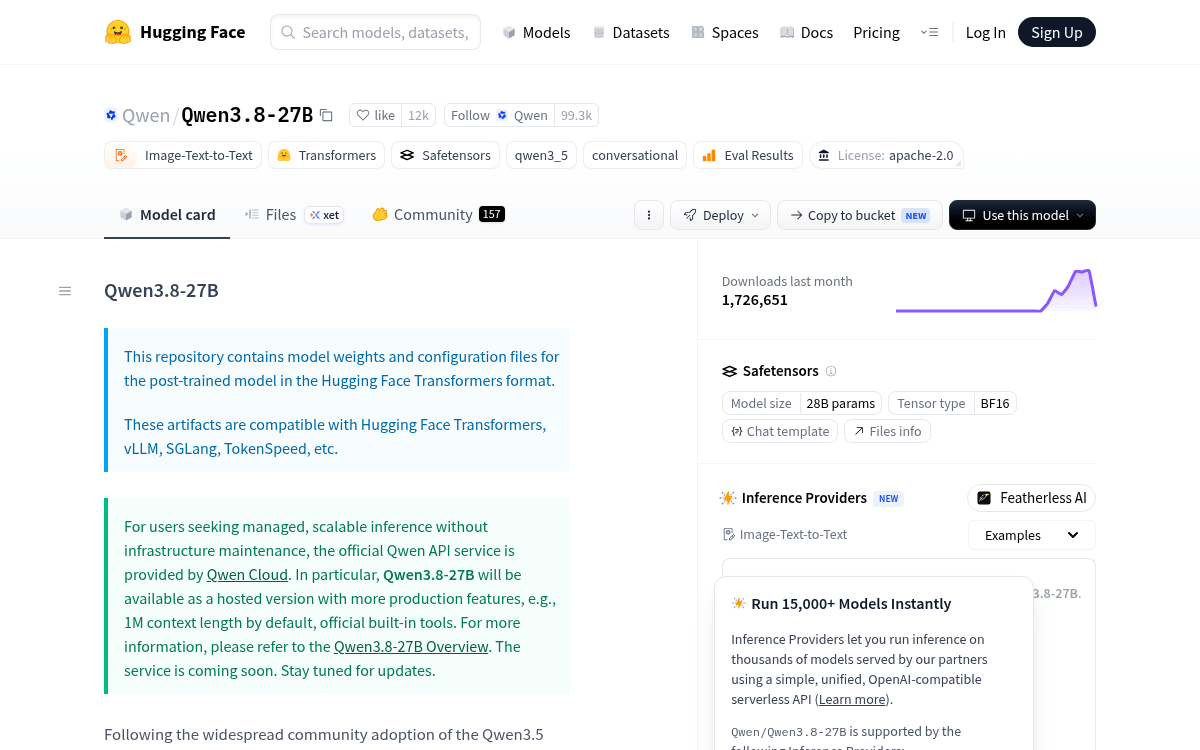
The official model card describes Qwen3.8-27B as a Causal Language Model with a Vision Encoder: 27B parameters, 5120 hidden dimension, 64 layers, and 262,144 tokens of native context extensible to 1,000,000. It handles images, video, and text out of the box, with flexible thinking control and a tunable reasoning depth dial.
The architecture is where things get interesting. The model uses a hybrid layout of 16 repeats of three Gated DeltaNet-plus-FFN blocks followed by one Gated Attention-plus-FFN block. Gated DeltaNet is a linear-attention variant that scales with context far more cheaply than standard softmax attention; interleaving it with periodic full-attention layers is how the model reaches a 262K window without exploding memory. It also ships with Multi-Token Prediction trained across multiple steps, which downstream quantizers exploit for speculative decoding.
The benchmark story
Qwen's self-reported numbers are what set the internet on fire. On coding, the model card reports:
- SWE-bench Pro: 61.7 (versus 53.4 for Claude Opus 4.6 Max)
- QwenSWEBench: 79.0 (versus 63.8 for Opus 4.6 Max)
- LiveCodeBench v6: 90.3 (versus 88.8 for Opus 4.6 Max)
- DeepSWE 1.1: 42.2, up from 13.3 on the prior generation
On agentic multimodal work, the card reports OSWorld-Verified at 84.3, AndroidWorld at 81.9, and WebArena-Verified at 64.8, all leading the comparison set. Opus 4.6 Max still leads on Terminal Bench, GPQA Diamond, and Humanity's Last Exam, so this is a strong showing in a size class where nobody expected these numbers at all rather than a clean sweep.
Independent voices are more cautious. Alibaba Cloud pitches Qwen 3.8 27B as a native multimodal dense model that outperforms Qwen3.7-Plus overall and shines in real-world coding and office workflows, with 262K native context easily extendable to 1M tokens via YaRN under Apache 2.0. No independent benchmark has yet confirmed the Opus 4.6 comparison, and the SWE-bench Pro figure was produced with a Claude Code harness at temperature 1.0, top_p 0.95, and a 256K context window, a specific configuration other teams will need to reproduce.
When the model won't stop thinking
The most useful independent observation so far is about defaults, not scores. The model exposes a reasoning_effort dial with xhigh (default), medium, and low settings. The shipped default sits at the far end of it, and it shows.
Simon Willison's hands-on testing found the model wildly overthinks routine prompts. On his usual pelican-on-a-bicycle SVG test at the default xhigh setting, the model burned 22,276 reasoning tokens over 21 minutes to produce 3,223 tokens of actual output. The same prompt with reasoning disabled finished in 137 seconds. Asked simply to draw an SVG of a circle, the reasoning trace started deliberating over concentric guide circles, tick marks, and restrained ambient motion.
He also hit a practical trap worth flagging: LM Studio's default 8,192-token context limit was exhausted by the model thinking about mundane problems before it could answer. Loading the full 262,144 context resolved it. If you plan to try this locally, override the defaults before you judge the model.
Getting it running
Deployment options are broad from day one. The weights ship as 55.6GB of BF16 safetensors across 18 shards, though the community quantizations are what most people will actually run:
- Unsloth Dynamic GGUFs run in roughly 16-17GB of RAM or VRAM, fitting on a single 3090 or 4090
- NVFP4 quants are available for Blackwell-class hardware
- An FP8 checkpoint is live for production inference
- vLLM, SGLang, Transformers, and Ollama all support it natively
The Chat Completions API is OpenAI-compatible and exposes the reasoning controls directly:
completion = client.chat.completions.create(
    model="Qwen/Qwen3.8-27B",
    messages=messages,
    reasoning_effort="medium",  # xhigh, medium, or low
    extra_body={
        "chat_template_kwargs": {
            "enable_thinking": True,
            "preserve_thinking": True,
        },
    },
)
The preserve_thinking flag is worth understanding. It retains reasoning blocks from historical messages across multi-turn conversations, which matters for agent loops where decision consistency and KV cache reuse dominate cost.
Two models, one confusing name
Two very different models share the Qwen 3.8 branding, and coverage keeps conflating them. The 27B is a dense open-weight model you can download today. Qwen 3.8-Max is a 2.4-trillion-parameter sparse mixture-of-experts flagship with roughly 95B active parameters per token, available API-only through Qwen Cloud at $2 per million input tokens and $6 per million output tokens. The 27B has no confirmed per-token API price yet; a managed Qwen Cloud version was announced as coming soon.
For teams weighing self-hosting against API access, this split is the whole story. Nobody self-hosts a 2.4T model on a workstation. The 27B is the half of this generation that most infrastructure teams will actually run on their own hardware.
Why this matters
The Opus 4.6 comparison will either survive independent testing or it will not. Either way, the structural shift is that a model claiming this tier of coding and computer-use capability now fits in the memory footprint of a mid-range gaming GPU, ships under a permissive license, and can be fine-tuned on realistic budgets.
For workloads blocked by data-residency constraints, the calculus changes materially. Healthcare, finance, legal, and government teams have been priced out of frontier-class capability by the requirement to keep data inside a private network. A 27B multimodal agent that runs behind your firewall is a genuinely new option rather than a marginal upgrade over last year's local models.
The practical takeaway is to benchmark the model on your own tasks at medium reasoning effort before trusting any single vendor number. Set a generous context limit at load time, expect the default reasoning mode to burn tokens aggressively on trivial prompts, and treat the SWE-bench 61.7 as a hypothesis you will verify on your own repositories. The weights are free, the license is permissive, and the only cost of finding out is your own GPU time.