
AEON-7's Ornith-1.0 Runs 3x Faster With Zero Refusals and No Capability Loss
AEON-7 abliterates Ornith-1.0-35B with zero capability loss, then squeezes 3x faster decode on a DGX Spark via NVFP4 + DFlash speculative decoding.
 Pro
Takeaways
- Zero refusals, zero capability loss: AEON-7 abliterated Ornith-1.0-35B to 0/80 refusals while keeping agentic coding pass@1 at 0.833 (identical to base) and KL ≈ 0.0014.
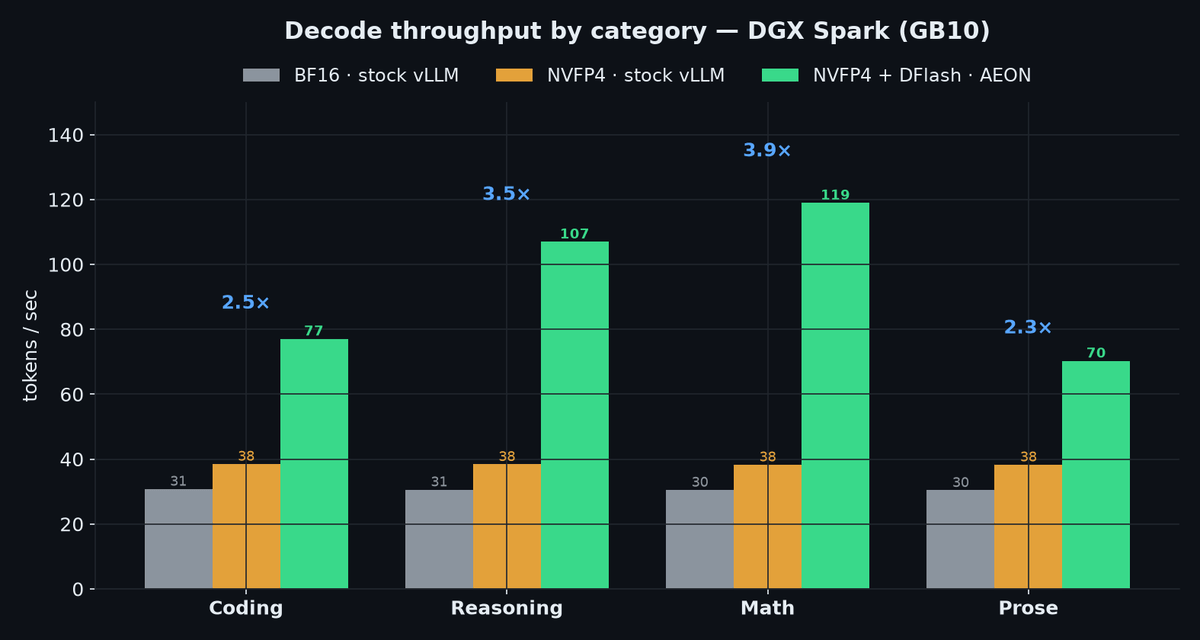
- 3x faster on DGX Spark: NVFP4 + DFlash speculative decoding delivers 93 tok/s avg decode vs. 30 tok/s on stock BF16 vLLM — a 3.05x speedup.
- Two weight variants: BF16 (~66 GB) for any vLLM GPU, NVFP4 (~23.7 GB) for Blackwell only (B200, GB10).
- Novel abliteration pipeline: Expert-Granular Abliteration across all 256 MoE experts + SSM conv1d outlier repair before editing — first known abliteration of a hybrid GatedDeltaNet MoE.
- Base model is SOTA: Ornith-1.0-35B scores 64.2 on Terminal-Bench 2.1, beating Qwen 3.5-397B (53.5) at a fraction of the parameters, with 256K context and vision.
- MIT licensed, fully open: Weights, recipe config, and DGX Spark QuickStart are all public on GitHub.
Ornith-1.0-35B AEON Ultimate Uncensored is a community release that takes DeepReinforce's brand-new state-of-the-art agentic coding model, surgically removes every refusal behavior, and then squeezes out 3x the decode speed on NVIDIA's DGX Spark , all without touching coding capability. It is the most technically detailed uncensored model release in recent memory, and it doubles as a practical performance guide for Blackwell hardware.
The base model is already a big deal
Ornith-1.0 is a self-improving family of open-source models for agentic coding, available in 9B Dense, 31B Dense, 35B MoE, and 397B MoE sizes, post-trained on Gemma 4 and Qwen 3.5, achieving state-of-the-art performance among open-source models of comparable size on benchmarks like Terminal-Bench 2.1 and SWE-Bench Verified. The key architectural trick is that the 35B variant is a Mixture-of-Experts model with 35B total parameters, but only ~3B are active per token , your model has a brain the size of 35B, but for any given thought, it only fires up the 3B neurons that matter, saving compute.
The key innovation behind Ornith-1.0 is a self-improving training framework: instead of relying on human-designed harnesses to drive solution generation in RL, Ornith-1.0 learns to generate both solution rollouts and the task-specific harnesses that guide those rollouts, jointly optimizing the scaffold and the resulting solution so the model can discover better search trajectories. The results are strong: Ornith-1.0-35B significantly outperforms similarly sized models including Qwen 3.5-35B and Gemma 31B, and despite having only 35B parameters, it even surpasses Qwen 3.5-397B on Terminal-Bench 2.1 (64.4 vs. 53.5).
What abliteration actually does
Abliteration is a model-editing technique, not a jailbreak prompt. It is used to create uncensored LLMs by removing a refusal-related signal from a model's internal representations, and because it changes internal behavior rather than prompt phrasing, it is often more stable than jailbreaks across sessions and prompts. Concretely, by identifying and removing a specific "refusal direction" in the model's activation space, you can make the model respond to harmful requests that it would normally refuse , without the need for retraining.
The challenge with Ornith-1.0-35B is that it is a hybrid architecture: 30 of its 40 layers use GatedDeltaNet (a linear-attention variant from state-space model research), not standard transformers. Standard abliteration tools do not handle this cleanly. AEON-7 solved it with a four-stage process:
- SSM conv1d outlier repair , two outlier blocks in layers 36/37 had abnormally high activation variance. These were rescaled before abliteration to prevent coherence collapse.
- Expert-Granular Abliteration (EGA) , abliterix v1.9 applied grimjim norm-preserving biprojected abliteration across all 256 fused experts, the shared expert, and router suppression, using an Optuna multi-objective search to balance refusals vs. output distribution shift (KL divergence).
- Gentle-knee selection , the lowest-refusal trial was over-abliterated and produced word-salad. The shipped version uses a 170x lighter expert edit that achieves the same refusal removal with coherent generation.
- NVFP4 quantization , a surgically-scoped MLP-only, weight-only NVFP4 quant (W4A16): weights are NVFP4 but activations stay BF16. This is the key choice , the well-known NVFP4 reasoning penalty comes from FP4 activations (W4A4), not the weights, and weight-only sidesteps it while dequantizing to BF16 in-register on Blackwell.
The numbers: 0 refusals, 0 capability loss
This is an uncensored/abliterated build of deepreinforce-ai/Ornith-1.0-35B with refusal behavior removed while preserving capability. The validation table tells the story clearly:
| Metric | Base Ornith-1.0-35B | AEON Ultimate |
|---|---|---|
| Refusals (80 harmful prompts) | ~94/100 | 0 / 80 (0.0%) |
| Agentic/coding pass@1 (18 tasks) | 0.833 | 0.833 (identical) |
| Output distribution shift (KL) | , | ~0.0014 (near-zero) |
A KL divergence of 0.0014 is essentially lossless , the model's token probability distributions are nearly identical to the base. This is the hardest part to get right: most abliteration attempts either leave residual refusals or degrade coherence. The norm-preserving biprojection technique (from the grimjim method, based on Arditi et al. 2024) is what makes the difference here, keeping weight magnitudes stable while removing the refusal direction.

3x faster on a DGX Spark
The second half of this release is a full performance optimization guide for NVIDIA's DGX Spark , a desktop-class machine built around the GB10 Grace Blackwell SoC. The DGX Spark is built around the GB10 Grace Blackwell SoC with a unified CPU+GPU memory pool. It is well suited to NVFP4 MoE serving: NVFP4 gives the biggest practical advantage by reducing memory pressure and improving prefill behavior, while decode speed is shaped by the active parameter count and the kernel path used.
AEON-7 benchmarked three stacks on the same Spark to isolate where the gains come from:
| Stack | Avg Decode | Prefill |
|---|---|---|
| BF16, stock vLLM | 30.6 tok/s | 3,517 tok/s |
| NVFP4, stock vLLM | 38.4 tok/s | 5,203 tok/s |
| NVFP4 + DFlash, AEON container | 93.3 tok/s | 9,661 tok/s |
The combined result is a 3.05x decode speedup and 2.75x prefill speedup over a naive BF16 deploy. The NVFP4 quantization alone accounts for about 1.25x of the decode gain and shrinks the model from ~66 GB to ~23.7 GB. The remaining ~2.4x comes from DFlash.
DFlash is a speculative decoding method. It uses a lightweight block diffusion model to draft multiple tokens in parallel; when enabled with vLLM DFlash support, it pairs the base model with a small 0.5B-parameter draft model. The draft model proposes a batch of tokens and the main model verifies them in one forward pass , if the drafts are accepted, you get multiple tokens for the cost of one. DFlash acceptance is content-dependent: expect 60 tok/s on code/reasoning, 30 tok/s on free prose.
One important caveat: NVFP4 requires a Blackwell GPU (B200 / sm_100, or GB10 / sm_120). The BF16 variant runs on any vLLM-compatible GPU. FP8 was explicitly ruled out , the hybrid GatedDeltaNet architecture degrades with W8A8, and there is no ScaledMM kernel for W8A16 on this arch.
How to run it
Both weights are available on Hugging Face: BF16 (~66 GB) for any vLLM setup, and NVFP4 (~23.7 GB) for Blackwell hardware. The BF16 quickstart is straightforward:
vllm serve AEON-7/Ornith-1.0-35B-AEON-Ultimate-Uncensored-BF16 \
  --served-model-name ornith --max-model-len 262144 \
  --gpu-memory-utilization 0.85 --max-num-batched-tokens 16384 \
  --mamba-cache-dtype float32 --reasoning-parser qwen3 \
  --enable-prefix-caching --trust-remote-code
This is a reasoning model: every turn opens a <think>...</think> block before the final answer. Recommended sampling is temperature 0.6, top_p 0.95, top_k 20.
For the full DFlash setup on a DGX Spark, the repo includes a dedicated DGX Spark QuickStart with the optimal settings (NVFP4 + DFlash n=6, --gpu-memory-utilization 0.7). Both models are MIT licensed.
Who is this for and what are the risks
Enterprise teams evaluate abliterated models when provider-side refusals interfere with authorized security testing, synthetic data generation, trust and safety research, model behavior analysis, or governed public-sector workflows. The practical use cases here are broad: red-teaming pipelines, security research, uncensored coding agents, synthetic data generation for alignment work, and any application where you want to own the safety layer yourself rather than delegate it to the model.
Ornith is a state-of-the-art agentic-coding model whose outputs are routinely tool calls and code that downstream systems execute, so an unsafe or malicious instruction can become a real-world action with real side effects , potentially without a human in the loop. Wielding it requires a different operational stance: you, not the model, are the safety layer. The repo is explicit about this: safety refusals are gone, and you are solely responsible for use.
The broader significance of this release is the methodology. Getting abliteration right on a hybrid SSM/attention MoE with 256 experts , while hitting a KL of 0.0014 and zero coding regression , is a non-trivial engineering result. The full recipe is published in config/ornith_35b.toml and RECIPE.md, making it reproducible. As more powerful open-weight agentic models ship, expect this pattern of "uncensored + Blackwell-optimized" to become a standard community release format.