Hey, | Welcome to this week's edition of AlphaSignal.
Whether you are a researcher, engineer, developer, or data scientist, our summaries ensure you're always up-to-date with the latest breakthroughs in AI.
Let's get into it!
Lior |
|
|
|
IN TODAY'S SIGNAL | News: Sakana creates a way to merge models Top Repos: OpenDevin, LaVague, Skyvern, CPE Top Paper: Google's New Method to Steal LLM Information
Read Time: 4 min 09 sec |
|
|
|
BREAKTHROUGH | Sakana Develops A Method To Combine 500,000 Open-Source Model | 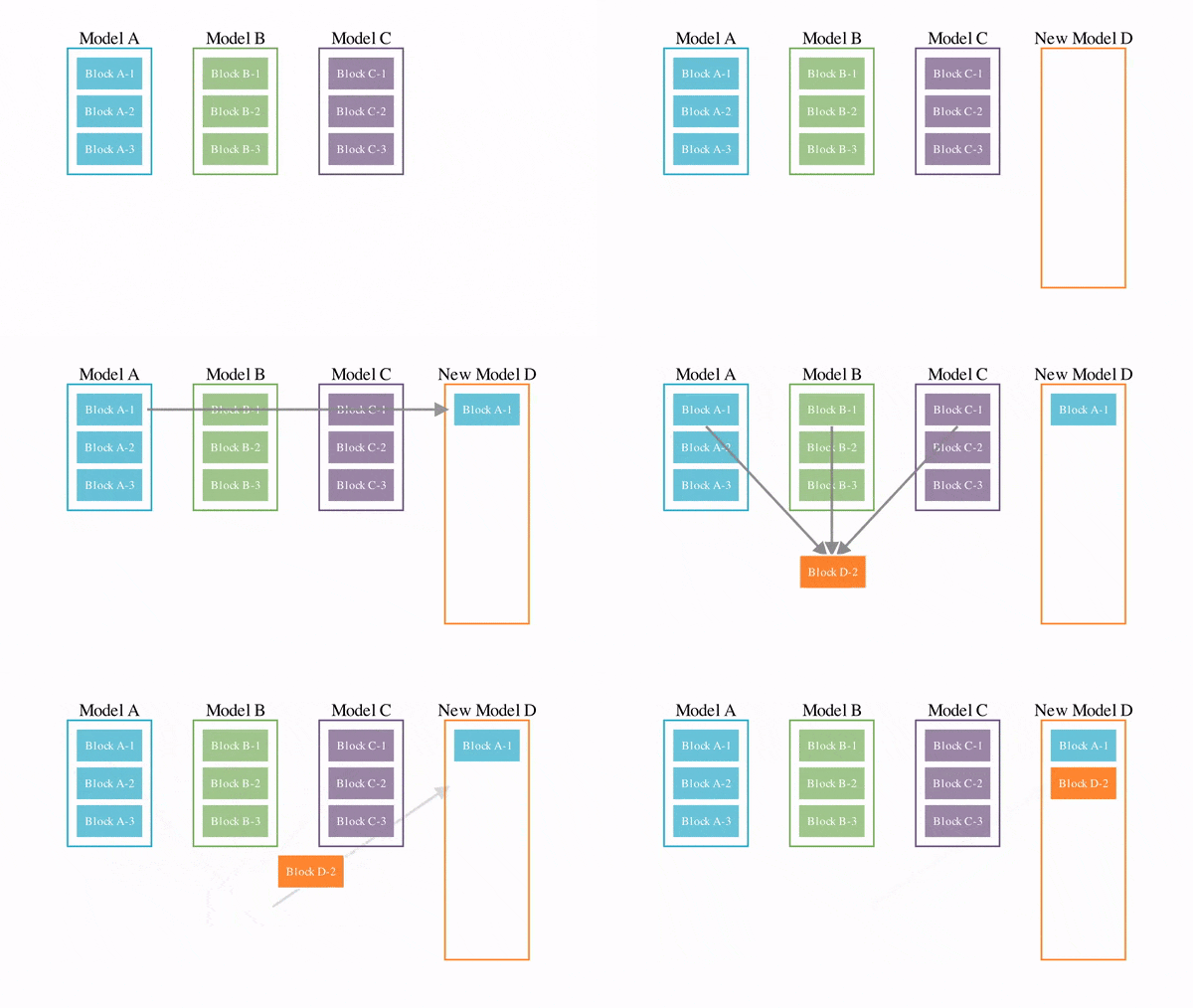 | What's New? | Sakana AI has crafted a method called "Evolutionary Model Merge." This technique leverages evolutionary algorithms to automatically forge new foundation models. It does this by mixing and matching from a pool of over 500,000 open-source models on HuggingFace.
The key is finding the best ways to combine these models, both in how they're built (their architecture) and how they think (their parameters).
Details on Specific Models: - EvoLLM-JP: This is a Japanese Large Language Model with 7 billion parameters, focused on math. It's remarkable because it outdoes models that are ten times its size on Japanese language tasks, hitting a 94.2% accuracy rate on the MGSM benchmark compared to the previous best of 75.6%.
- EvoVLM-JP: They also created a Japanese Vision-Language Model, EvoVLM-JP, that beats current models on visual question answering tests, scoring 74.3% on JA-VG-VQA-500 and 69.8% on JA-VLM-Bench-In-the-Wild.
- EvoSDXL-JP: Finally, they've developed a highly efficient Japanese image generation model that works in just four diffusion steps, making for rapid image creation.
Neuroevolution: Sakana AI's approach isn't just about making individual models better. It's about how you can stitch together a variety of models to build AI systems that are more general-purpose and efficient, all while cutting down on the hefty costs usually involved in training them.
Artificial General Intelligence: The ability to combine different aspects of intelligence—like language understanding, reasoning, and visual processing—into a cohesive whole suggests a path forward for the development of Artificial General Intelligence (AGI). | | Read the post |
|
|
|
 | Lightning AI Studio: Never set up a local environment again | Developed by the creators of PyTorch Lightning, this is where deep learning meets simplicity and speed. Discover a persistent GPU cloud environment that's ready whenever you are.
Prototype, train, serve, and so much more – all from one place. Zero setup.
Key Features
Collaborative Deep Learning: Develop collaboratively in the cloud at any scale.
Massive Data Handling: Up to 12TB per studio and live distributed metrics.
Multi-node Jobs: Scalable and effortless, with no code changes required.
Advanced File Management: Visualize and manage over 100M+ files easily.
Flexible Connectivity: SSH, PyCharm, local VSCode integration, and AWS deployment..
Start today and get 22 free TP4 hours each month.
| | Start today | partner with us |
|
|
|
TOP REPOS | --------------------- OpenDevin lets you replicate, enhance, and innovate Devin, an AI for software engineering, using open source. It gained popularity after Cognition Labs's Devin video went viral. The project uses large language models (LLMs) for development tasks, ensuring safe code execution with Docker and Kubernetes, and facilitating user interaction through React or VSCode interfaces. | | --------------------- LaVague converts your natural language instructions into Selenium code to automate browser tasks. It targets repetitive, low-cognitive activities, freeing you to concentrate on more important tasks. It employs local AI models such as Gemma-7b for privacy and uses advanced techniques like RAG and Few-shot learning for efficient code generation. | | --------------------- Skyvern helps you automate browser-based workflows with LLMs and computer vision. It parses viewport items, plans interactions without pre-set XPaths, improving adaptability to layout changes. | | --------------------- The claude-prompt-engineer helps you create optimal prompts for Claude 3 by describing your task. The process involves generating multiple prompts, testing them in an ELO tournament style, and selecting the best one. The tool is open-source, improves prompt creation through automation, supports multi-variable prompts, and utilizes Claude 3's advanced capabilities, leading to higher quality outputs than previous versions. | |
| |
|
|
UNLOCKING THE FUTURE OF AI AGENTS | MM01 AI announces the US$ 1 million AI Agents Global Challenge.
Global challenge, 20 winners, diverse themes/domains. Create your Agent, Train it, Empower it, Compete! Take part today in the challenge, build your future!
Click here to stay updated ↗️ |
|
|
|
TOP PAPER | Stealing Part of a Production Language Model | 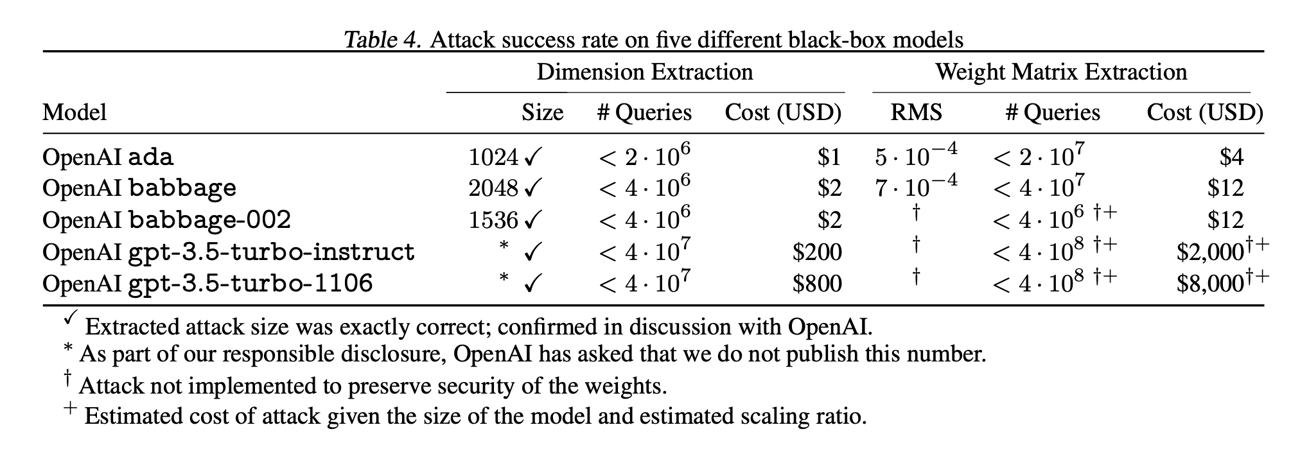 | What's New? | Google has introduced a method for extracting data from AI models such as ChatGPT and PaLM-2. This method targets the embedding projection layer and reveals that the hidden dimensions of OpenAI's Ada and Babbage models are 1024 and 2048, respectively. The technique can be used with typical API access and costs under $20.
Logit Recovery Process: - The method sets logit biases for different tokens and uses linear constraints to figure out logit values.
- It compiles constraints from many API requests and uses linear programming to make better guesses about the differences between logits. This allows the full projection matrix of big language models to be understood.
New Attack Techniques: The research introduces a 'logprob-free attack' that makes calculations more efficient by turning the problem into a shortest path problem in a graph. This reduces the time needed for calculations and shows a way to get around standard AI model security.
Security Concerns: - The hyperrectangle approach used by the researchers is more accurate and efficient than previous methods, with much lower error rates in recovering logits.
- The results point out a serious vulnerability in large language models due to the low cost and efficiency of the attack, suggesting that AI security needs to be reevaluated.
| | Read the paper |
|
|
|
| | Ghita is an editor at AlphaSignal and AI Engineer at Clear Ventures. Experienced in Computer Vision and Language models, she holds 2 masters in Applied Mathematics. | | Thank You. |
| | Want to promote your company, product, job, or event to 175,000+ AI researchers and engineers? You can reach out here. | |
|
|
|
|
