| Hey, | Welcome to AlphaSignal – the most read newsletter by AI developers.
We bring you the top 1% of news, papers, models, and repos, all summarized to keep you updated on the latest in AI. |
|
|
|
IN TODAY'S SIGNAL
| Read time: 5 min 53 sec | 🎖️ Top News
📌 Pixeltable
⚡️ Trending Signals
💻 Top Lectures
🧠 Deep Dive
|
|
|
|
If you're enjoying AlphaSignal please forward this email to a colleague.
It helps us keep this content free. |
|
|
|
TOP NEWS
| Code Generation | Google unveils AlphaEvolve, a Gemini-powered coding agent for algorithm design and optimization
| ⇧ 17,937 Likes |
| What's New |
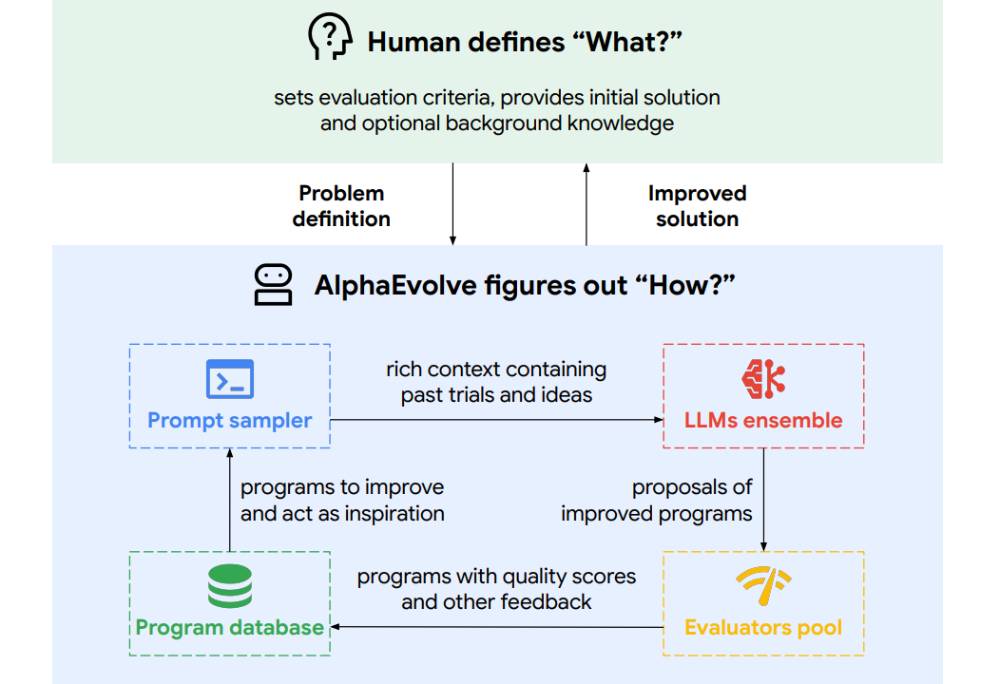
Google has introduced AlphaEvolve, a Gemini-powered coding agent that discovers and optimizes algorithms for complex problems. It builds on the earlier AlphaTensor model but extends beyond single-function optimization to evolve entire codebases. It uses a combination of Gemini Flash for rapid idea generation and Gemini Pro for deeper analysis.
Algorithm Discovery
AlphaEvolve generates and refines algorithms through an evolutionary framework.
Found a 4x4 matrix multiplication algorithm using 48 scalar multiplications
Solved over 50 open math problems, including analysis, combinatorics, and number theory
Rediscovered the best-known solutions in 75% of cases
Improved upon known solutions in 20% of cases
System Overview
AlphaEvolve replaces AlphaTensor’s transformer with a mutation-based algorithm search pipeline.
Starts from human-written code blocks and mutates them without training a model
Uses Gemini Pro 1.5 to verify correctness and measure runtime performance
Evaluates thousands of mutations per task using modular code execution and analysis
Filters candidates using test harnesses and domain-specific input-output specifications
Real-World Impact
AlphaEvolve delivers measurable efficiency gains in large-scale computing.
Recovered 0.7% of Google’s global data center compute resources
Reduced Gemini model training time by 1% with 23% faster matrix operations
Improved low-level GPU instructions with a 32.5% speedup for the FlashAttention kernel
Hardware Design
AlphaEvolve optimizes hardware for performance and efficiency.
Proposed Verilog rewrites for matrix multiplication circuits
Removed unnecessary logic while maintaining functional correctness
Integrated into upcoming Tensor Processing Units (TPUs)
Availability and Access
DeepMind releases results but not the system. You can inspect outputs and setup. Open-sources evolved algorithms and technical benchmarks on GitHub
Provides evaluation specs and testing harnesses for Gemini-based runs
No public API or full codebase for running AlphaEvolve end-to-end
Community Feedback
AIFRontier
"We’ve always seen algorithm design as this artsy, painstaking craft: sketching ideas on napkins, debugging line by line. AlphaEvolve flips the script: Gemini spits out wild code ideas, automated verifiers knock out the flops, and the rest evolve like digital organisms. It’s the scientific method on steroids. And no, it’s not just theater. It’s already optimizing Google’s data centers, inventing hacks for classic NP-hard problems, and even cooking up fresh tricks for reinforcement-learning benchmarks. The real kicker is that the only limit now is how well we can set up objectives and feedback loops."
Ethan Mollick
"With Google's AlphaEvolve, we have evidence that LLMs can discover novel & useful ideas, when put together with the right tooling. These results are impressive: given 50 open math problems, the AI rediscovered the leading approach 75% of the time & improved on it 20% of the time"
Sir-Tox-Alot
"Now hopefully you all will be smart about this and not open source it, so OpenAI can use it. Unless you all think it's the best thing for industry as a whole."
| |
| Learn more
|
|
|
|
| Build your Stateful Agent Framework in 200 lines of code | Pixelagent is an open-source blueprint for building persistent, reliable agents without rebuilding your data infrastructure.
With just 200 lines of code, it provides a reference implementation to help you build your own agent SDK, supporting: Multimodal data workflows — storage, retrieval, indexing, and orchestration
LLM integration — connect to providers like OpenAI
Custom tool support — integrate your own functions and APIs
Reasoning patterns — implement approaches like ReAct and team-based agent workflows
Persistent memory — maintain context across sessions and interactions
The tutorial walks you through building a conversational agent with memory, orchestration, and storage using OpenAI.
Instead of relying on complex or rigid frameworks, Pixelagent gives you a minimal and modular foundation to design the abstractions your workflow needs. |
| Build your own
| partner with us → |
|
|
|
TRENDING SIGNALS
| AI Models |
|
⇧ 12,484 Likes | |
Distributed Computing |
|
⇧ 2,017 Likes | |
AI Agents |
|
⇧ 1,382 Likes | |
AI Safety | |
| ⇧ 1,294 Like |
| Video Generation |
|
⇧ 1,028 Like | | |
|
|
|
|
TOP LECTURES
| LLMs |
| ⇧ 1,479 Likes |
Learn how to build applications with Reasoning LLMs like o3, Gemini 2.5 Pro, and Claude 3.7 Sonnet. This guide covers reasoning model design, agentic planning, multi-tool use, and effective prompting strategies. Gain practical skills for building agentic systems, evaluating complex outputs, and optimizing cost and latency.
|
| AI Product Strategy |
|
| ⇧ 739 Likes |
This lecture teaches you how to build and optimize AI wrappers for domain-specific tools. It covers rapid prototyping, token cost management, and multi-context integration. Understand the economics of wrappers, from scaling models to building meta-apps that leverage multimodal AI for high-value use cases.
|
| LLM Evaluation |
| ⇧ 2,048 Likes |
Learn how to build robust data extraction pipelines using GPT-4o and o3-mini for receipt processing. This lecture covers integrating multi-model verification, reducing hallucinations, and implementing Human-in-the-Loop workflows for accurate data extraction. Gain practical skills in structured JSON export, error detection, and automated prompt optimization.
|
| |
| |
|
|
DEEP DIVE
| AI Integration Protocol |
Build Context-Rich AI Apps with Anthropic’s Model Context Protocol (MCP) |
⇧ 1,837 Likes |
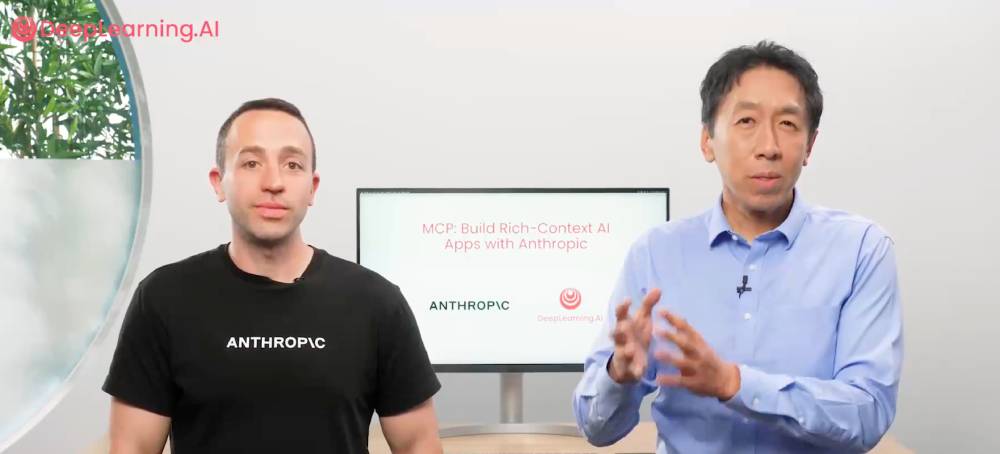
| This course by Andrew Ng's deeplearning.ai teaches you how to connect AI apps to external tools, data, and prompts using the Model Context Protocol (MCP). MCP helps you avoid writing custom integrations by using a client-server setup that standardizes communication between your AI app and external systems.
You will:
Learn how MCP reduces fragmentation in AI development
Understand MCP’s client-server architecture and communication model
Build a chatbot that uses MCP to connect to external tools
Create a local MCP server with FastMCP and test it with MCP Inspector
Implement an MCP client inside your chatbot
Connect to Anthropic’s reference servers (e.g. filesystem, fetch)
Use Claude Desktop to manage server connections
Deploy your MCP server remotely
Explore upcoming MCP features: server discovery, auth, and multi-agent support |
| Start now
|
|
|
|
At Alpha Signal, our mission is to build a sharp, engaged community focused on AI, machine learning, and cutting-edge language models, helping over 200,000 developers stay informed and ahead. We’re passionate about curating the best in AI, from top research and trending technical blogs to expert insights and tailored job opportunities. We keep you connected to the breakthroughs and discussions that matter, so you can stay in the loop without endless searching. We also work closely with partners who value the future of AI, including employers and advertisers who want to reach an audience as passionate about AI as we are.
Our partnerships are based on shared values of ethics, responsibility, and a commitment to building a better world through technology.Privacy is a priority at Alpha Signal. Our Privacy Policy clearly explains how we collect, store, and use your personal and non-personal information. By using our website, you accept these terms, which you can review on our website. This policy applies across all Alpha Signal pages, outlining your rights and how to contact us if you want to adjust the use of your information. We’re based in the United States. By using our site, you agree to be governed by U.S. laws. |
|
|
|
Looking to promote your company, product, service, or event to 200,000+ AI developers? Let's work together.
|
| Work with us
|
|
|
|
|
