
youtube-transcript-api Hits 8K Stars Pulling Captions Without Chrome
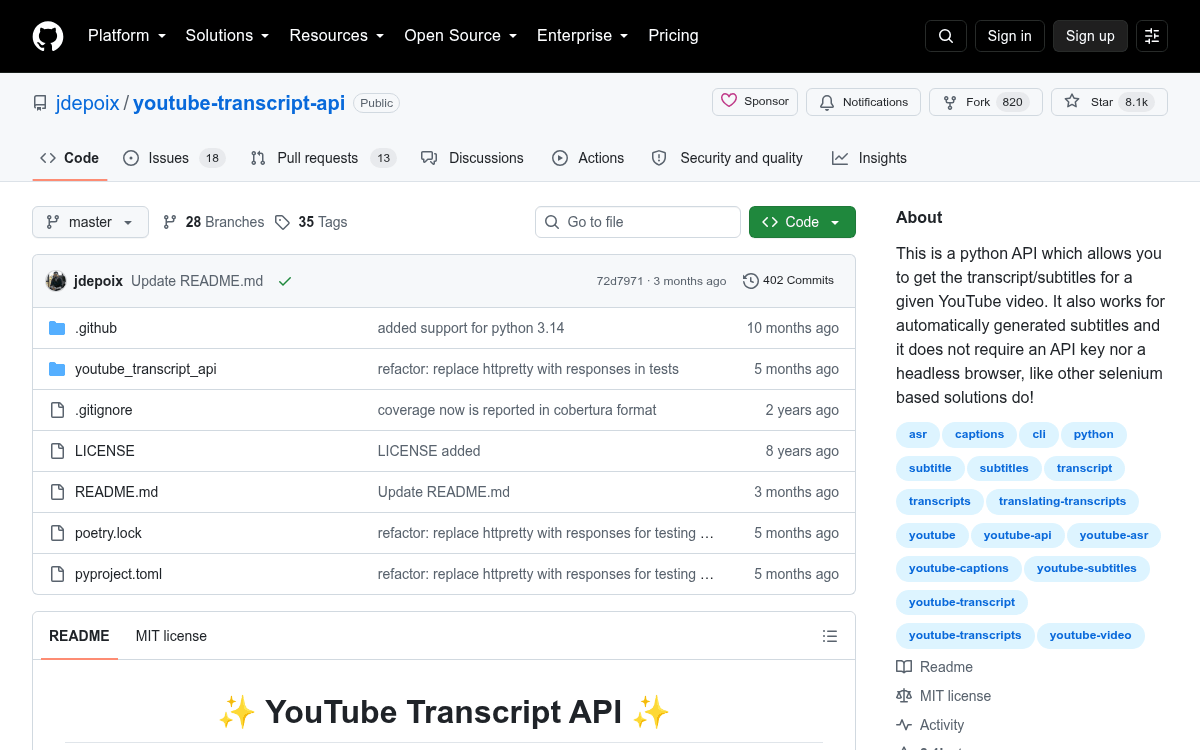
A lightweight Python library pulls YouTube captions directly without Selenium, API keys, or headless browsers, and ships with proxy and translation support.
Takeaways
- youtube-transcript-api is a Python library that fetches YouTube captions without API keys or headless browsers.
- The project has 8k+ GitHub stars and MIT license, installable with pip install youtube-transcript-api.
- Supports auto-generated captions, manual captions, language priority lists, and YouTube's built-in translation feature.
- Ships formatters for JSON, plain text, WebVTT, and SRT, plus a CLI for shell pipelines.
- Built-in Webshare rotating residential proxy support to bypass cloud provider IP blocks from YouTube.
- Cookie authentication for age-restricted videos is currently broken due to recent YouTube API changes.
Grabbing YouTube transcripts is one of those tasks that sounds trivial until you actually try it. The official Data API requires OAuth for captions, third-party services charge per call, and rolling your own scraper usually means firing up a headless Chrome instance. youtube-transcript-api sidesteps all of that with a small Python module that talks directly to the same undocumented endpoint the YouTube web client uses.
The project has crossed 8,000 stars on GitHub and remains actively maintained under an MIT license. It has become one of the standard building blocks for RAG pipelines, video summarization tools, and dataset construction workflows that need caption text at scale.
What it actually does
The library retrieves transcripts and subtitles for a given YouTube video, including automatically generated captions, and supports translating them without spinning up a headless browser. Installation is a single pip command, and the core call is three lines of Python:
from youtube_transcript_api import YouTubeTranscriptApi
ytt_api = YouTubeTranscriptApi()
transcript = ytt_api.fetch(video_id)
The returned FetchedTranscript object behaves like a list of snippet objects, each carrying