
Y Combinator's Executor Shrinks a 278k-Token AI Prompt Down to 1k
Executor is an MIT-licensed MCP gateway that collapses thousands of API tools into one sandboxed endpoint, cutting context bloat from 278k tokens to 1k.
Takeaways
- Executor is an open-source MCP gateway that connects any agent to OpenAPI, GraphQL, MCP, and custom tools through one endpoint.
- Reduces tool-schema context from ~278,800 tokens across 1,640 tools to ~1,044 tokens using a single code-mode
executetool. - Credentials stay host-side and are injected into outbound requests, so the model and agent never see raw tokens.
- Ships as CLI, desktop app, hosted cloud, Docker, or Cloudflare Worker with the same codebase.
- Free tier includes 10,000 executions and 3 members; Team is $150/month for 250,000 executions.
- MIT licensed, YC-backed, 3.1k GitHub stars, with per-tool allow/approve/block policies derived from spec semantics.
Anyone who has wired up a serious agent workflow knows the pain: every client wants its own copy of every integration, API keys get pasted into three different config files, and the model's context window drowns under hundreds of tool schemas it will never use. Executor is a new open-source project that tries to fix all of that by sitting between your agents and the outside world as a single MCP gateway.
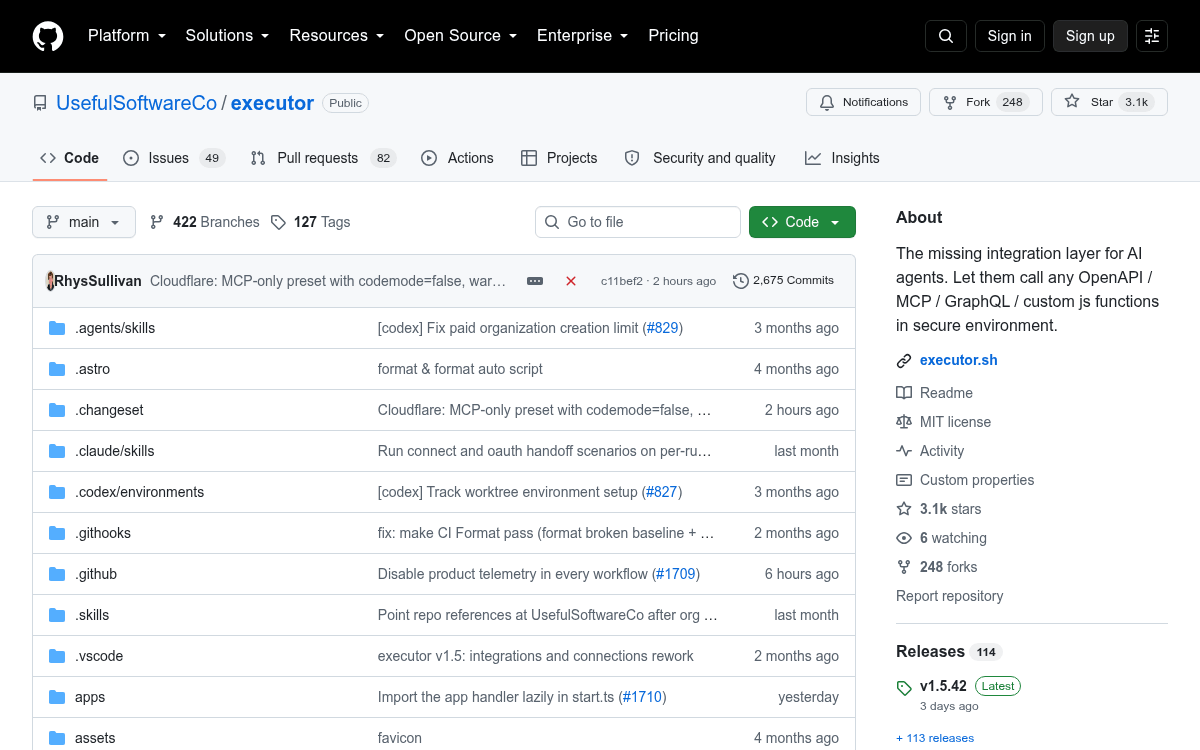
The repo has crossed 3.1k stars and is Y Combinator backed, with a hosted cloud, a desktop app, and self-hosted Docker and Cloudflare Worker deployments all sharing the same TypeScript codebase.
One catalog, every agent
Configure every integration once (MCP servers, OpenAPI specs, GraphQL APIs) with authentication and per-tool policies, then use that catalog from any MCP-compatible agent. Claude Code, Cursor, ChatGPT, Codex, or anything speaking the protocol points at the same endpoint and inherits the same tools, credentials, and guardrails.
First-party support covers MCP servers, OpenAPI, GraphQL, and Google Discovery, and the plugin system is open to any integration type describable with a JSON schema. Each tool can be always allowed, gated behind approval, or blocked, with sensible defaults derived from the spec.