
Y Combinator Open-Sources QM, the AI Agent Harness Running Its Whole Company
Y Combinator open-sourced Quartermaster, the MIT-licensed agent harness it runs its own accounting, legal, and engineering on, with scoped sandboxes per employee and Slack room.
Takeaways
- Y Combinator open-sourced QM (Quartermaster), the multiplayer agent harness it runs internally, under MIT license.
- Each employee and Slack room gets scoped memory, files, credentials, permissions, crons, and a durable sandbox.
- Harness-agnostic: Pi, OpenCode, Codex, and Claude Code all drive the same TypeScript core.
- Three security postures (Strict, Auto, Dangerous) plus a predeclared command policy for destructive actions.
- Memory is stored as a markdown notebook of atomic bullet facts in Postgres, no vector index required.
- Deploys to Fly or AWS via the
qmCLI in the operator's own cloud account.
Y Combinator has released the software it uses to run its own company. QM, short for Quartermaster, is a multiplayer agent harness that gives an entire organization a shared fleet of AI agents living in Slack and a web UI, with strict boundaries between what each person and each room can see and do. The repo shipped under an MIT license and has already pulled in more than 13,000 GitHub stars.
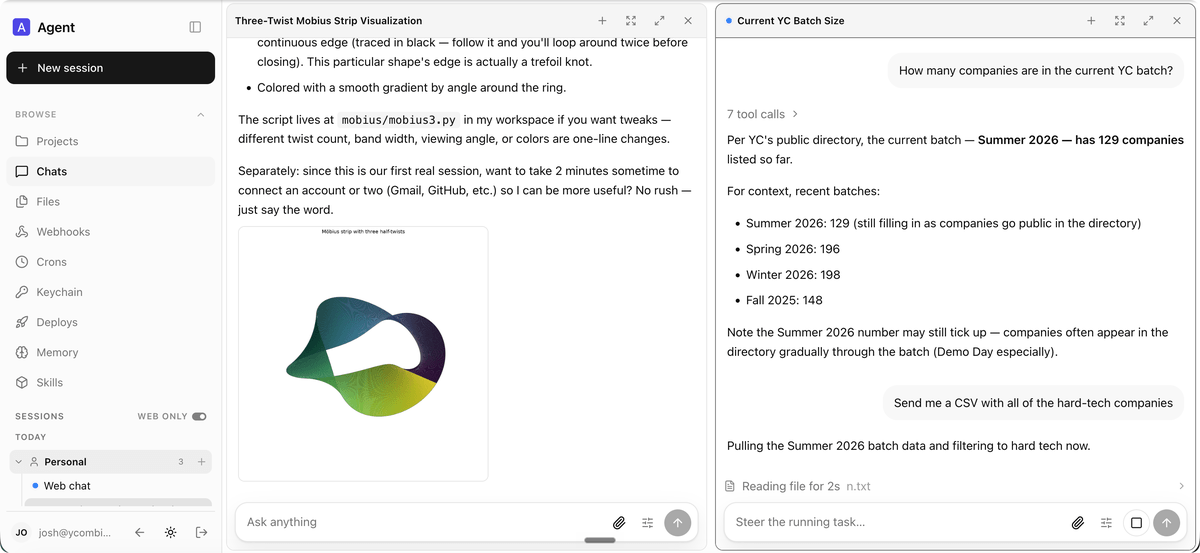
QM lives inside Slack, where different employees and rooms get scoped memory and permissions across accounting, legal, events, and engineering work. YC has been running it internally for months, including building QM with QM, before pushing the code out.
Past the personal-assistant ceiling
Most agents today are shaped like personal assistants. Hand one to a whole company and context, credentials, and permissions immediately become the entire problem. QM is the harness YC built after running 50+ individual Hermes agents internally and hitting the ceiling of what personal assistants can do at organizational scale.
The design flips the primitive. Rather than one agent per person, QM is a single org-wide harness where each person and each room gets scoped memory, files, keychain view, permissions, crons, web apps, and a durable sandbox. Finance's email token never leaks into Engineering's sandbox. A shared Slack channel has its own memory that neither participant can silently exfiltrate to their private workspace.
How the pieces fit together
Under the hood, QM runs a headless core with a small, fixed tool surface. Every turn passes through that core, which handles API, identity, policy, and scheduling while driving an agent loop. A Postgres layer holds user data, session history, and other durable state. One of the tools is