
VideoLingo Automates Netflix-Quality Video Dubbing for Free at 17K Stars
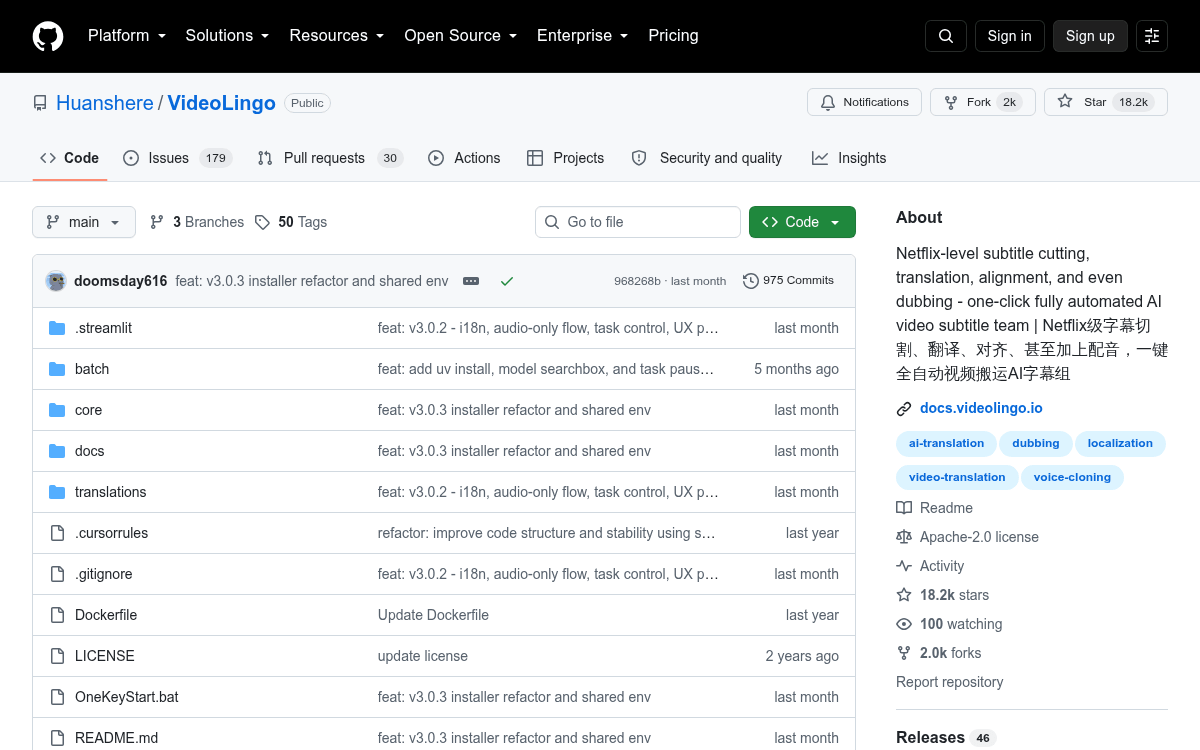
VideoLingo is an open-source pipeline that replaces an entire subtitle team — transcription, translation, and voice dubbing — with one automated workflow
 Pro
Takeaways
- What it is: VideoLingo is an open-source, end-to-end video localization pipeline: transcription, translation, subtitle alignment, and dubbing in one tool.
- Translation quality: Uses a three-step Translate-Reflect-Adapt LLM loop plus a per-video terminology glossary to produce natural, non-literal subtitles.
- Voice dubbing: Supports 7 TTS backends including GPT-SoVITS voice cloning from just 5-15 minutes of audio; no lip-sync support.
- Cost: Free and Apache 2.0 licensed; run fully local with Ollama + Edge-TTS at zero cost, or pay only for LLM/TTS API calls.
- Limitations: Struggles with noisy audio, mixed-language videos, and requires models of 30B+ parameters for reliable structured outputs.
- Traction: 17,200+ GitHub stars, 1,900 forks, 46 releases, and a 32% recent growth in web traffic.
VideoLingo is an open-source Python tool that takes a video in, and spits out a fully localized version , subtitles cut, translated, aligned, and optionally dubbed , with no human subtitle editor in the loop. It has crossed 17,000 GitHub stars and nearly 1,900 forks, and it is actively maintained with 46 releases to date. The pitch is simple: what Netflix pays entire localization teams to do, VideoLingo automates end-to-end.
The problem it actually solves
Manually translating a 45-minute lecture into multiple languages can cost $5,000+ and take weeks. For most content creators, educators, or small teams, that cost is simply prohibitive. Existing auto-translation tools produce robotic, misaligned subtitles that feel machine-made. VideoLingo addresses this gap: while basic auto-translation tools produce robotic, misaligned subtitles, VideoLingo delivers cinematic-quality results through sophisticated NLP pipelines.
How the pipeline works
At its core, VideoLingo leverages WhisperX for word-level speech recognition, implements a unique three-step translation refinement process, and integrates multiple TTS engines for lifelike dubbing. Each stage is distinct and worth understanding:
- Transcription: WhisperX performs word-level timeline subtitle recognition, ensuring every word is accurately synchronized. WhisperX is a faster, more precise variant of OpenAI's Whisper that adds per-word timestamps using a wav2vec2 alignment model , critical for knowing exactly how much audio space each subtitle line occupies.
- Segmentation: NLP and LLM-based segmentation splits the transcript into natural sentence units. Adhering to Netflix's high standards, VideoLingo generates only single-line subtitles, avoiding the clutter and distraction of multi-line subtitles.
- Translation: VideoLingo employs a three-step process of Translate-Reflect-Adaptation to achieve cinematic-quality subtitles. This method ensures subtitles not only convey the original meaning but also adapt naturally to the target language context. The LLM also builds a custom terminology glossary from the video content to keep domain-specific terms consistent across the whole video.