
Vercel Labs Ships Open Agents, a Forkable Coding Agent That Opens PRs Autonomously
Vercel Labs open-sourced a forkable reference app that runs background coding agents in isolated cloud sandboxes with durable workflow execution.
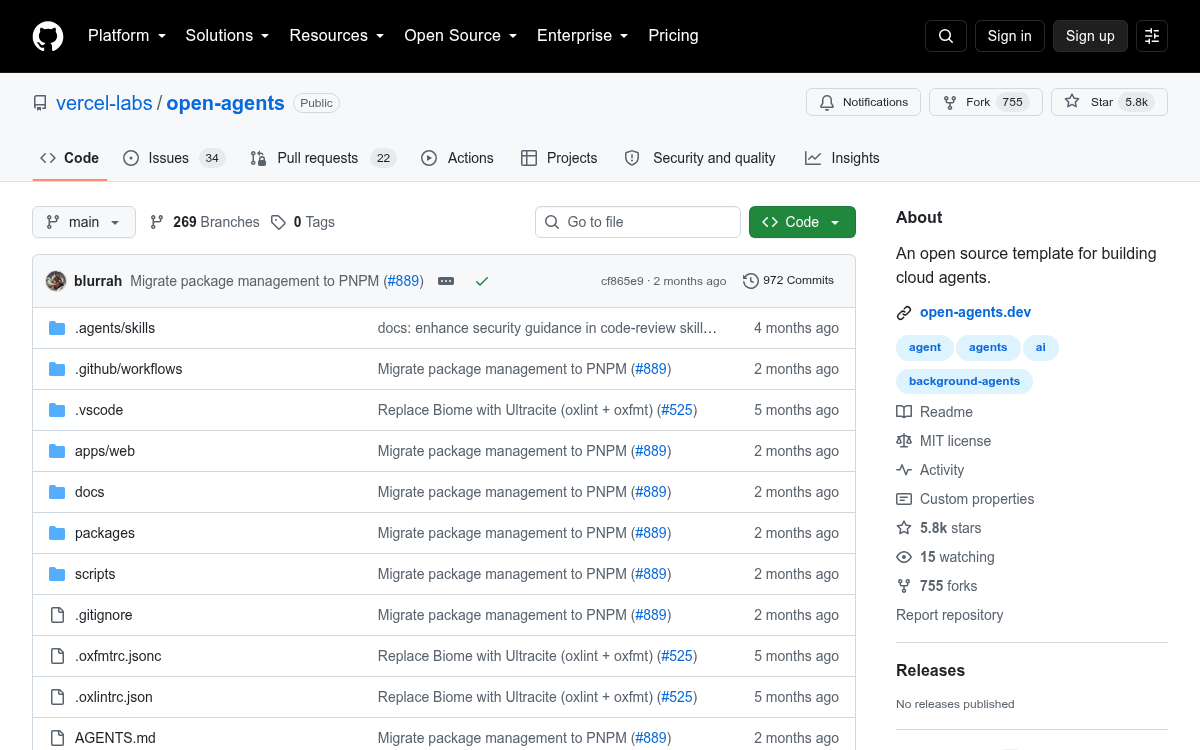
Takeaways
- Vercel Labs open-sourced Open Agents, a full reference app for background coding agents.
- Ships web UI, durable agent runtime, sandbox orchestration, and GitHub App integration for auto PRs.
- Agent runs outside the sandbox VM and interacts through file, shell, and search tools.
- Runs on Workflow SDK so agent turns survive restarts and resume via stream reconnect.
- One-click Vercel deploy with Neon Postgres, Better Auth, and optional ElevenLabs voice input.
- MIT licensed, TypeScript, roughly 5.8k stars and 745 forks, designed to be forked.
Vercel Labs has released Open Agents, an open-source reference app that wires a durable workflow engine, isolated sandbox VMs, and a multi-model gateway into a full background coding agent you can fork and deploy. The project has picked up around 5.8k stars and 745 forks. Unlike most "build your own agent" repos, it ships every layer needed to go from a chat prompt to a merged pull request without keeping a local terminal open.
From prompt to PR, no laptop required
Give Open Agents a GitHub repo and a prompt. It clones the code into an isolated sandbox VM, runs a multi-step coding agent against it, and optionally commits and opens a pull request. The bundle includes the web UI, the agent runtime, sandbox orchestration, and the GitHub integration to make that loop work end to end.
The stack is entirely Vercel-native: Next.js for the web app, the Workflow SDK for durability, Vercel Sandbox for the execution VM, and the AI SDK plus AI Gateway for model routing. The repo is meant to be forked and adapted rather than treated as a black box.
The architectural bet: agent outside the box
The most interesting design decision sits at the boundary between the agent and its execution environment. The agent does not run inside the VM. It runs outside the sandbox and interacts with it through tools for file reads, edits, search, and shell commands.