
Vellum AI Ships an Open-Source AI That Proactively Manages Your Life
Vellum AI open-sources its personal assistant: 8 memory types, proactive reach-outs, and multi-channel presence across macOS, Telegram, and Slack
Takeaways
- Open-sourced under MIT: Vellum AI releases vellum-assistant, a full personal AI assistant platform written in TypeScript.
- 8 memory types: Episodic, semantic, procedural, emotional, prospective, behavioral, narrative, and shared memory — each with its own staleness window and hybrid retrieval.
- Proactive by design: The assistant re-reads its notes every hour and messages you if something needs attention, without waiting to be asked.
- Multi-channel, one memory: macOS, iOS, Telegram, Slack, Web, Voice, Email, and Twilio — start a thought in one channel and continue it in another.
- Model-agnostic: Works with OpenAI, Anthropic, Gemini, Ollama (local), and any OpenAI-compatible endpoint; embeddings run locally by default.
- Free to self-host; managed cloud starts free: MIT license, self-hostable on any VPS; hosted Pro starts at $50/month plus usage credits.
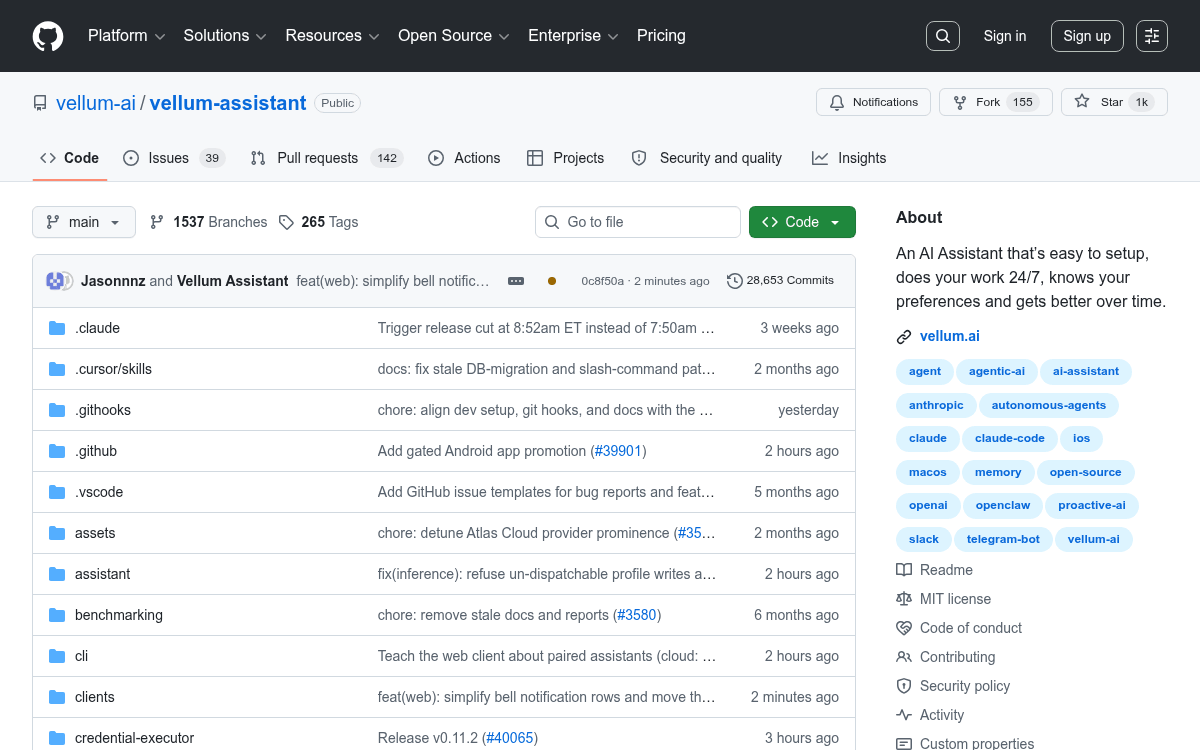
Vellum Assistant is an open-source, always-on personal AI built around memory, ownership, and proactive execution. It has its own identity, workspace, tools, channels, and long-term context. The full source is available under an MIT license.
Beyond the chat window
ChatGPT, Claude, and Gemini are primarily model interfaces: you prompt, they respond. Vellum operates as an agent runtime, taking real actions on your behalf, including scheduling, messaging, file management, browsing, and code execution, while keeping your data on your own machine. By 2026, personal AI tools had split into three rough categories: model runners and document chat interfaces, developer frameworks for building agentic systems, and full personal AI assistants with identity layers, proactivity, and multi-channel presence. Vellum sits in the third group.
Eight kinds of memory
The assistant is designed to evolve with you. Eight distinct memory types, each with its own staleness window, use hybrid dense and sparse retrieval to surface both recent events and older long-term context depending on what is relevant:
- Episodic: specific events and conversations you have had
- Semantic: facts and preferences extracted from those conversations
- Procedural: how you like things done, including writing style and workflow preferences
- Emotional: tone and sentiment patterns in your interactions