
VectorSpaceLab's OmniGen2 Handles Editing, Generation, and Understanding in One Open Model
A dual-path multimodal model that unifies text-to-image, image editing, and subject-driven generation with state-of-the-art open-source consistency.
 Pro
Takeaways
- OmniGen2 is an Apache 2.0 multimodal model handling text-to-image, editing, in-context generation, and understanding: GitHub
- Dual-path architecture uses separate decoders for text and image, built on Qwen-VL-2.5 backbone.
- Novel Omni-RoPE positional encoding handles multiple reference images in one context.
- State-of-the-art open-source consistency on the new OmniContext subject-driven benchmark.
- Runs on 17GB VRAM natively, drops to under 3GB with sequential CPU offload.
- TeaCache and TaylorSeer integrations deliver up to 2x faster inference with minimal quality loss.
VectorSpaceLab has released OmniGen2, an open-source multimodal generative model that handles text-to-image, instruction-guided editing, in-context (subject-driven) generation, and visual understanding inside a single system. It ships with Apache 2.0 weights on Hugging Face, a Gradio demo, training code, a fine-tuning guide, and a fresh benchmark called OmniContext for reference-based generation.
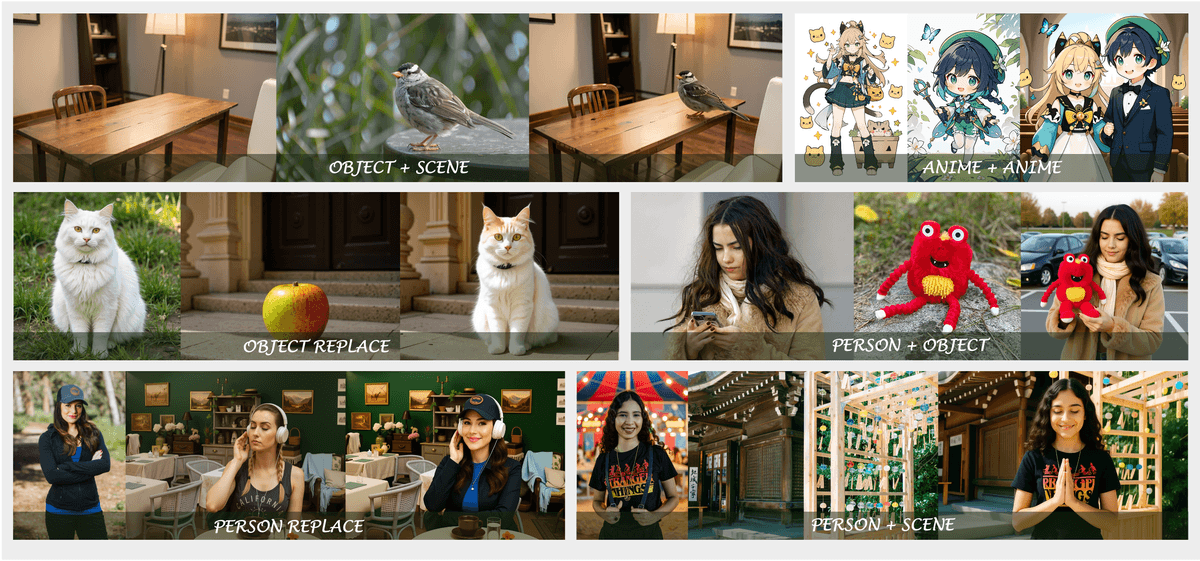
The pitch: point one model at a reference photo and say something like edit the first image: replace the mug with the mug from the second image, and get a coherent result without stitching together separate ControlNets, IP-Adapters, or LoRAs. The paper reports competitive scores across text-to-image and editing benchmarks despite a modest parameter budget, and state-of-the-art consistency among open-source models on OmniContext.
Two decoders beat one
The most interesting design choice is architectural. OmniGen2 uses a dual-path setup with separate autoregressive and diffusion Transformers for text and image generation. A ViT encoder feeds visual information into a multimodal LLM for understanding tasks, while a VAE encoder supplies fine-grained features exclusively to the diffusion decoder. That split preserves the language model's capabilities while enabling high-fidelity synthesis.