
UsefulSoftwareCo's Executor Cuts 278,800 Agent Tokens Down to 1,044
UsefulSoftwareCo released Executor, an open-source MCP gateway that lets any AI agent share one catalog of OpenAPI, GraphQL, and MCP integrations.
Takeaways
- UsefulSoftwareCo released Executor, an open-source MIT-licensed MCP gateway for AI agents.
- Normalizes OpenAPI, GraphQL, MCP, and Google Discovery into one tool shape.
- Claims 1,640 tools compress from ~278,800 tokens to ~1,044 tokens via lazy schema loading.
- Runs tool calls in a sandboxed JS runtime, keeping tokens out of the model.
- Ships as Cloud, CLI, desktop app, Docker, or Cloudflare Worker deployment.
- Per-tool policies: allow, require approval, or block, derived from spec semantics.
Wiring tools into AI agents has become a copy-paste nightmare. Every client (Claude Code, Cursor, ChatGPT, Codex) wants its own MCP config, its own pasted API keys, and its own idea of which actions are safe to run. Executor, a new open-source project from UsefulSoftwareCo, wants to be the single integration layer that sits between all of them.
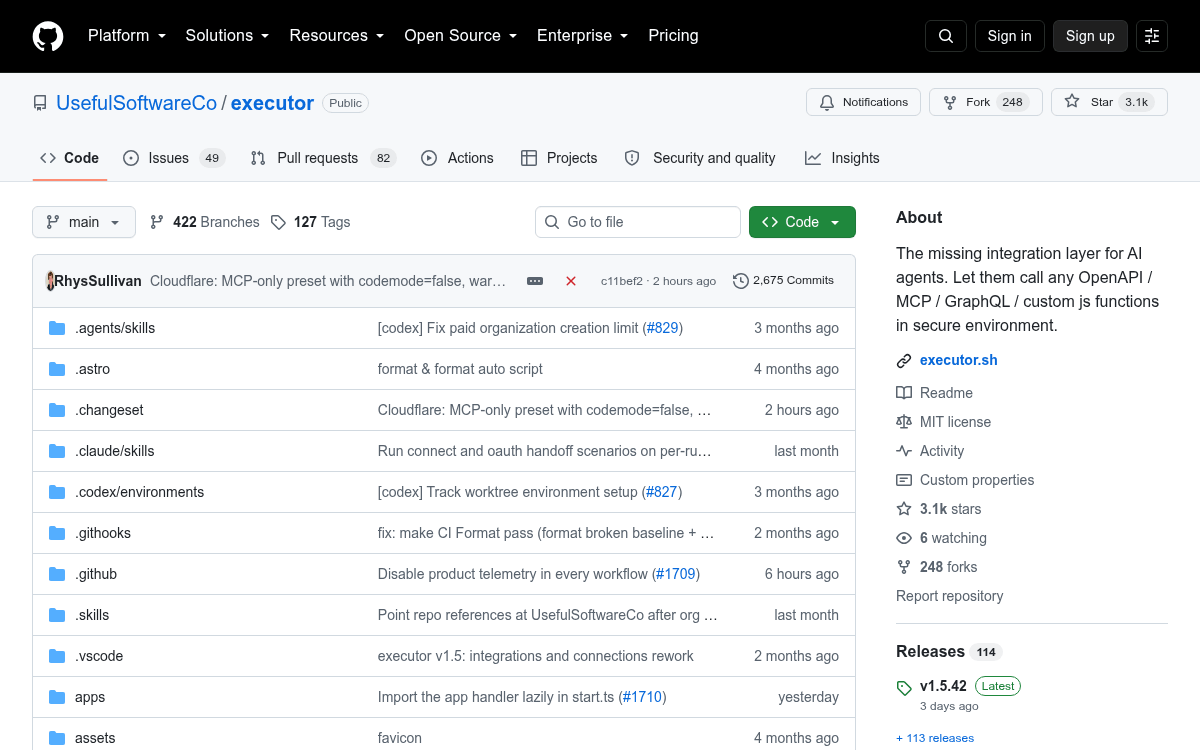
The repo is MIT licensed, written in TypeScript on a Bun and Turborepo monorepo, and has crossed 3,000 GitHub stars. It exposes one MCP endpoint that any agent can point to, and behind that endpoint sits a shared catalog of tools imported from OpenAPI specs, GraphQL APIs, MCP servers, and Google Discovery documents.
One tool shape to rule them all
The core idea is normalization. MCP, OpenAPI, GraphQL, or a custom integration all collapse into a tool name, an input schema, and an output schema under the hood. Once a service is in that shape, the same guardrails, the same auth, and the same calling convention apply no matter which agent is on the other end.
The workflow the project describes is straightforward:
- Add an integration by pasting an OpenAPI, GraphQL, or MCP URL. Executor detects the type and indexes the tools.