
Understand Anything Turns Any 200k-Line Codebase Into a Clickable Knowledge Graph
A Claude Code plugin that builds an interactive knowledge graph of any codebase using Tree-sitter parsing and a multi-agent LLM pipeline.
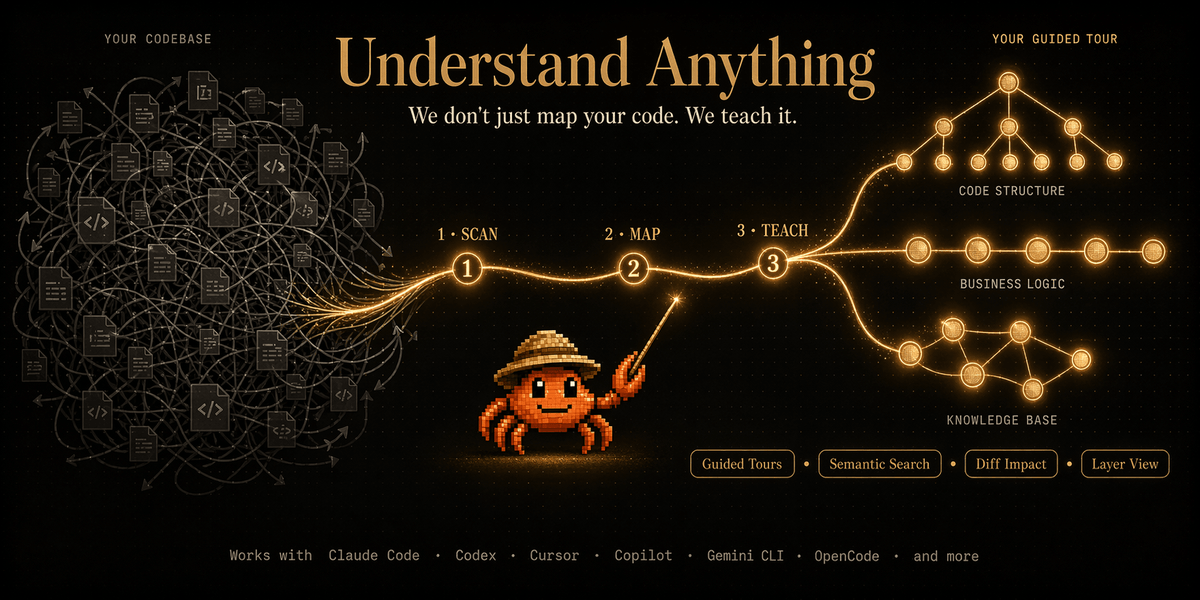
Takeaways
- Understand Anything turns any codebase into an interactive, clickable knowledge graph with plain-English summaries.
- Hybrid pipeline: Tree-sitter extracts structure deterministically while LLM agents add semantic layers, tags, and tours.
- Orchestrates 5-6 specialized agents including project-scanner, file-analyzer, architecture-analyzer, tour-builder, and graph-reviewer.
- Runs on Claude Code, Cursor, Codex, Copilot, Gemini CLI, and a dozen other platforms via one-line install.
- Graph is JSON; commit it and teammates open a read-only dashboard without any LLM calls.
- Ships commands like
/understand-diff,/understand-onboard, and/understand-chatfor daily codebase work.
Joining a new team and staring at a 200,000-line codebase is one of software's least glamorous rituals. Understand Anything tries to fix that by turning any repository into an interactive knowledge graph you can pan, click, search, and interrogate in plain English. The Claude Code plugin analyzes your project with a multi-agent pipeline, builds a graph of every file, function, class, and dependency, then exposes the result through an interactive dashboard.
The project has crossed 79k stars on GitHub and reaches well beyond Anthropic's stack, working with Claude Code, Codex, Cursor, Copilot, Gemini CLI, and others. It also handles knowledge bases and docs, not only source code. Licensing is MIT and the tool is free; your only spend is the LLM tokens burned during initial analysis.
Parsers do the facts, LLMs do the meaning
The core design choice is a hybrid pipeline that avoids asking an LLM to do work a parser can do reliably. Tree-sitter handles the deterministic side, parsing source into a concrete syntax tree and extracting imports, exports, function and class definitions, call sites, and inheritance. LLMs then read that parsed structure alongside the original source to produce what parsers cannot: plain-English summaries, tags, architectural layer assignments, business-domain mapping, and guided tours.