
UNC's AutoResearchClaw Writes Full Academic Papers, Beats AI Scientist v2 by 54.7%
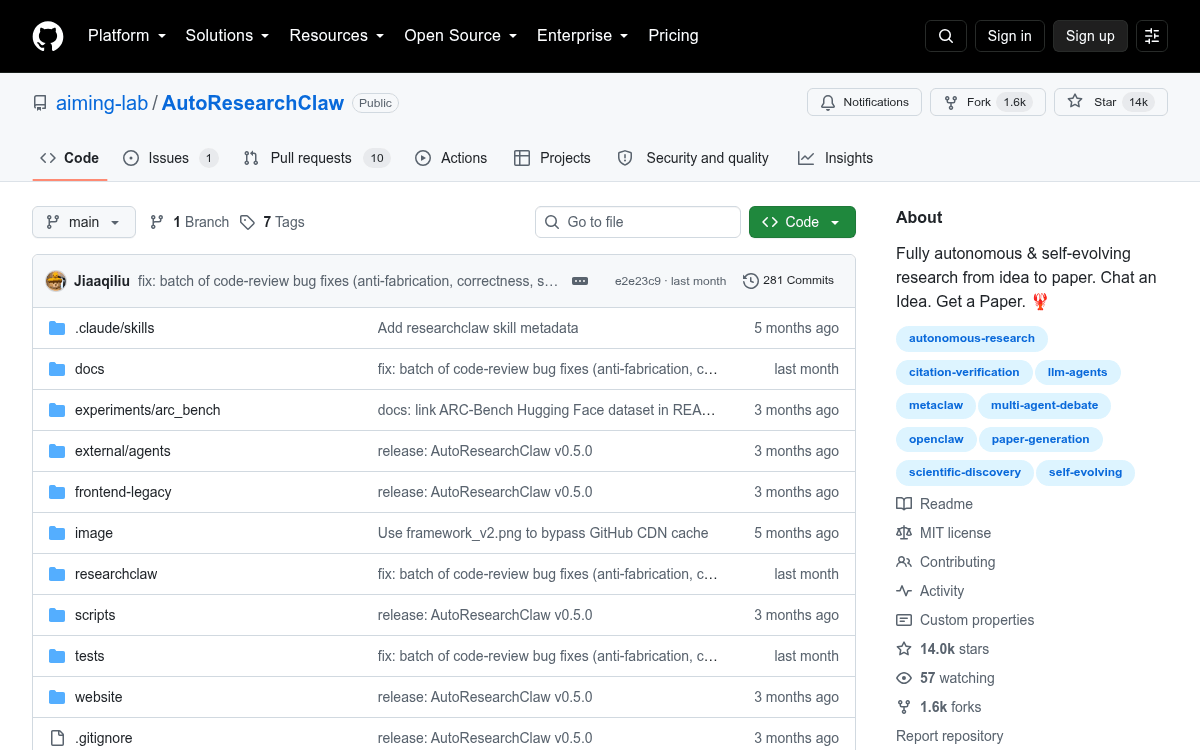
AutoResearchClaw is an open-source, 23-stage multi-agent pipeline that turns a one-line research idea into a conference-ready paper, outperforming AI Scientist v2 by 54.7% on a new benchmark.
 Pro
Takeaways
- AutoResearchClaw is a free, MIT-licensed, open-source pipeline that turns a one-line idea into a full academic paper with real experiments and verified citations. GitHub
- The 23-stage system covers literature search, hypothesis generation via multi-agent debate, sandboxed experiment execution, paper writing, and LaTeX export targeting NeurIPS/ICML/ICLR.
- On their ARC-Bench benchmark, it outperforms AI Scientist v2 by 54.7%; Co-Pilot mode achieves an 87.5% paper acceptance rate vs. 25% for full-auto.
- A self-healing Pivot/Refine loop lets the system recover from failed experiments autonomously, rather than halting the pipeline like prior systems.
- MetaClaw cross-run learning converts pipeline failures into reusable skills, improving robustness by +18.3% and cutting refinement cycles by 40% in A/B tests.
- Supports any ACP-compatible LLM backend (Claude Code, Gemini CLI, Codex CLI) and can be triggered from Discord or Telegram via OpenClaw. Paper
AutoResearchClaw is a fully autonomous, self-evolving research system that takes a single research idea and produces a complete academic paper -- literature review, experiments, figures, LaTeX, and verified citations included. You type a topic. It does the rest. The project has already crossed 5,000 GitHub stars and comes with a published arXiv paper backing its claims.
The system is built by Aiming Lab (UNC) with a 35-person author list spanning Salesforce Research, Stanford, and UCSC. It is MIT-licensed, free to use, and available right now on GitHub.
The problem with existing autonomous research tools
Automating scientific discovery requires more than generating papers from ideas. Real research is iterative: hypotheses are challenged from multiple perspectives, experiments fail and inform the next attempt, and lessons accumulate across cycles. Existing autonomous research systems often model this process as a linear pipeline -- they rely on single-agent reasoning, stop when execution fails, and do not carry experience across runs.
A major limitation of previous autonomous systems is their tendency to stop entirely when an experiment fails. AutoResearchClaw introduces a "self-healing" executor that treats failures as valuable data. That shift -- from brittle linear pipelines to adaptive, iterative loops -- is the core design philosophy here.
23 stages, 8 phases, one command
The tool operates through a 23-stage pipeline, divided into eight phases: Research Scoping, Literature Discovery, Knowledge Synthesis, Experiment Design, Execution, Analysis and Decision, Paper Writing, and Finalization. The whole thing can be triggered with a single shell command:
# Fully autonomous
researchclaw run --topic "Your research idea here" --auto-approve
# Human-in-the-loop co-pilot mode
researchclaw run --topic "Your research idea here" --mode co-pilot
The output lands in a timestamped artifacts/ folder and includes everything you need to submit to a conference:
paper.tex-- conference-ready LaTeX targeting NeurIPS, ICML, or ICLR templatesreferences.bib-- real BibTeX from OpenAlex, Semantic Scholar, and arXiv, auto-pruned to match inline citationsverification_report.json-- 4-layer citation integrity check (arXiv ID, CrossRef DOI, Semantic Scholar title match, LLM relevance scoring)