
Tsinghua's OpenMAIC Turns Any Document Into a Live AI Classroom
Tsinghua's OpenMAIC turns any topic or PDF into a live multi-agent classroom with AI teachers, debates, simulations, and quizzes — free and open source
 Pro
Takeaways
- What it is: OpenMAIC is Tsinghua University's open-source platform that turns any topic or PDF into a live multi-agent AI classroom.
- Key innovation: Multiple AI agents (teacher, TA, classmates) interact in real time with 28+ action types — whiteboard, voice, simulations, debates.
- Validated at scale: Tested with 700+ Tsinghua students and 100K+ learning records, achieving 84.1% satisfaction, outperforming traditional MOOCs.
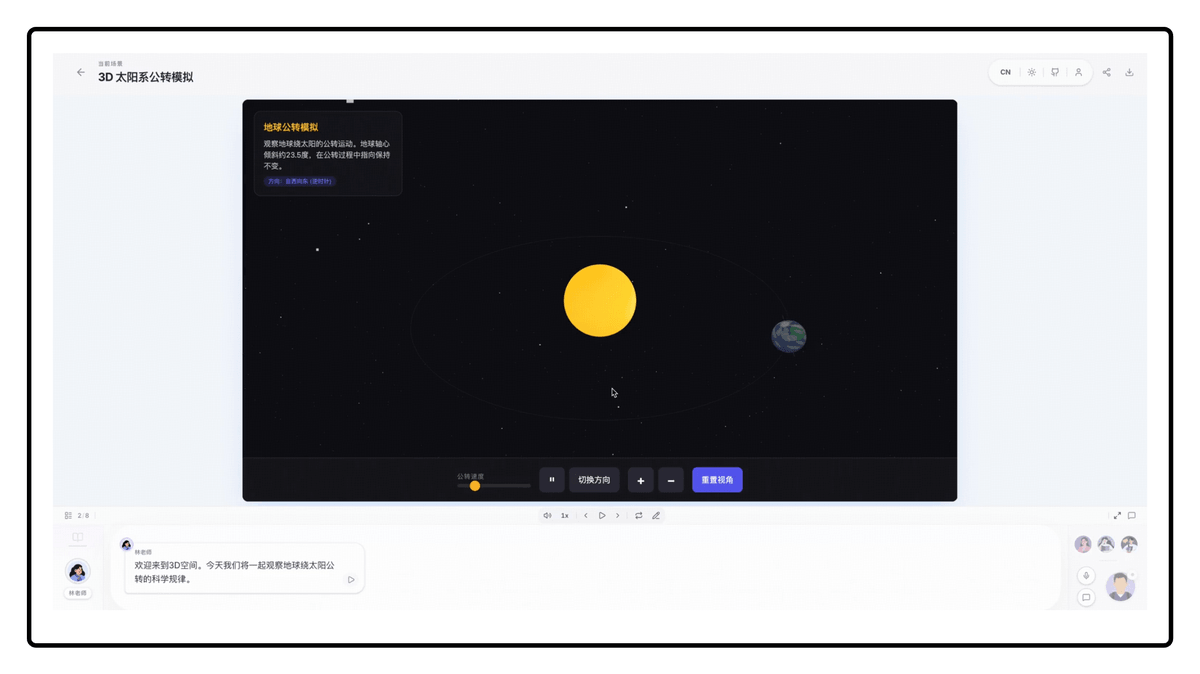
- Deep Interactive Mode: Generates 3D visualizations, physics simulations, mini-games, mind maps, and in-browser coding environments per lesson.
- Flexible deployment: Runs locally, on Docker, or Vercel; supports OpenAI, Anthropic, Gemini, DeepSeek, Ollama, and 15+ other LLM providers.
- Free and MIT-licensed: Commercially usable at no cost; exports to .pptx, interactive HTML, offline ZIP, and now one-click MP4 video.
OpenMAIC (Open Multi-Agent Interactive Classroom) is a fully open-source platform from Tsinghua University that converts any topic description or uploaded document into a complete, interactive classroom experience , in minutes. Instead of a single chatbot answering questions, you get a cast of AI agents: a teacher with a distinct personality, a teaching assistant, and AI classmates who debate, ask questions, and draw on a shared whiteboard. The repo has already crossed 20,700 stars on GitHub, a signal that the idea of replacing passive video lectures with social, agentic learning is resonating broadly.
The Problem With MOOCs , and Why It Matters Now
The MOOC (Massive Open Online Course) model, pioneered by platforms like Coursera and edX, solved the distribution problem for education: anyone, anywhere, could access university-grade content. But it never solved the engagement problem. Completion rates for MOOCs hover around 5-15%, largely because watching a pre-recorded lecture is fundamentally passive. You can pause, rewind, and re-watch, but you cannot raise your hand, get called on, or argue with a classmate.
Launched in early 2026 and backed by a JCST 2026 research paper titled "From MOOC to MAIC," OpenMAIC represents the shift from passive video learning to active, social AI-powered education. The project introduces the MAIC (Multi-Agent Interactive Classroom) paradigm , a conceptual evolution from the MOOC model , that leverages LLM-driven agents to create active, personalized, and socially rich learning environments.
How It Actually Works Under the Hood
OpenMAIC follows a two-stage LangGraph-powered pipeline that ensures structured, pedagogically sound lessons. LangGraph is a framework for building stateful, graph-based agent workflows , think of it as a state machine that decides which agent speaks next, what action it takes, and how to handle your response.
- Stage 1 , Outline: A Lesson Planner agent analyzes your input (a topic string or uploaded PDF) and generates learning objectives, breaks content into logical scenes, and sequences activities for optimal retention.
- Stage 2 , Scene generation: A Content Generator creates slides, voice scripts, quiz questions at multiple difficulty levels, and HTML-based interactive simulations for each outline item.
Once generated, the classroom enters live mode. The platform simulates an authentic classroom environment populated by AI teachers with distinct teaching styles, AI teaching assistants who provide supplementary help, and AI classmates who participate in discussions and debates. The action engine supports 28+ distinct action types , speech, whiteboard draw, spotlight, laser pointer, and more , all coordinated by the LangGraph orchestrator in real time via Server-Sent Events.
Five Ways Students Actually Interact
OpenMAIC's "Deep Interactive Mode" goes well beyond slides. It orchestrates specialized AI agents , teachers with distinct teaching styles, teaching assistants, and interactive classmates , delivering live slides, voice narration, real-time quizzes with instant grading, HTML simulations, whiteboard collaboration, and group debates. The five scene types available in Deep Interactive Mode are:
- 3D Visualization , Three.js-powered spatial models for abstract structures like molecular geometry or network topologies
- Simulation , Physics and process simulators where you adjust variables and observe outcomes in real time
- Game , Knowledge-reinforcement mini-games that test comprehension through interactive challenges
- Mind Map , Auto-generated concept maps that build a visual framework of the lesson's key ideas
- Online Programming , In-browser code editor with instant execution, so you learn by writing and running code, not just reading it
The AI teacher does not just hand off to these widgets , it actively operates them, highlighting areas, setting initial conditions, and directing your attention at the right moments.
The Research Behind the Product
The platform has been validated through extensive real-world deployment with over 700 students at Tsinghua University across more than two years of testing, iteration, and refinement. Validated with over 700 real Tsinghua students and 100K+ learning records, it achieved 84.1% satisfaction while outperforming traditional MOOCs in engagement and retention. The underlying research paper was published in the Journal of Computer Science and Technology (JCST 2026), giving the project an unusually solid empirical foundation for an open-source tool.
Getting It Running
The setup is straightforward. You need Node.js ≥ 20 and pnpm ≥ 10, then:
git clone https://github.com/THU-MAIC/OpenMAIC.git
cd OpenMAIC
pnpm install
cp .env.example .env.local
# Add at least one LLM API key, then:
pnpm dev
Visit http://localhost:3000 and you are running. For production, a one-click Vercel deploy button is available, and Docker Compose handles containerized deployments.
Built with Next.js, LangGraph, and support for OpenAI, Anthropic, Google Gemini, and DeepSeek models, OpenMAIC runs locally, on Docker, or Vercel.
The recommended starting model is Gemini 3 Flash for the best speed-to-quality ratio.
The platform supports a wide range of LLM providers out of the box: OpenAI, Azure OpenAI, Anthropic, Amazon Bedrock, Google Gemini, DeepSeek, Qwen, Kimi, MiniMax, Grok, and Ollama for fully local inference. You can also run speech recognition locally via FunASR and voice cloning via VoxCPM2 , no API keys required for either.
What You Can Export
Generated classrooms are not locked inside the app. OpenMAIC supports three export formats:
- .pptx , Fully editable PowerPoint slides with images, charts, and LaTeX formulas rendered via MathML-to-OMML conversion
- Interactive HTML , Self-contained web pages with all simulations and interactive elements baked in
- Classroom ZIP (.maic.zip) , Full offline export with all assets inlined as
data:URIs, so the course plays in air-gapped or intranet environments with no CDN dependencies
The latest v0.3.1 update also added one-click MP4 video export via an optional Docker sidecar that uses Chromium and FFmpeg to render the classroom as a video file.
Where It Shines , and Where It Does Not
OpenMAIC is strongest for self-directed learning on well-defined topics, corporate training sessions, and rapid course prototyping. Give it a research paper and it will build a structured lesson around it. Give it a topic like "teach me Python in 30 minutes" and it generates a full curriculum with code exercises.
The limitations are worth knowing upfront. Long classroom sessions with premium models (GPT-4-class) can get expensive fast , the project recommends Gemini Flash as a cost-effective default. Complex PDFs with dense tables or equations need the optional MinerU integration for accurate parsing, otherwise the content generator may misread the source material. Self-hosting gives full control over data and costs , a free, extensible alternative to proprietary AI tutors. But that also means you are responsible for managing API keys, server costs, and the persistence layer if you want multi-user deployments.
A New Assumption About What AI Tutors Can Be
Unlike single-chat AI tutors, OpenMAIC simulates an entire classroom environment with multiple autonomous agents that interact with each other and the learner in real time. This is the real shift the project represents. The dominant mental model for AI-assisted learning has been one-on-one tutoring , you ask, the model answers. OpenMAIC argues that the social dynamics of a classroom , being called on, watching peers debate, collaborating on a project , are not incidental to learning, they are central to it.
The platform is MIT-licensed and commercially usable at no cost. For teams building internal training tools, education startups, or researchers studying AI-driven pedagogy, the combination of a production-ready codebase, a published research foundation, and a rapidly growing community makes OpenMAIC one of the more substantive open-source releases in the AI education space this year.
 X X post by @alphasignal