
TradingAgents-CN Rebuilds AI Stock Analysis for China's A-Share Market
TradingAgents-CN brings a full multi-agent analyst team to Chinese stock markets, with A-share data, domestic LLMs, and a production-grade web UI
Takeaways
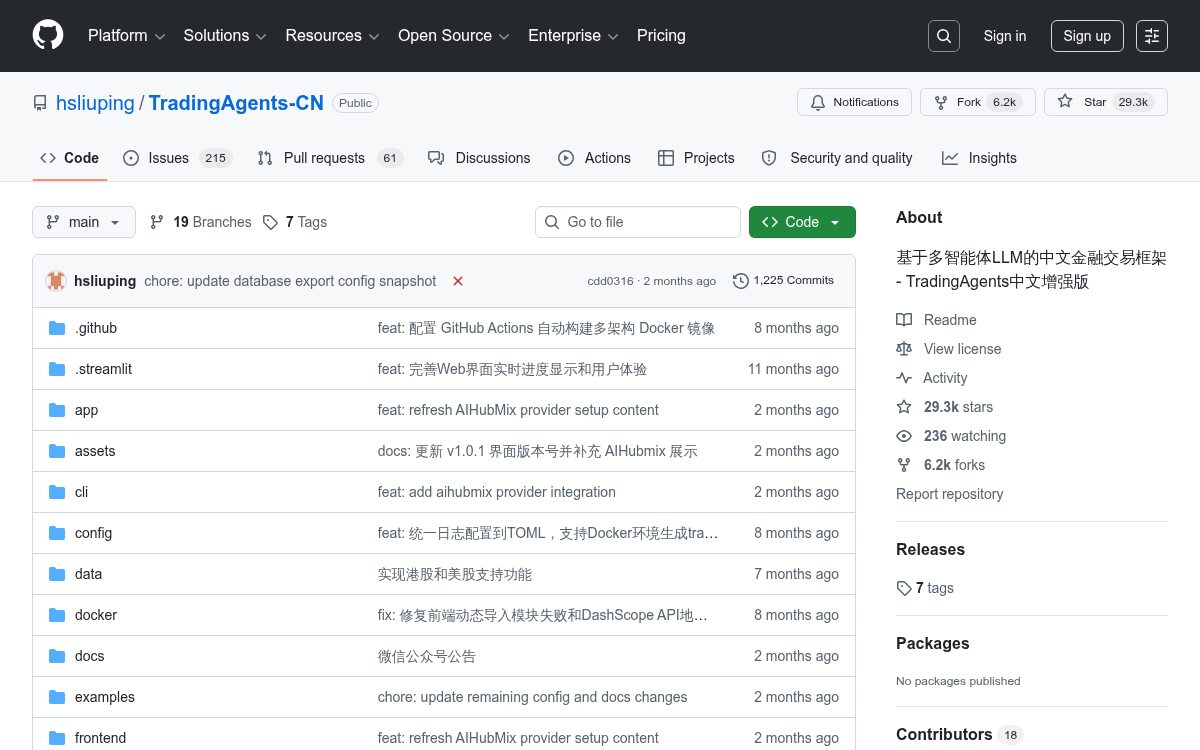
- TradingAgents-CN is an open-source, Chinese-localized multi-agent LLM trading research framework with ~27K GitHub stars, built on top of TauricResearch/TradingAgents.
- Simulates a full trading firm with specialized agents: fundamental, technical, news, and sentiment analysts, plus bull/bear researchers and a trader agent that synthesizes their debate.
- v1.0.1 upgrades the stack to FastAPI + Vue 3, MongoDB + Redis (10x perf claim), and adds Docker multi-arch support for x86 and ARM64.
- Supports A-shares, HK stocks, and US stocks via Tushare, AkShare, and BaoStock; integrates domestic LLMs including DeepSeek, Qwen, and Google Gemini.
- The original paper reports 23%+ cumulative returns over baselines, but the backtest is only one quarter long and each decision costs 11+ LLM calls -- not production-ready for live trading.
- Free for personal/research use; the FastAPI backend and Vue frontend require commercial authorization for business deployments.
TradingAgents-CN is an open-source, Chinese-localized adaptation of the original TauricResearch/TradingAgents framework -- a multi-agent system that simulates an entire trading firm using LLMs. The Chinese fork takes the core architecture and rebuilds it for the realities of the A-share market: domestic model support, Chinese-language data pipelines, and a full web management interface. With nearly 27,000 stars and over 5,700 forks on GitHub, it has become one of the most-watched AI finance projects in the Chinese developer community.
The problem it actually solves
Chinese users care about different data sources, market habits, stock names, trading systems, news expressions, and financial terms compared with English environments. Using an English framework directly often creates problems: Chinese stock names and codes are not handled smoothly, and A-share, Hong Kong stock, and US stock contexts get mixed up. TradingAgents-CN addresses this directly by building the entire workflow around Chinese market conventions from the ground up.
In finance, prior efforts largely focused on single-agent systems handling specific tasks or multi-agent frameworks independently gathering data. The multi-agent systems' potential to replicate real-world trading firms' collaborative dynamics remained underexplored. That gap is exactly what the underlying TradingAgents architecture was designed to fill -- and what this fork extends to the Chinese market.
How the agent team is structured
The core idea is that in real financial institutions, trading decisions are rarely made by one person. They go through multiple roles like analysts, researchers, risk managers, and portfolio managers. TradingAgents recreates this structure using AI agents, where each one focuses on a different part of market understanding.
The agent roster maps closely to a real trading desk:
- Fundamental Analyst: analyzes company financial status, industry trends, and macroeconomic factors.
- Technical Analyst: analyzes price trends, technical indicators, and chart patterns.
- News Analyst: analyzes financial news, company announcements, and market dynamics.
- Social Media Analyst: analyzes market sentiment, investor sentiment, and social media discussions.