
This Free Open-Source Claude Tool Audits Your AI Search Visibility
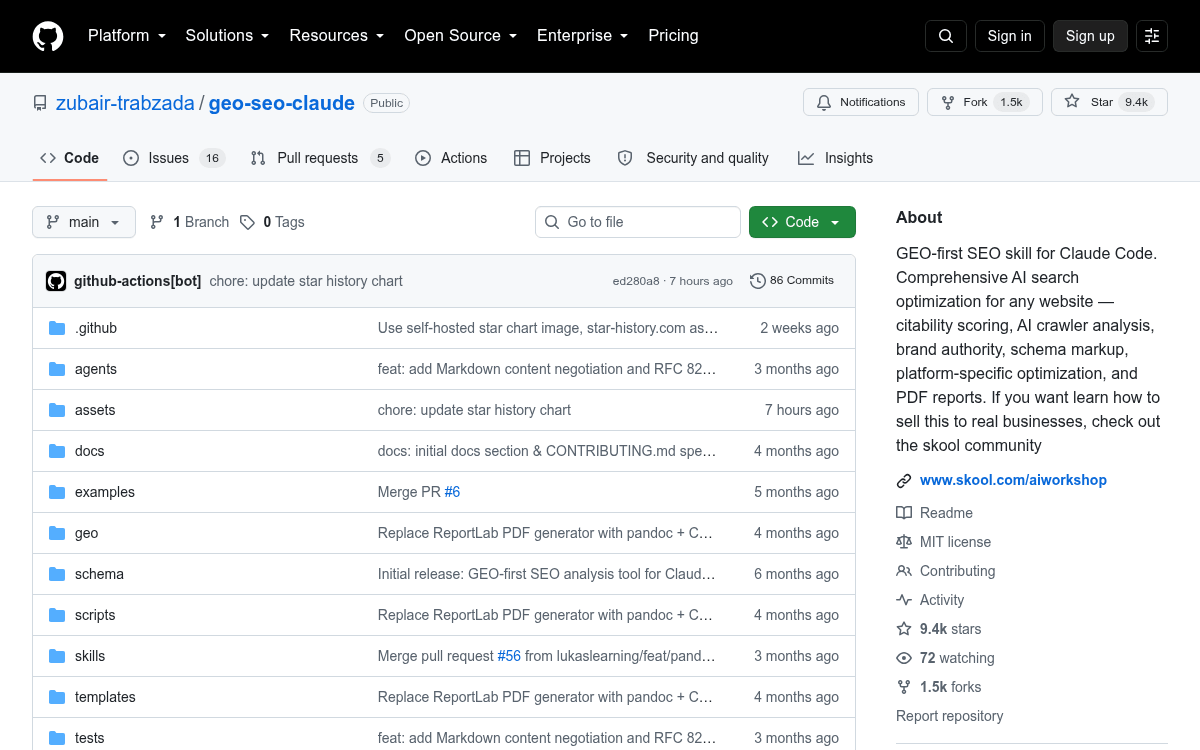
geo-seo-claude is a free, open-source Claude Code skill that audits websites for AI search visibility using 5 parallel subagents and a composite GEO score
 Pro
Takeaways
- geo-seo-claude is a free, MIT-licensed Claude Code skill that audits websites for AI search visibility across ChatGPT, Perplexity, Gemini, and Google AI Overviews.
- A single
/geo audit <url>command launches 5 parallel subagents covering citability, brand mentions, technical SEO, schema, and platform readiness. - The tool checks 14+ AI crawlers in your robots.txt -- including the critical distinction between training bots (GPTBot) and search bots (OAI-SearchBot) that most sites get wrong.
- AI-referred traffic converts at up to 15.9% vs. 1.76% for organic search, making GEO one of the highest-ROI acquisition channels available.
- The overlap between top Google rankings and AI-cited sources has dropped from 70% to below 20%, meaning traditional SEO rank no longer predicts AI visibility.
- Install with one curl command; requires Python 3.8+, Git, and the Claude Code CLI. GitHub repo here.
Traditional SEO optimized for ten blue links. GEO -- Generative Engine Optimization -- is about earning a place among the two to seven domains that large language models typically cite in a single response. That is a much smaller stage, and most websites are not even on it yet. geo-seo-claude is a free, open-source Claude Code skill that automates the full audit: it crawls your site, scores it for AI citability, checks which AI bots can reach it, and spits out a client-ready PDF report -- all from a single slash command.
Why this matters right now
The numbers behind the GEO shift are hard to ignore. According to the project's README, AI-referred traffic has grown 527% year-over-year, and that traffic converts at a dramatically higher rate than organic search. LLM visitors convert at 15.9% from ChatGPT, 10.5% from Perplexity, and 5% from Claude, compared to a 1.76% organic search conversion rate. Ahrefs found AI search visitors generated 12.1% of signups despite accounting for only 0.5% of total visitors -- because AI search users arrive with specific, researched queries and a pre-formed shortlist, making a click-through a high-intent action from a buyer already deep in evaluation.
The competitive landscape is shifting too. Research from GEO firm Brandlight suggests that the overlap between top Google links and AI-cited sources has dropped from 70% to below 20%, and that gap is growing as AI systems develop their own preferences for which sources to cite. Ranking well on Google no longer guarantees you show up in ChatGPT or Perplexity answers.
What the tool actually does
The skill installs into Claude Code and exposes a suite of /geo slash commands. Claude Code Skills are self-contained capabilities that create slash commands -- a system that was unified in 2026 so that both custom commands and Skills behave the same way. Once installed, you get eleven commands covering every layer of GEO:
/geo audit <url>-- Full GEO + SEO audit using 5 parallel subagents/geo quick <url>-- 60-second AI visibility snapshot/geo citability <url>-- Scores content blocks for AI citation readiness/geo crawlers <url>-- Checks which AI bots your robots.txt allows or blocks/geo llmstxt <url>-- Analyzes or generates anllms.txtfile/geo brands <url>-- Scans brand mentions across AI-cited platforms (Reddit, YouTube, Wikipedia, LinkedIn, and more)/geo schema <url>-- Detects and generates structured data (JSON-LD)/geo report-pdf-- Generates a client-ready PDF with score gauges and charts
The full audit flow launches five subagents in parallel: AI Visibility, Platform Analysis, Technical SEO, Content Quality, and Schema Markup. They run simultaneously, then a synthesis step aggregates their outputs into a composite GEO Score from 0 to 100.
How the score is built
The composite score weights six categories:
| Category | Weight |
|---|---|
| AI Citability & Visibility | 25% |
| Brand Authority Signals | 20% |
| Content Quality & E-E-A-T | 20% |
| Technical Foundations | 15% |
| Structured Data | 10% |
| Platform Optimization | 10% |
E-E-A-T (Experience, Expertise, Authoritativeness, Trustworthiness) is Google's framework for evaluating content quality -- it matters for GEO because AI systems use similar signals to decide what to cite. The citability scorer targets the sweet spot for AI-cited passages: 134-167 words, self-contained, fact-rich, and directly answering a question. Brand mentions get heavy weight because the README notes they correlate 3x more strongly with AI visibility than backlinks do.
The robots.txt problem it quietly solves
One of the most practically useful features is the AI crawler audit. In 2026, robots.txt is doing a job it was never designed for: refereeing the AI web, where dozens of crawlers -- GPTBot, ClaudeBot, PerplexityBot, Google-Extended and more -- pull content to train models and to answer questions in real time. Most sites have no explicit rules for any of these bots.
The situation is more nuanced than a simple allow/block. OpenAI runs GPTBot for training and OAI-SearchBot for building the ChatGPT search index -- block OAI-SearchBot and your site will not appear in ChatGPT search answers, even though both bots are run by the same company. Anthropic goes further, running three distinct bots: ClaudeBot for training, Claude-SearchBot for search indexing -- meaning you can block one without blocking the other, which is the entire basis of a smart 2026 policy: opt out of training while staying eligible for AI-search citations.
The /geo crawlers command checks all 14+ of these bots and gives you specific allow/block recommendations -- something that previously required manually reading documentation for each AI provider.
What it is good at -- and where it has limits
The tool is strongest as an audit and recommendation engine. The parallel subagent architecture means a full audit is fast, and the PDF report output is genuinely useful for client delivery. The brand mention scanner covers YouTube, Reddit, Wikipedia, LinkedIn, and seven other platforms -- surfaces that traditional SEO tools ignore entirely.
There are real caveats worth knowing:
- llms.txt adoption is still low. The llms.txt standard -- a curated map of your most important content written for LLMs -- sits at roughly 10% adoption. Google has said no on the record: Gary Illyes confirmed Google doesn't support llms.txt and isn't planning to, and no major LLM provider has publicly committed to using it as a signal in their production search surfaces. The tool generates it anyway, which is low-cost to do, but don't expect dramatic results from it alone.
- GEO is not a replacement for SEO. GEO is an additional layer -- brands that excel at GEO are typically the same brands with strong traditional SEO foundations, but GEO adds specific requirements around content structure, citation-friendliness, and data richness that SEO alone does not address.
- Platform-specific gaps are real. The README notes only 11% of domains are cited by both ChatGPT and Google AI Overviews for the same query, which means optimizing for one platform does not automatically help on another.
- Some bots ignore the rules. OpenAI, Anthropic, and Google publish bot documentation and honor robots.txt -- but Perplexity has been caught running stealth crawlers, and Bytespider has a documented non-compliance history.
Getting started
The tool is free and MIT-licensed. Installation is a one-liner on macOS and Linux:
curl -fsSL https://raw.githubusercontent.com/zubair-trabzada/geo-seo-claude/main/install.sh | bashRequirements are minimal: Python 3.8+, Git, and the Claude Code CLI. Dependencies install into an isolated virtual environment at ~/.claude/skills/geo/.venv/ so nothing touches your system Python. After that, open Claude Code and run /geo audit https://yoursite.com.
The project also ships a CRM-lite pipeline for agencies: /geo prospect manages a client pipeline, /geo proposal auto-generates proposals, and /geo compare tracks monthly progress deltas. The README is transparent that the tool is free but the monetization playbook lives in a paid Skool community -- GEO agencies, it notes, charge $2K-$12K per month for this kind of audit work.
The bigger picture
GEO is the practice of structuring your content and digital presence so that AI-powered search platforms -- including ChatGPT, Google AI Overviews, Perplexity, Claude, and Copilot -- can retrieve, cite, and recommend your brand when answering user questions. What geo-seo-claude does is make that practice executable without requiring deep expertise in every platform's quirks. The fact that it runs inside Claude Code -- rather than as a standalone SaaS -- means you can pipe the audit results directly into code changes, schema generation, and content rewrites in the same session. That tight loop between diagnosis and fix is where it stands apart from browser-based GEO dashboards.
 X X post by @alphasignal