
TaxHacker Turns Messy Receipts Into Structured Data With Local AI
TaxHacker is a free, MIT-licensed, self-hosted app that uses LLMs to extract and organize data from receipts, invoices, and PDFs — with full control over your AI provider and prompts.
Takeaways
- What it is: TaxHacker is a free, MIT-licensed, self-hosted app that uses LLMs to extract structured data from receipts, invoices, and PDFs.
- LLM flexibility: Supports OpenAI, Gemini, Mistral, and any local model via OpenAI-compatible API (Ollama, LM Studio, vLLM).
- Custom prompts: Every extraction field has an editable LLM prompt — you can add unlimited custom fields to pull any data you need.
- Multi-currency: Automatically converts 170+ currencies and 14 cryptocurrencies using historical exchange rates from the transaction date.
- Two-command deploy: Ships as a Docker Compose stack with PostgreSQL; runs on any server or home machine on port 7331.
- Cloud option: A managed cloud edition is available at €10/month for those who prefer not to self-host.
TaxHacker is an open-source, self-hosted accounting app that uses large language models to turn a pile of receipts, invoices, and PDFs into a clean, searchable database. It is designed for freelancers, indie hackers, and small businesses who want to automate expense and income tracking using the power of modern AI. The repo has crossed 6,100 stars and nearly 1,000 forks, signaling real traction in the self-hosted community.
Created by indie developer vas3k, TaxHacker addresses a critical gap in the market: while commercial solutions like Expensify or Receipt Bank require you to surrender financial data to the cloud, TaxHacker runs entirely on your own infrastructure. The self-hosted edition is free under the MIT license. A managed cloud edition is also available at €10/month for those who prefer not to run their own server.
Drop a file, get structured data
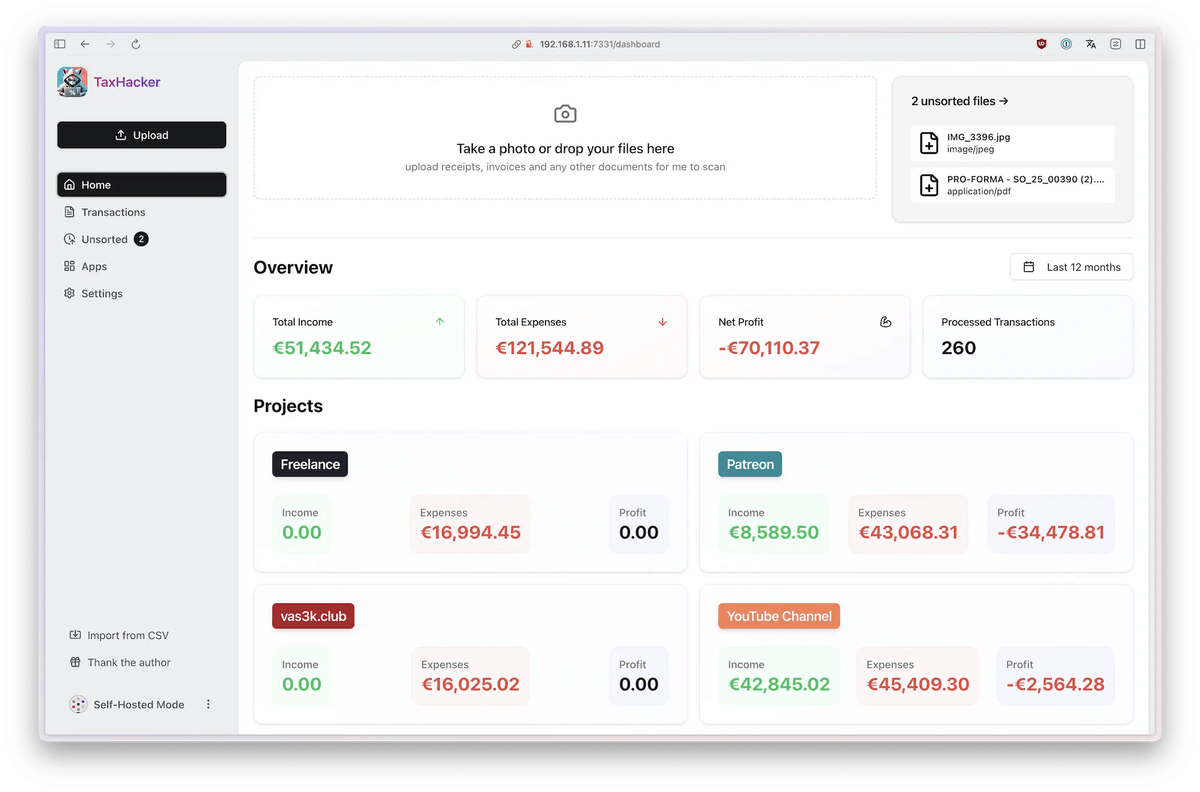
Upload photos of receipts, invoices, or PDFs, and TaxHacker will automatically recognize and extract all the important data you need for accounting , product names, amounts, items, dates, merchants, taxes , and save it into a structured, Excel-like database. The pipeline handles a surprisingly wide range of inputs.
TaxHacker works with store receipts, restaurant bills, invoices, bank statements, letters, and even handwritten receipts. It handles any language and any currency.

Under the hood, the app sends the document image or PDF to an LLM of your choice. You can use OpenAI, Google Gemini, or Mistral, or even a local LLM in the self-hosted version. Local model support works with any OpenAI-compatible API endpoint , Ollama, LM Studio, vLLM, LocalAI , though the project notes that OCR quality with local models is not guaranteed.