
TAKT's Open-Source CLI Forces AI Coding Agents to Follow Rules
TAKT is an open-source CLI that lets you define multi-agent coding workflows in YAML, with built-in review loops, guardrails, and full audit logs
Takeaways
- TAKT is a free, open-source CLI that runs AI coding agents through YAML-defined workflows with built-in plan-implement-review-fix loops.
- Supports Claude Code, Codex, OpenCode, Cursor, GitHub Copilot CLI, and Kiro as providers; works via SDK or CLI.
- Introduces Faceted Prompting: prompts are split into five reusable files (Persona, Policy, Instruction, Knowledge, Output Contract) composed declaratively per step.
- Each task runs in an isolated git clone with per-step permission modes (readonly/edit/full) and full NDJSON audit logs.
- Supports parallel task execution (up to 10 concurrent), GitHub Issue integration, and a GitHub Actions plugin.
- Install with
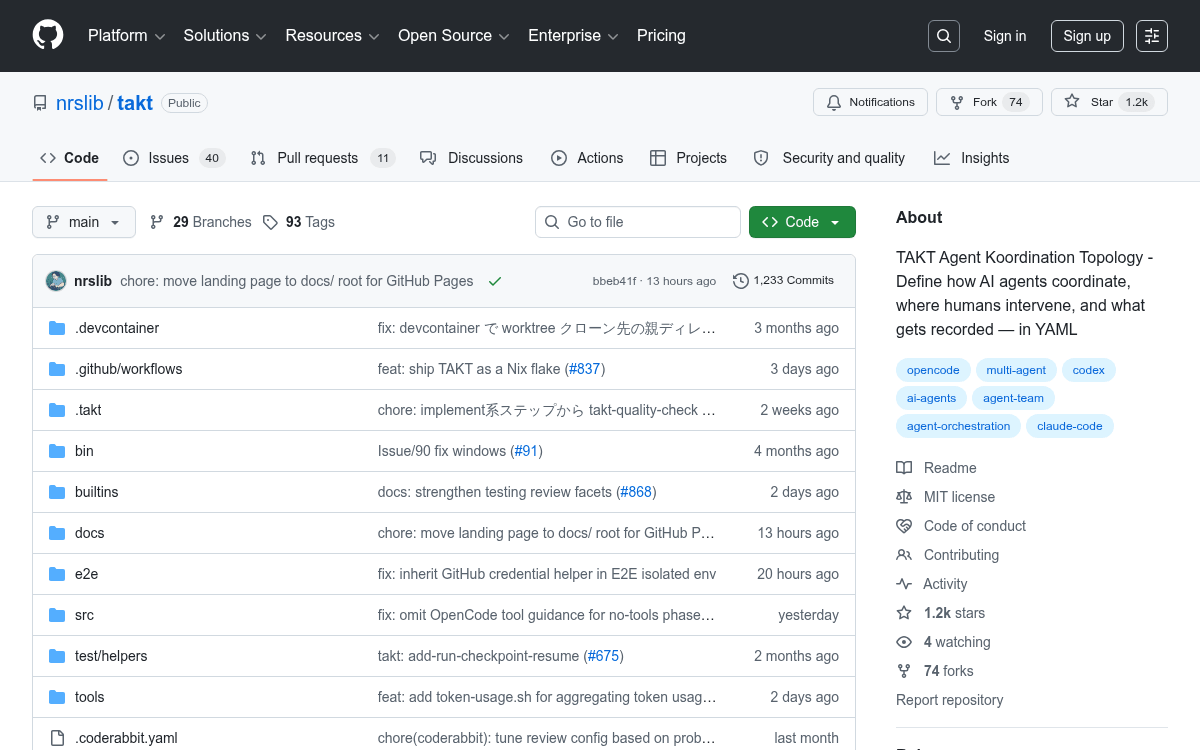
npm install -g takt; MIT licensed. GitHub repo
AI coding agents can write code fast, but they are notoriously bad at staying on track. They forget instructions mid-task, accumulate polluted context, blur the line between implementing and reviewing, and force you to repeat the same feedback over and over. TAKT (Agent Koordination Topology) is an open-source CLI that attacks this problem at the process level: instead of hoping your agent follows rules embedded in a prompt, you define the entire workflow in YAML and let TAKT enforce it from the outside.
The name comes from the German word for a conductor's baton stroke. The metaphor is deliberate. TAKT uses a music metaphor to describe how it keeps agents in time, just as a baton keeps an orchestra synchronized. You write the score; the agents play their parts.
The core problem it solves
AI coding agents are powerful, but they do not automatically create a stable development process. In long-running work, they forget instructions, accumulate polluted context, blur implementation and review responsibilities, and often force humans to repeat the same feedback again and again. That wears people down.
Adding more rules to prompts or skill files can help, but it cannot enforce the process. Whether the rules are followed is still left to the agent's behavior. TAKT treats AI agents as something to be controlled from the outside, not simply trusted.
This is a meaningful shift in philosophy. Most agent frameworks today ask you to write better prompts and hope for the best. TAKT asks you to define a state machine, then runs agents through it step by step.
How it works
TAKT orchestrates multiple AI agents with structured review loops, managed prompts, and guardrails. You talk to AI to define what you want, queue it as a task, and run it with takt run. Planning, implementation, review, and fix loops are defined in YAML workflow files, so the process is not left to the agent's discretion.
A workflow is a sequence of steps. Each step specifies a persona (who), permissions (what's allowed), and rules (what happens next). Rules determine transitions: a step can route to the next step, loop back to a previous one, or terminate with