
Strukto AI's Mirage Lets Agents Control S3, Slack and GitHub With Plain Bash
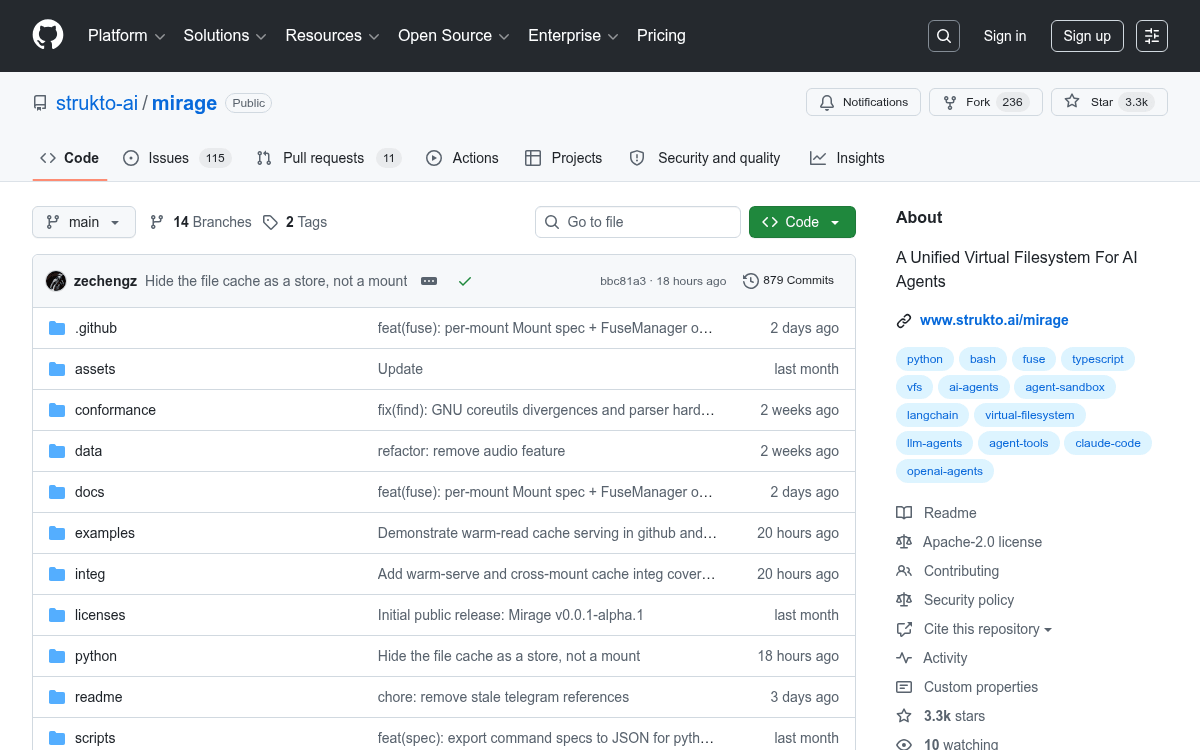
Mirage mounts S3, Slack, GitHub, and 15+ other services as a single bash-navigable filesystem, giving AI agents one universal interface instead of dozens of SDKs.
Takeaways
- One filesystem for everything: Mirage mounts S3, Slack, GitHub, Google Drive, Redis, and 15+ other backends as a single virtual directory tree agents navigate with bash.
- Zero new vocabulary: Agents use
ls,cat,grep, and pipes across all services — no new APIs or MCP servers to learn. - Two-layer cache built in: Index and file caches cut repeated remote API calls to zero; Redis backend available for multi-process and serverless deployments.
- Portable workspaces: Entire agent environments snapshot to a single
.tarfile, enabling reproducible runs and easy debugging of failures. - Broad framework support: Integrates with OpenAI Agents SDK, Vercel AI SDK, LangChain, Pydantic AI, CAMEL, OpenHands, Claude Code, and Codex.
- Open source, Apache 2.0: Available now on GitHub with Python and TypeScript SDKs and a CLI installer.
Mirage is a new open-source project from Strukto AI that gives AI agents a unified virtual filesystem: a single directory tree where S3, Google Drive, Slack, GitHub, Redis, and a dozen other backends all live side by side. Instead of wiring up a separate SDK for every service your agent needs to touch, you mount them as paths and let the agent navigate with plain bash commands like ls, cat, grep, and pipes.
The core bet is simple but sharp. Modern LLMs are most fluent in bash and filesystem semantics. Mirage exposes every backend through the same handful of Unix-like tools, so agents reason about one abstraction instead of N SDKs and M MCPs. Any model that already knows bash works out of the box, with zero new vocabulary to learn.
The problem it actually solves
Building AI agents that interact with real-world data often feels like a fragmented nightmare. You end up juggling a dozen different SDKs, managing authentication for every service, and writing custom glue code just to get an agent to read a file from S3 and post a summary to Slack.
The MCP (Model Context Protocol) ecosystem tried to address this, but it introduced its own complexity: a separate server per integration, a new protocol to learn, and a growing list of things that need to be wired together. AI agents do not need to learn new APIs or MCP protocols. They simply reuse the bash and filesystem semantics already dominant in LLM training data. Data can flow between completely different backends as naturally as local disk operations, allowing agents to complete more work in a single interaction.
How it works under the hood
Mirage is not just a thin wrapper. It uses a tree-sitter bash parser plus a custom executor that routes commands to per-mount handlers, so there is no subshell to /bin/bash and no os.system. Most common Unix verbs work (