
Stanford's OpenJarvis Runs Your Personal AI Locally Without Sending Data to the Cloud
Stanford's Hazy Research Lab releases an open-source, fully on-device AI agent framework that keeps your data off the cloud and gets smarter over time.
 Pro
Takeaways
- Stanford's Hazy Research Lab released OpenJarvis, an open-source framework for fully on-device personal AI agents under Apache 2.0.
- Local models already handle 88.7% of chat and reasoning queries, with 5.3x efficiency gains since 2023, making cloud routing unnecessary for most tasks.
- Built around five composable primitives: Intelligence, Engine, Agents, Tools & Memory, and Learning, each independently benchmarkable and swappable.
- A self-improvement loop fine-tunes local models, prompts, and agent logic from on-device interaction traces using SFT, GRPO, DSPy, and more.
- Ships with 8 built-in agents (morning digest, deep research, code assistant, etc.) and access to 13,700+ community skills via OpenClaw.
- Installs in ~3 minutes on macOS/Linux; energy and cost are first-class metrics tracked at 50ms intervals across NVIDIA, AMD, and Apple Silicon.
Most "personal" AI tools are personal in name only. Your emails, documents, and messages get routed to a cloud server, processed by someone else's model, and returned to you. OpenJarvis, a new open-source framework from Stanford's Hazy Research and Scaling Intelligence Lab, is built around a different premise: the AI runs on your machine, your data never leaves, and the system gets better the more you use it.
The problem it's solving
Personal AI agents have exploded in popularity, but the architecture has stayed the same: a thin local shell calling a cloud API. In nearly all of today's personal AI projects, the local component is a thin orchestration layer, while the "brain" lives in someone else's data center. OpenJarvis argues this is no longer a technical necessity. Their Intelligence Per Watt research showed that local language models already handle 88.7% of single-turn chat and reasoning queries, with intelligence efficiency improving 5.3x from 2023 to 2025. The hardware and models are ready. What was missing was the software stack.
The team identified three concrete gaps holding back local-first AI:
- No shared abstractions. Teams assemble bespoke stacks, choosing independently among model servers, orchestration frameworks, memory stores, tool interfaces, and adaptation pipelines, resulting in duplicated effort and brittle, non-interoperable systems.
- Efficiency is an afterthought. Systems are tuned for task quality alone, even though on-device deployments must jointly satisfy constraints on latency, energy, memory footprint, and dollar cost.
- No closed-loop learning. Because most AI systems run in the cloud, the pieces needed for local improvement don't exist: trace data isn't available, model weights are closed, and the runtime isn't tunable.
Five primitives, one coherent stack
OpenJarvis is structured around five composable primitives: Intelligence, Engine, Agents, Tools & Memory, and Learning. Each primitive can be benchmarked, substituted, and optimized independently, or analyzed within the context of the full system. Think of it as a modular, hardware-aware software stack for on-device AI, analogous to what PyTorch did for model training.
- Intelligence (model layer). Rather than forcing users to track model releases, parameter counts, or memory tradeoffs, OpenJarvis lets them specify the capability they need and then determines what their hardware can realistically support. It supports Qwen, Gemma, Granite, GLM, and other open model families.
- Engine (inference backend). Local inference today is powerful but fragmented, with backends such as Ollama, vLLM, SGLang, llama.cpp, Apple Foundation Models, and others each offering different strengths depending on platform, memory, and performance constraints. OpenJarvis abstracts over all of them.
jarvis initdetects your hardware and picks the right backend automatically. - Agents (reasoning layer). OpenJarvis provides a composable set of agent roles designed for bounded context windows, limited working memory, and strict efficiency constraints, including an Orchestrator that breaks complex tasks into subtasks and an Operative, a lightweight executor for recurring personal AI workflows.
- Tools & Memory (grounding layer). OpenJarvis provides native support for MCP (Model Context Protocol) for standardized tool use, Google A2A (Agent-to-Agent) for inter-agent communication, and semantic indexing for local retrieval over papers, notes, and documents.
- Learning (adaptation layer). OpenJarvis turns local traces into an operational improvement loop, using personal interaction data to synthesize training data, refine agent behavior, and improve model selection over time.
Self-improvement without the cloud
The Learning primitive is arguably the most novel piece. Because everything runs locally, OpenJarvis can capture rich structured traces across the entire stack and use them to improve the system. Closed-loop optimization covers four layers: model weights (via SFT, GRPO, DPO), LM prompts (via DSPy-style optimization), agentic logic (via approaches like GEPA), and inference engine tuning including quantization selection and hardware-specific kernel configuration.
In practice, this means the system can fine-tune a local model on your own interaction history, automatically refine the prompts it uses, and adjust how it routes tasks, all without sending anything to an external server. The jarvis optimize command packages this entire workflow into a single command.
Efficiency as a first-class citizen
OpenJarvis includes a hardware-agnostic telemetry system that profiles energy consumption across NVIDIA GPUs (via NVML), AMD GPUs, and Apple Silicon (via powermetrics), sampling at 50ms intervals. The jarvis bench command benchmarks latency, throughput, and energy per query. This matters because running AI on a laptop on battery is a fundamentally different constraint than running it in a data center, and most frameworks ignore that entirely.
Eight agents, ready out of the box
OpenJarvis ships with eight built-in agents across three execution modes: on-demand, scheduled, and continuous. Here's what's included:
| Agent | Mode | What it does |
|---|---|---|
morning_digest | Scheduled | Daily briefing from email, calendar, health, news with TTS audio |
deep_research | On-demand | Multi-hop research with citations across web and local docs |
monitor_operative | Continuous | Long-horizon monitoring with memory, compression, and retrieval |
orchestrator | On-demand | Multi-turn reasoning with automatic tool selection |
native_react | On-demand | ReAct (Thought-Action-Observation) loop agent |
operative | Continuous | Persistent autonomous agent with state management |
native_openhands | On-demand | CodeAct: generates and executes Python code |
simple | On-demand | Single-turn chat, no tools |
Getting started in under 3 minutes
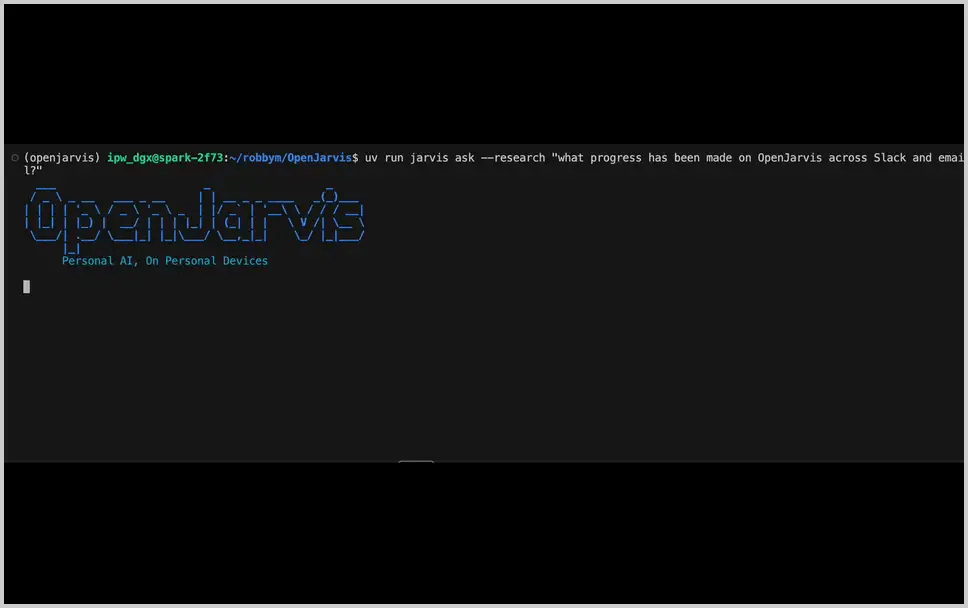
The installer handles everything: the Python environment, Ollama, and a starter model. On macOS or Linux:
curl -fsSL https://open-jarvis.github.io/OpenJarvis/install.sh | bash
jarvis
From there, preset configs let you jump straight into a specific use case:
# Morning briefing
jarvis init --preset morning-digest-mac
jarvis connect gdrive          # OAuth for Gmail, Calendar, Tasks
jarvis digest --fresh
# Local research assistant
jarvis init --preset deep-research
jarvis memory index ./docs/
jarvis ask "Summarize all emails about Project X"
Skills can be imported from Hermes Agent (~150 skills) or OpenClaw (~13,700 community skills), and follow the agentskills.io open standard. You can also optimize skills directly from your own usage history with jarvis optimize skills --policy dspy.
What it's good at, and where it falls short
OpenJarvis is well-suited for personal AI tasks like email triage, morning briefings, and scheduled summaries that run on a cron schedule without cloud dependencies, as well as agentic workflows like code review, web research, and document processing pipelines. It connects to iMessage, Telegram, WhatsApp, and 26+ other messaging channels, keeping all personal data on-device.
The tradeoffs are real, though. Local models still lag behind frontier cloud models on complex reasoning and long-context tasks. Native Windows is not supported (WSL2 or the desktop binary is required). And the self-improvement loop, while architecturally compelling, is new territory: the quality of personalization will depend heavily on how much interaction data accumulates over time.
The bigger picture
The Stanford team draws an explicit analogy to the PC revolution: in the 1970s and 80s, computing moved from mainframes to personal computers, not because PCs were more powerful, but because they became efficient enough for what people actually needed. OpenJarvis is betting AI is at that same inflection point now.
The project is backed by Google Cloud, IBM Research, Lambda Labs, Ollama, Stanford HAI, and the Laude Institute, and is released under Apache 2.0. OpenJarvis provides an evaluation harness spanning 30+ benchmarks, and the team is actively inviting researchers to use it to push the frontier of on-device AI. The ENERGY leaderboard lets users compete on efficiency metrics, with a Mac Mini as the current prize for top performers. The full paper is on arXiv and the documentation covers Docker deployment, cloud engine fallback, and contributor setup.
