
SGLang Team Shrinks Their AI Serving Framework to 5,000 Readable Lines
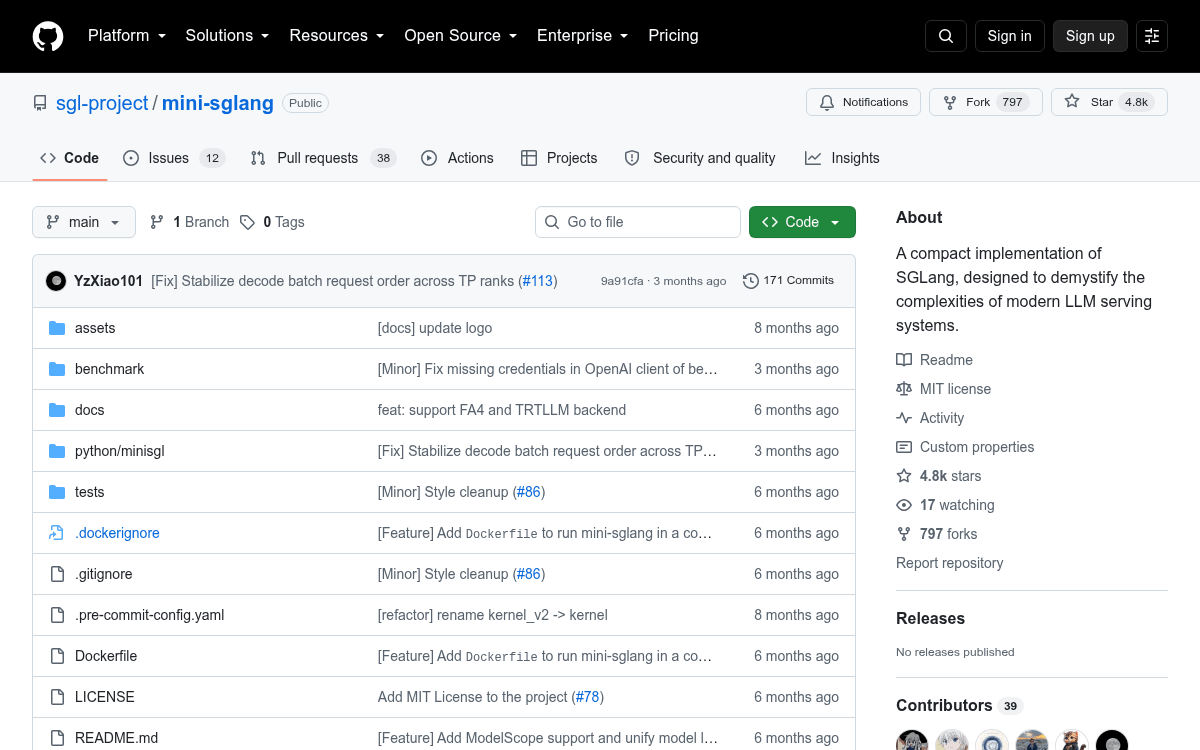
SGLang team released a 5,000-line Python distillation of their production LLM serving stack, complete with radix caching, tensor parallelism, and FlashAttention.
 Pro
Takeaways
- SGLang team open-sourced Mini-SGLang, a ~5,000 line Python reference implementation of their serving engine.
- Ships with Radix Cache, Chunked Prefill, Overlap Scheduling, and Tensor Parallelism across GPUs.
- Integrates FlashAttention, FlashInfer, and TensorRT-LLM attention backends for competitive kernel performance.
- Exposes an OpenAI-compatible API server plus an interactive shell mode with
--shell. - Benchmarks on H200 show throughput and TTFT/TBT close to full SGLang on Qwen3-32B with 4-way TP.
- Linux-only, MIT-licensed; Windows users need WSL2 or the provided Docker image.
Modern LLM inference stacks like vLLM and SGLang have grown into sprawling codebases where the actual serving logic is buried under kernel dispatchers, quantization paths, and hardware backends. The SGLang team just released Mini-SGLang, a stripped-down version of their production framework that keeps the interesting parts and throws out the rest.
Mini-SGLang fits in roughly 5,000 lines of Python and works as both a capable inference engine and a transparent reference for researchers and developers. The framing matters: this is a working system, not a toy. It runs Qwen and Llama models with tensor parallelism across multiple GPUs, exposes an OpenAI-compatible API, and ships with the same advanced scheduling tricks the parent project uses.
What survived the diet
The team preserved the optimizations that matter most for throughput and latency while cutting the surface area that makes production frameworks intimidating to read. The core feature list includes Radix Cache for reusing KV cache across shared prefixes, Chunked Prefill to reduce peak memory usage for long-context serving, Overlap Scheduling to hide CPU scheduling overhead behind GPU computation, Tensor Parallelism for scaling across GPUs, and integration with FlashAttention and FlashInfer kernels.
A few of those deserve a plain-English translation:
- Radix Cache: Prompts that share a prefix (system messages, few-shot examples, chat history) reuse the same cached activations instead of recomputing the KV cache for every request. Mini-SGLang enables this by default and lets you fall back to a naive strategy with
--cache naive. - Overlap Scheduling: The CPU normally sits idle while the GPU runs a forward pass, then the GPU waits while the CPU plans the next batch. Mini-SGLang borrows the technique from NanoFlow to overlap CPU scheduling work with GPU computation.
- Chunked Prefill: Long prompts get sliced into chunks so a single 100K-token prefill does not blow up GPU memory or block short requests queued behind it.
How the system is wired together
The architecture mirrors real SGLang and runs as a set of cooperating processes rather than a monolithic script. The API Server provides an OpenAI-compatible endpoint like /v1/chat/completions, a Tokenizer Worker converts input text into tokens, a Detokenizer Worker converts them back, and a Scheduler Worker runs per GPU (referred to as a TP Rank), managing computation and resource allocation for that specific device. Components communicate using ZeroMQ for control messages and NCCL via torch.distributed for heavy tensor data exchange between GPUs.
Reading this layout in 5,000 lines is a very different experience from tracing it through the full SGLang repo, which is the whole point.
The performance claim
The team ran two benchmark scenarios on H200 hardware. Offline throughput was measured against Nano-vLLM on Qwen3-0.6B and Qwen3-14B with 256 sequences of randomly sampled 100 to 1024 token inputs and outputs.
For online serving, they compared against full SGLang on Qwen3-32B across 4x H200 GPUs connected by NVLink, replaying the first 1000 requests of the Qwen trace dataset. The chart tracks Time-To-First-Token (TTFT) and Time-Between-Tokens (TBT) across varying request rates, and the mini version tracks the full framework closely despite running a fraction of the code.
Getting it running
The project is MIT-licensed and installs from source with uv or pip. Only Linux is supported (x86_64 and aarch64); Windows and macOS are out due to dependencies on Linux-specific CUDA kernels like sgl-kernel and flashinfer. Windows users need WSL2 or the provided Docker image.
Launching a server is a one-liner:
# Single GPU
python -m minisgl --model "Qwen/Qwen3-0.6B"
# 4-way tensor parallel on a 70B model
python -m minisgl --model "meta-llama/Llama-3.1-70B-Instruct" --tp 4 --port 30000
A --shell flag drops you into an interactive chat REPL with automatic history caching and a /reset command, which is a nice touch for poking at models without wiring up a client.
Who this is actually for
If you are running production inference, stick with full SGLang or vLLM. Mini-SGLang targets a narrower but important audience: anyone who needs to understand or modify how a modern serving system works. That includes researchers writing serving papers, engineers building custom schedulers, and anyone tired of grep-ing through 100K-line codebases to answer basic questions like where the KV cache actually lives.
The architecture doc walks through process topology and message flow explicitly, which pairs well with the small code footprint. Mini-SGLang sits alongside projects like nanoGPT and Nano-vLLM in the growing category of readable reference implementations for systems that have gotten too large to onboard into quickly.