
Semantica Gives Regulated AI Agents a Full Auditable Decision Trail
An open-source Python library adds a deterministic graph layer under AI agents so every decision carries provenance, causal links, and an audit trail.
Takeaways
- Open source Python framework Semantica adds a graph-native governance layer under AI agents.
- Records every agent decision as a queryable node with W3C PROV-O provenance and causal chains.
- Ships forward chaining, Rete, Datalog, and SPARQL reasoning with fully explainable derivations.
- Polyglot storage across RDF stores, LPG graphs (Neo4j, Neptune), and vector backends including FAISS and Qdrant.
- v0.6.6 is a security release patching SSRF, path traversal, SQL injection, and XSS issues.
- MIT-licensed, self-hostable, with MCP server, REST API, CLI, and native Agno and CrewAI integrations.
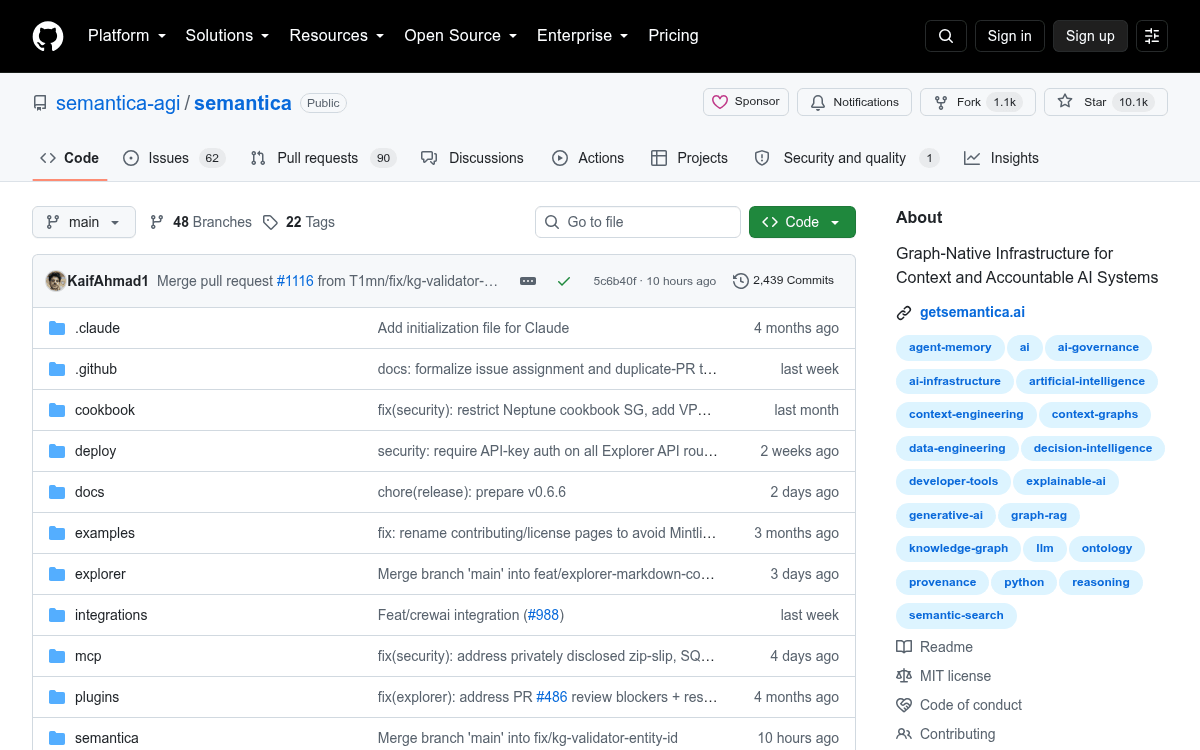
A new open-source project called Semantica is picking up traction on GitHub with a pitch aimed at teams shipping AI agents into regulated environments. It positions itself as a graph-native substrate that sits under your existing LLM, vector store, and agent framework, turning every decision an agent makes into a queryable, auditable record with full lineage back to its sources.
The repository, published under the MIT license by the semantica-agi organization, describes itself as infrastructure for accountable AI. The framing is deliberate: the maintainers are betting that as agents move into lending, healthcare, and government workloads, teams will need something more structured than embeddings to answer a regulator's question about why an agent did what it did.
The gap it wants to fill
The core argument in the README is that most agent stacks store embeddings but not meaning, which makes their decisions hard to explain months later when someone asks. Semantica tries to close that gap without asking you to rip out your stack, complementing your LLM and vector database with decision records, causal reasoning, W3C PROV-O provenance, ontology governance, conflict detection, and audit trails layered on top.
One caveat the maintainers repeat: this is system-level explainability, not foundation-model explainability. Semantica does not try to reconstruct what happens inside the LLM. What it captures is everything around it, meaning the context fed in, the decision produced, the policies applied, and the full execution trail.