
Real-Time-Voice-Cloning Hits 60K Stars and Gets a Fresh Overhaul
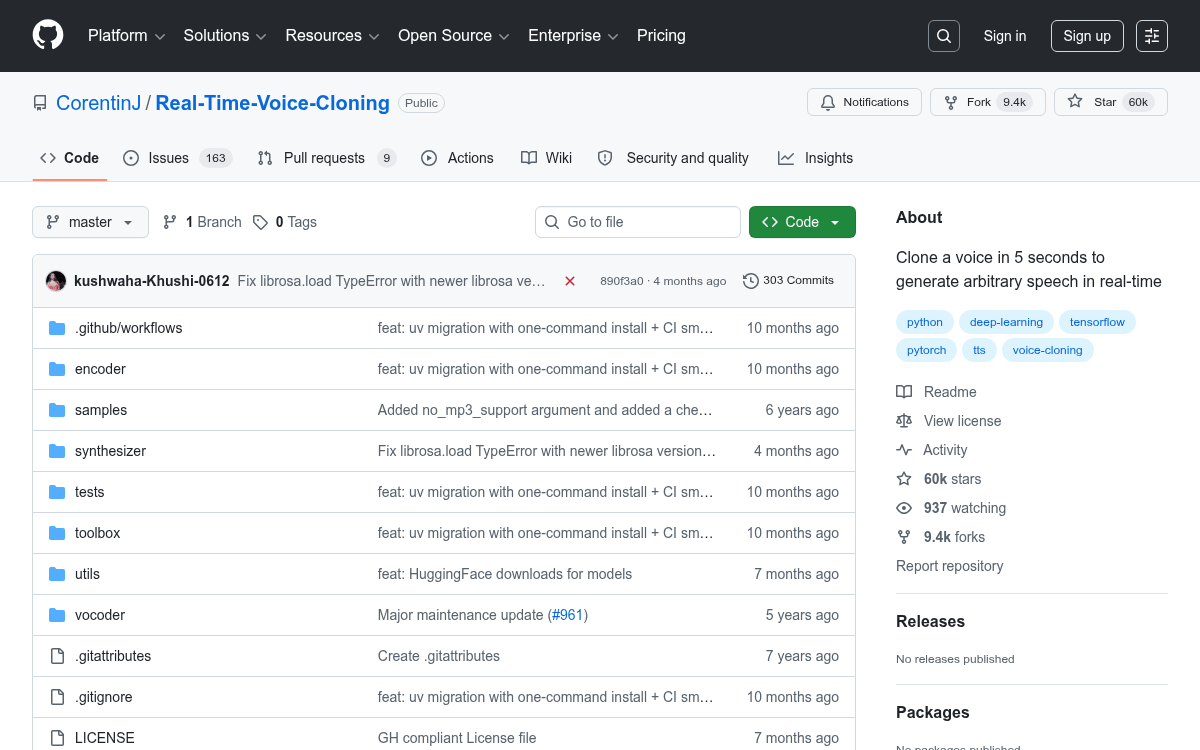
A master's thesis project that seeded an entire ecosystem of open source voice cloning now runs on uv and hits 60k GitHub stars.
 Pro
Takeaways
- Real-Time-Voice-Cloning by Corentin Jemine crosses 60,000 GitHub stars, one of the most starred audio ML repos ever.
- Implements Google's SV2TTS paper with encoder, Tacotron synthesizer and WaveRNN vocoder in Python.
- Clones a target voice from roughly 5 seconds of reference audio and generates speech in real time.
- Recently migrated to the
uvpackage manager with automatic pretrained model downloads from Hugging Face. - Author acknowledges the code is aging and recommends Chatterbox for 2025 quality.
- Still the clearest teaching reference for the three stage speaker embedding to waveform pipeline.
Long before ElevenLabs made voice cloning a household demo, a Belgian graduate student open sourced a working implementation of Google's zero shot speech synthesis paper and accidentally lit the fuse on the modern voice cloning scene. Real-Time-Voice-Cloning by Corentin Jemine has now crossed 60,000 stars and picked up a fresh round of maintenance, including a switch to the uv Python package manager and automatic pretrained model downloads.
The project is an implementation of Transfer Learning from Speaker Verification to Multispeaker Text-To-Speech Synthesis (SV2TTS) with a vocoder that works in real-time, originally written as the author's master's thesis at the University of Liège. Before this code existed, the SV2TTS paper had no public implementation. Jemine's thesis work later led to his side project Resemble, which runs as a voice cloning solution for various platforms.
Three networks in a trench coat
SV2TTS splits voice cloning into a pipeline of three separately trained networks rather than one monolithic model. In the first stage, one creates a digital representation of a voice from a few seconds of audio. In the second and third stages, this representation is used as reference to generate speech given arbitrary text.
Concretely, the repo bundles three modules that mirror three different research papers:
- Encoder - a GE2E speaker verification network that turns a 5 second clip into a fixed length embedding representing the target voice.
- Synthesizer - a Tacotron model that takes text plus that speaker embedding and produces a mel spectrogram in the target voice.
- Vocoder - a WaveRNN that turns the mel spectrogram into a raw audio waveform, tuned to run fast enough for real-time playback.
Each of the three modules contains code to preprocess data, visualize data, load data, train the model, define hyperparameters and finally to use the model for inference. This last inference interface is exposed as an inference.py for each model, and these are the only files you need to import to use the models.
Getting it running
The setup story is dramatically simpler than it used to be. Install ffmpeg for audio decoding, install uv, then run one command. Pretrained weights download automatically, or you can grab them manually from Hugging Face.
# GPU
uv run --extra cuda demo_toolbox.py
# CPU only
uv run --extra cpu demo_toolbox.py
# Headless CLI
uv run --extra cuda demo_cli.py
The toolbox GUI lets you record a reference clip or drop in a wav file, then type any sentence and hear it back in the cloned voice within seconds. Windows and Linux are both supported.
What it is and is not good at
The strengths are the same ones that made this repo the reference implementation for years: it captures timbre and prosody from very short reference audio, runs in real time on a single GPU, exposes all three networks as hackable Python modules, and has a training pipeline for anyone who wants to fine tune on their own data.
The author is refreshingly blunt about the weaknesses. Like everything else in deep learning, this repo has quickly gotten old. Many SaaS apps, often paying, will give you a better audio quality than this repository will. Output can sound robotic on longer sentences, struggles with expressive prosody, and is English-centric because the pretrained models are LibriSpeech based. For teams that want the same lineage but modern quality, the README now points at Chatterbox from Resemble AI as a 2025 state of the art alternative.
Why it still matters
The practical use cases have not gone away: prototyping voice UX, generating placeholder narration, academic research on speaker embeddings, low friction demos in classes, and building datasets for downstream models. Because it is MIT-adjacent open source with no API keys, no rate limits, and no cloud dependency, it remains the easiest way to teach yourself how the encoder-synthesizer-vocoder decomposition actually works before graduating to newer flow matching or diffusion based systems.
The broader lesson from the star count is worth naming out loud. A single graduate thesis, released with a working demo and clean code, ended up seeding a category that is now worth billions in commercial voice APIs. The infrastructure to clone a voice in five seconds has been sitting in a public repo the entire time.