
RapidOCR Runs PaddleOCR Models Anywhere Without the Heavy Framework
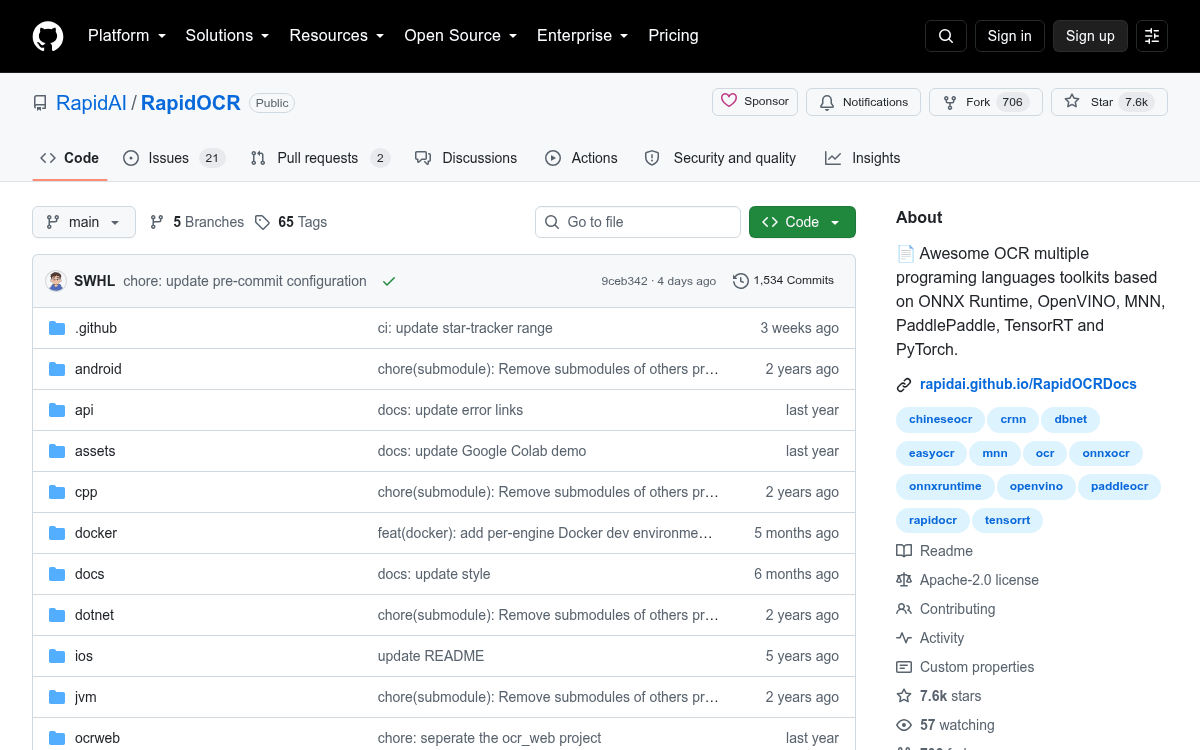
RapidOCR ports PaddleOCR into a dependency-light ONNX toolkit, giving you offline text recognition across Python, C++, Java, C#, and mobile.
 Pro
Takeaways
- RapidOCR is an Apache 2.0 OCR toolkit that ports PaddleOCR models to ONNX for portable deployment.
- Runs across ONNX Runtime, OpenVINO, MNN, TensorRT, PaddlePaddle, and PyTorch backends from the same weights.
- Ships bindings for Python, C++, Java, C#, Android, and iOS, all offline capable.
- Benchmarks around 15 pages per second on CPU with the smallest footprint among mainstream Python OCR engines.
- Powers document pipelines in Docling, LangChain, Umi-OCR, and other production projects.
- Weaker point: users report the detector can run 2-3x slower than calling PaddleOCR directly.
If you have ever tried to ship an OCR pipeline and hit a wall installing PaddlePaddle inside a slim container, or needed a text recognizer that runs on both an Android phone and a Windows desktop, RapidOCR is worth a look. The Apache 2.0 project takes the well-regarded PaddleOCR models and reshapes them into something you can actually deploy anywhere.
The pitch is simple: keep PaddleOCR-level accuracy, drop the heavy framework, and run on whatever hardware you already have. RapidOCR supports multiple platforms and languages, offers rapid offline deployment, and leans on ONNX Runtime instead of PaddlePaddle for inference.
Why the ONNX detour matters
PaddleOCR still has rough edges on the engineering side, especially around packaging and dependencies. The RapidOCR team converted PaddleOCR's trained models into ONNX to simplify inference deployment across terminal devices, then wrote bindings for Python, C++, Java, and C#.