
Qualcomm's Nexa SDK Finally Puts Frontier AI on Idle Phone Chips
Qualcomm's Nexa SDK offers day-0 support for frontier LLMs and VLMs across NPU, GPU, and CPU on Windows, Linux, Android, and iOS.
Takeaways
- Qualcomm now hosts the Nexa SDK, a local inference framework spanning NPU, GPU, and CPU backends.
- Day-0 support for Qwen3-VL, DeepSeek-OCR, Gemma3n, GPT-OSS, Granite-4, and Ministral-3.
- Runtimes cover Windows, Linux, Android, iOS, and ARM64 Docker, with an OpenAI-compatible server built in.
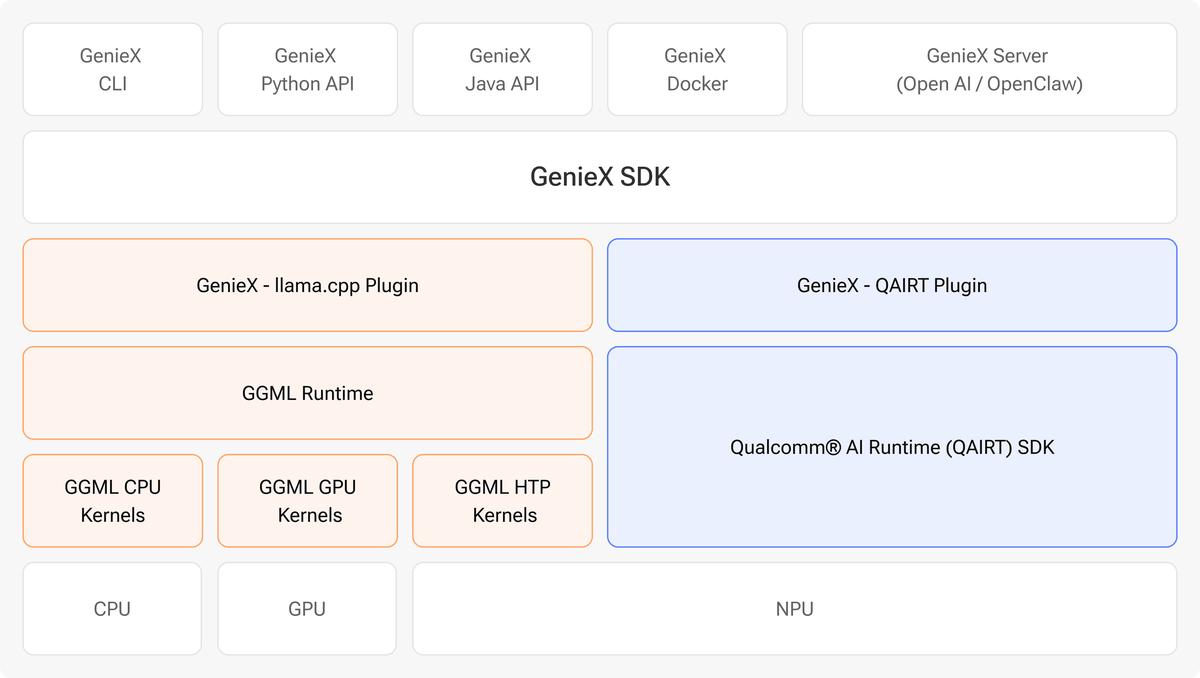
- Powered by NexaML, a kernel-level engine built from scratch rather than wrapping llama.cpp.
- NPU acceleration requires Snapdragon X Elite, 8 Gen 4, or Dragonwing IQ9 hardware plus a free access token.
- Includes NPU-native models like OmniNeural-4B and AutoNeural-VL-1.5B for automotive assistants.
Running frontier open models on a laptop is easy. Running them on the neural processing unit inside your laptop, phone, or car dashboard is where things fall apart. That gap is what the Nexa SDK, now hosted under the Qualcomm GitHub organization, is trying to close, and its star count (over 8,000) suggests the effort is landing.
The project bills itself as a local inference framework that runs recent multimodal models on NPU, GPU, and CPU across Android, Windows, and Linux with a few lines of code. One SDK, any backend, any modality, with a working CLI, a Python package, an Android AAR, and a Linux Docker image out of the box.
The NPU gap nobody else fills
Most local runtimes today, including Ollama, llama.cpp, and LM Studio, assume you are running on a CPU or a discrete GPU. They largely ignore the NPU, the low-power neural accelerator sitting idle on Snapdragon laptops, Snapdragon 8 Gen phones, automotive SoCs, and IoT boards. Nexa flips that priority.
The runtime is powered by NexaML, a unified inference engine built at the kernel level rather than as a wrapper around an existing framework. That architecture is what lets the SDK ship Day-0 support for new model architectures across LLMs, vision-language, audio, and vision. In practice, Qwen3-VL, DeepSeek-OCR, and Gemma3n (Vision) landed here weeks or months before appearing elsewhere. If you have ever waited for llama.cpp to merge a new vision-language architecture, that lag is the thing being targeted.