
pyVideoTrans Turns Any Video Into Dubbed Multilingual Content With 17.9k Stars
An open-source toolkit chains speech recognition, LLM translation, and voice cloning into a one-click video dubbing pipeline with 30+ model backends.
Takeaways
- Open-source video translation tool pyVideoTrans hits 17.9k GitHub stars with full ASR-to-dubbing pipeline
- Chains speech recognition, LLM translation, and TTS into a single one-click video workflow
- Integrates F5-TTS, CosyVoice, and GPT-SoVITS for zero-shot voice cloning from short reference clips
- Supports 30+ backends including Faster-Whisper, DeepSeek, Ollama, Edge-TTS, and Qwen3-ASR
- Pre-packaged Windows .exe available, plus
uv-based source install for macOS and Linux - Licensed GPL-3.0, runs fully offline, ships GUI, WebUI, and CLI modes
Dubbing a video into another language used to mean stitching together a speech-to-text service, a translation API, a text-to-speech engine, and a video editor by hand. pyVideoTrans collapses that chain into a single desktop app that has quietly grown into one of the most popular open-source video translation projects on GitHub, now sitting at roughly 17.9k stars and 2.2k forks.
The pitch is straightforward: point it at a video, pick a target language, and get back a new file with translated subtitles and synchronized AI dubbing. Under the hood it orchestrates a pipeline of swappable models, and that flexibility is why the project keeps showing up in developer feeds.
One pipeline, many backends
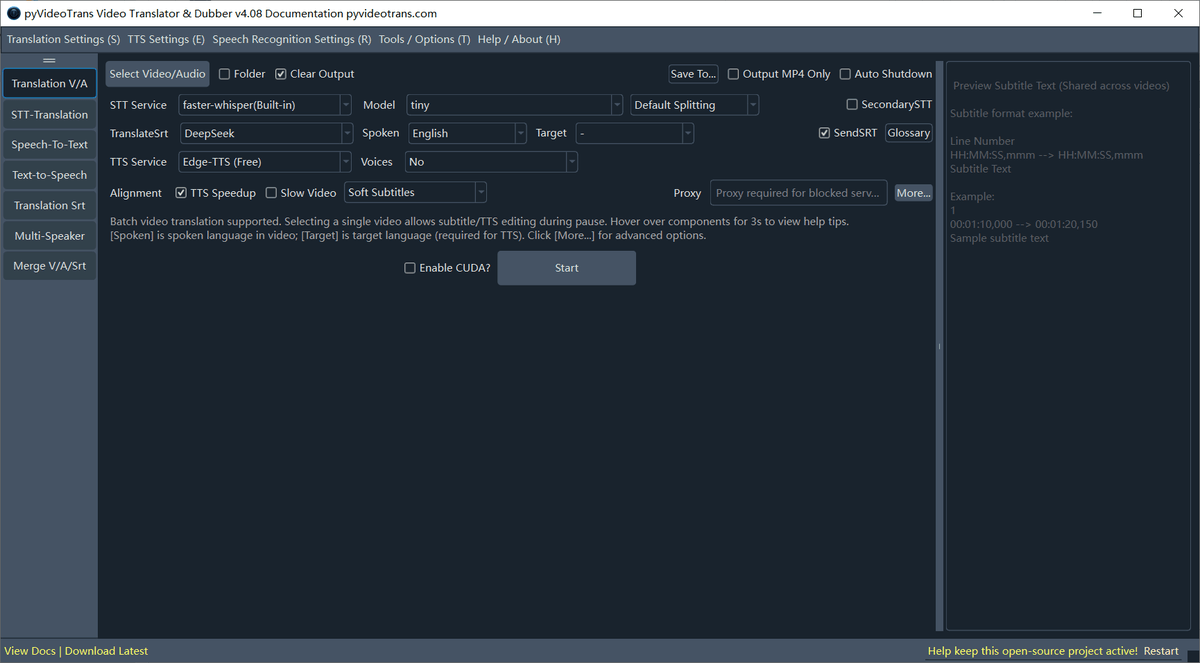
The core loop chains together speech recognition (ASR), subtitle translation, speech synthesis (TTS), and video synthesis, with each stage exposed as a plug-in slot rather than a hardcoded call.
For recognition, you can run Faster-Whisper locally or route to OpenAI Whisper, Alibaba Qwen, ByteDance Volcano, Azure, or Google. Translation can go through DeepSeek, ChatGPT, Claude, Gemini, MiniMax, Ollama locally, or Alibaba Bailian. On the synthesis side you get Edge-TTS (free), OpenAI, Azure, Minimaxi, ChatTTS, and ChatterBox. Anyone building similar tooling will appreciate that the whole thing can run fully offline.