
Picobot Squeezes a Full AI Agent Into a 9MB Binary
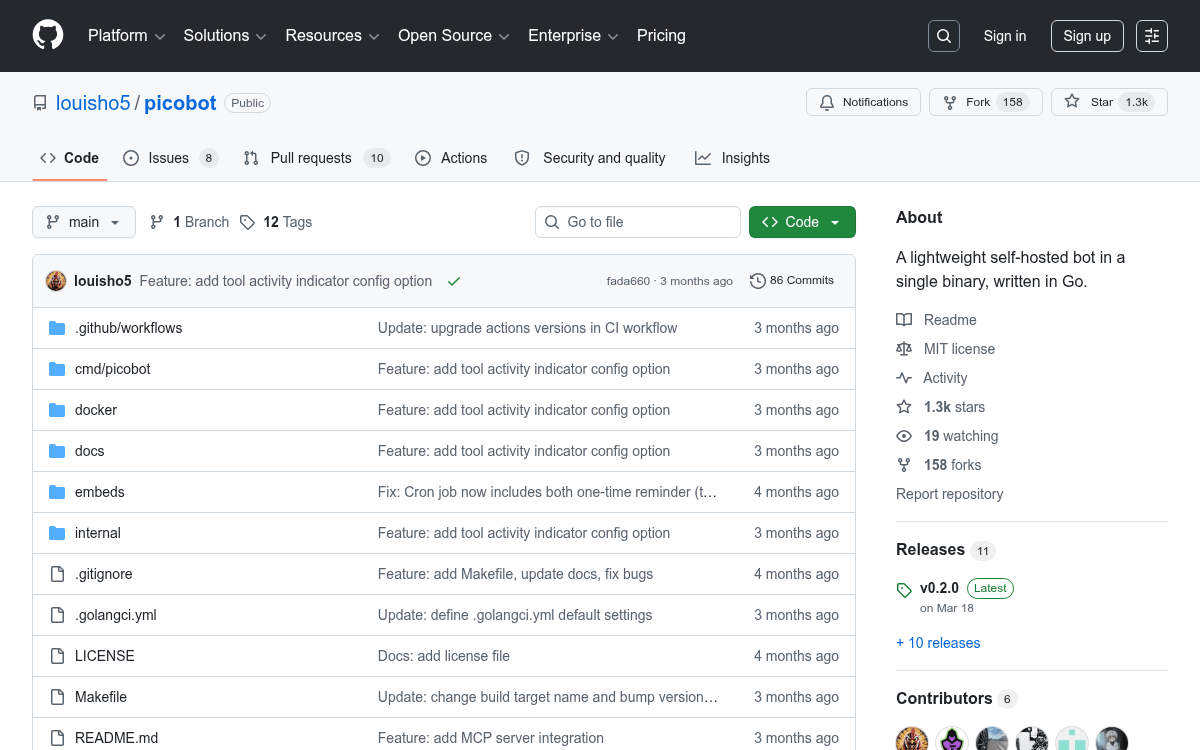
Picobot is a full-featured AI agent that runs as a single 9MB Go binary — no Python, no Node, no bloat — on any hardware from a $5 VPS to a Raspberry Pi.
 Pro
Takeaways
- 9MB binary, zero dependencies: Picobot is a self-hosted AI agent written in Go that runs anywhere, including Raspberry Pi and $5 VPS instances.
- 16 built-in tools: The agent can read/write files, run shell commands, search the web, schedule tasks, and spawn background subagents.
- MCP server support added in v0.2.0: Connect any Model Context Protocol server and its tools auto-register at startup with no code changes.
- Works with any OpenAI-compatible LLM: OpenAI, OpenRouter, and local Ollama models are all supported via a single config file.
- Persistent memory with semantic recall: Daily notes and long-term memory survive restarts; ranked memory search finds relevant context per query.
- Channels: Telegram, Discord, Slack, WhatsApp: Chat with your agent from any major messaging platform, with per-user allowlists for access control.
Picobot is a self-hosted AI agent that fits in a 9MB binary. No Python runtime, no Node.js, no 500MB Docker image , just a single Go executable and a config file. It has crossed 1,200 GitHub stars and is gaining traction among people who want a capable personal AI agent without the infrastructure overhead that frameworks like LangChain or AutoGen drag along.
The pitch is simple: most open-source agent frameworks are powerful but heavy. Picobot gives you persistent memory, tool calling, skills, and Telegram and Discord integration in a single ~9MB binary that boots in milliseconds. That's not a stripped-down demo , it's a fully functional agentic loop that can browse the web, run shell commands, schedule tasks, and remember things across sessions.
The numbers that matter
Compared to typical agent frameworks, Picobot's binary weighs ~9MB versus 200MB+ for Python-based alternatives, its Docker image is ~29MB (Alpine) versus 500MB–1GB+, its cold start is instant versus 5–30 seconds, and its idle RAM usage is ~10MB versus 200MB–1GB , with zero external dependencies.
Picobot runs happily on a $5/mo VPS, a Raspberry Pi, or even an old Android phone via Termux. The project explicitly targets constrained environments, and the binary compiles for both AMD64 and ARM64 with no CGO dependencies , meaning you can cross-compile and just copy the file over.
What it can actually do
This isn't a chatbot wrapper. The agent can take real actions , not just chat. Picobot ships with 16 built-in tools out of the box: