
Paweł Huryn Ships 68-Skill Open-Source Plugin to Fix Claude's Generic PRDs
PM Skills Marketplace brings 68 structured PM frameworks to Claude Code and Cowork as installable plugins, replacing generic AI prompting with rigorous, chained workflows.
 Pro
Takeaways
- 68 PM skills, 42 chained workflows, 9 plugins — open-source marketplace for Claude Code, Cowork, Codex, Gemini CLI, and Cursor, free under MIT.
- Skills auto-load when relevant; slash commands like
/discoverchain multiple skills into end-to-end guided PM processes. - Covers the full product lifecycle: discovery, strategy, execution, market research, analytics, GTM, growth, and AI-code shipping audits.
- Frameworks baked in: Teresa Torres, Marty Cagan, Alberto Savoia, RICE, OKRs, Opportunity Solution Trees, Porter's Five Forces, and 9 prioritization methods.
- Install in seconds: enter
phuryn/pm-skillsin Claude Cowork's plugin browser, or useclaude plugin marketplace add phuryn/pm-skillsin the CLI. - 20,000+ GitHub stars and community forks including a Chinese translation — repo here.
Most AI-assisted product work follows the same pattern: you ask Claude to write a PRD, it gives you something plausible but generic, and you spend the next hour editing it into something actually useful. PM Skills Marketplace is an open-source plugin collection built to fix that. Instead of starting from a blank prompt, you get 68 structured PM skills and 42 chained workflows, organized into 9 installable plugins that cover the full product lifecycle.
The marketplace is designed for Claude Code and Cowork, with skills compatible with other AI assistants. It was built and curated by Paweł Huryn from The Product Compass Newsletter, and it has grown quickly: the project has over 20,000 stars and 2,000+ forks, indicating an active community.
Skills vs. Commands vs. Plugins
The architecture has three layers, and understanding them matters for getting the most out of the marketplace:
- Skills are the building blocks. Each skill gives Claude domain knowledge, analytical frameworks, or a guided workflow for a specific PM task, and they are loaded automatically when relevant to the conversation , no explicit invocation needed.
- Commands are slash-triggered workflows. Commands are user-triggered workflows invoked with
/command-name. They chain one or more skills into an end-to-end process. For example,/discoverchains four skills together: brainstorm-ideas → identify-assumptions → prioritize-assumptions → brainstorm-experiments. - Plugins are domain-scoped bundles. Plugins group related skills and commands into installable packages, each covering a PM domain , discovery, strategy, execution, and so on.
Commands are designed to flow into each other, matching the PM workflow. After any command completes, it suggests relevant next commands , just follow the prompts. This chaining behavior is what separates it from a prompt library: you're not copy-pasting templates, you're running a guided process.

What's in the Box
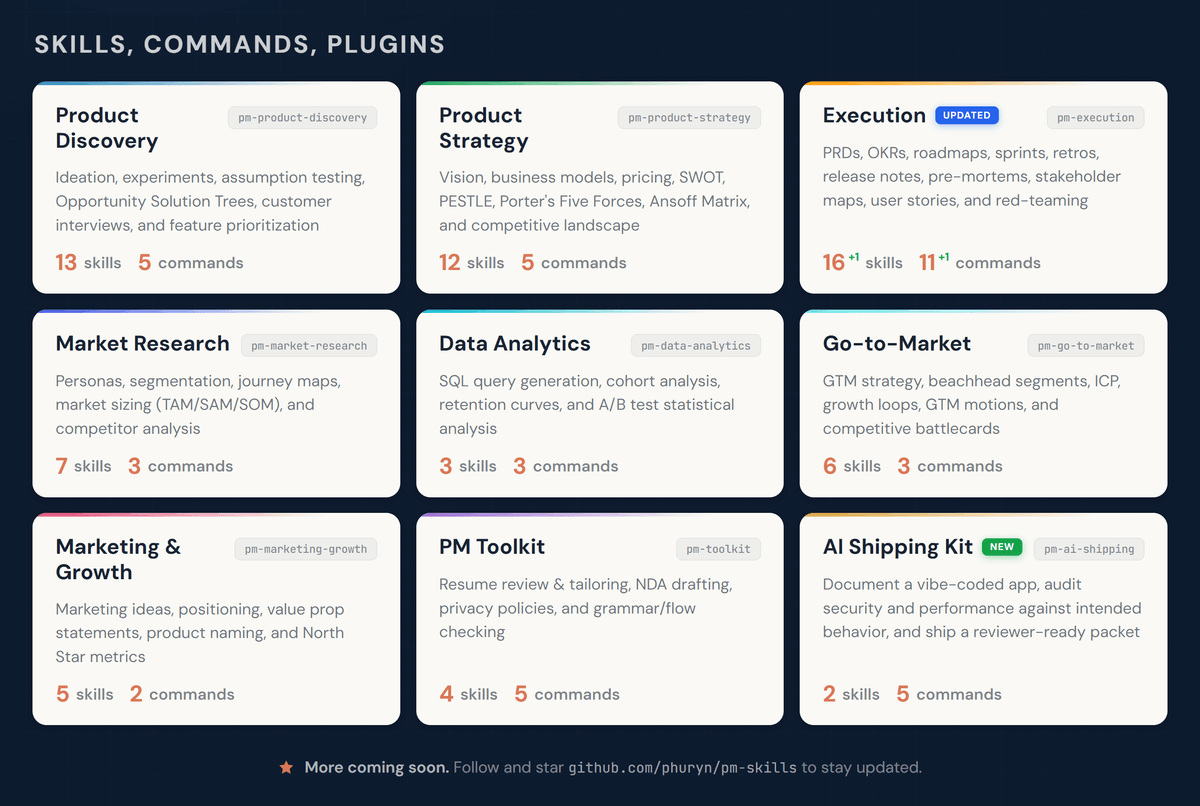
The 9 plugins span the entire product lifecycle. Here's a quick map of what each one covers:
- pm-product-discovery (13 skills, 5 commands) , Ideation, assumption mapping, Opportunity Solution Trees (Teresa Torres), customer interview scripts, and feature prioritization
- pm-product-strategy (12 skills, 5 commands) , Product Strategy Canvas, Lean Canvas, Business Model Canvas, pricing strategy, Porter's Five Forces, PESTLE, Ansoff Matrix
- pm-execution (16 skills, 11 commands) , PRDs, OKRs, roadmaps, sprint planning, retrospectives, stakeholder maps, pre-mortems, and a red-team command that adversarially stress-tests your plans
- pm-market-research (7 skills, 3 commands) , Personas, segmentation, customer journey maps, TAM/SAM/SOM sizing, competitor analysis
- pm-data-analytics (3 skills, 3 commands) , Natural language to SQL, cohort analysis, A/B test statistical significance
- pm-go-to-market (6 skills, 3 commands) , GTM strategy, ICP definition, growth loops, competitive battlecards
- pm-marketing-growth (5 skills, 2 commands) , Positioning, North Star metrics, value proposition statements
- pm-toolkit (4 skills, 5 commands) , Resume review, NDA drafting, GDPR/CCPA privacy policies, proofreading
- pm-ai-shipping (2 skills, 5 commands) , Security and performance audits for AI-generated code, test coverage mapping, shipping checklists
The pm-ai-shipping plugin is worth calling out specifically. It targets a real pain point for teams shipping vibe-coded apps: AI agents write code fast but leave no record of intent. The /ship-check command reverse-engineers a codebase into architecture docs, permission flows, and a security audit , then cross-references what the code actually does against what the docs say it should.

The Frameworks Baked In
The skills aren't just prompts with PM vocabulary sprinkled in. Each one encodes a specific methodology from the PM canon. The frameworks referenced include Teresa Torres's Continuous Discovery Habits, Marty Cagan's INSPIRED, Alberto Savoia's pretotype-first approach from The Right It, Ash Maurya's Running Lean, and Jobs-to-Be-Done theory from Anthony Ulwick. The prioritization plugin alone covers nine frameworks: Opportunity Score, ICE, RICE, MoSCoW, Kano, and more.
This matters because the structure is opinionated. You're not getting a blank canvas , you're getting a guided process that reflects how experienced PMs actually work. The tradeoff is that if your team uses different frameworks or terminology, you'll need to adapt the skills or contribute new ones.
Installing It
Installation depends on which tool you're using. For Claude Cowork (the non-terminal path): open Customize, go to Browse plugins → Personal → +, select Add marketplace from GitHub, and enter phuryn/pm-skills. All 9 plugins install at once.
For Claude Code CLI:
claude plugin marketplace add phuryn/pm-skills
claude plugin install pm-product-discovery@pm-skills
claude plugin install pm-execution@pm-skills
# ... repeat for each plugin
Codex reads the same plugin marketplace file as Claude Code, so you can install PM Skills natively , no conversion or file-copying needed. For other tools like Gemini CLI, Cursor, or Kiro, the individual SKILL.md files work by copying them into the tool's skills directory , though slash commands are Claude-specific and won't transfer.
The repo is MIT-licensed and free. Anthropic launched a Cowork plugin marketplace that makes third-party plugin installation like this a first-class workflow, and PM Skills is already listed as one of the essential sources in the broader Claude Cowork ecosystem. Beyond built-in skills and Anthropic's plugins, there's a growing ecosystem worth exploring, with PM Skills Marketplace cited as a key source for 100+ agentic skills covering discovery, strategy, execution, launch, and growth.
The Bigger Picture
Claude Cowork is Anthropic's agentic product for general knowledge work , an AI coworker you hand an outcome to, which then works in the background, splits big projects into parallel chunks, and checks in only when it needs a decision. PM Skills slots into this model cleanly: the skills define the methodology, the commands trigger the workflows, and Cowork handles the execution.
With the right skills installed, Cowork becomes a specialist , and the gap between "impressive demo" and "does my actual job" is almost entirely a skills question. PM Skills is a direct answer to that gap, specifically for product work. The community response , a Chinese translation of the marketplace has already appeared on GitHub, and the repo has attracted forks adapting it for Codex and OpenRouter workflows , suggests the format is resonating beyond its original Claude-specific scope.
The companion project PM Brain pairs with it: plain markdown files on your laptop that Claude reads before answering and writes to after, acting as persistent memory across sessions. Together they form something closer to a full AI operating system for product work than a prompt library.
 X X post by @alphasignal